More Perfect Union exposes a brutal truth about modern sports economics: the new Buffalo Bills stadium isn't just a venue upgrade, but a mechanism that effectively prices out the very fans who built the franchise's legacy. By juxtaposing the billionaire owners' record-breaking wealth against the working-class reality of Buffalo, the author reveals how public subsidies and personal seat licenses are shifting the financial burden of luxury onto the least able to pay. This is not merely a story about ticket prices; it is a case study in how the "country clubification" of American sports is reshaping who gets to participate in our national pastime.
The Architecture of Exclusion
The piece opens by dismantling the narrative of a "community project," revealing instead a deal where taxpayers footed the bill for the bulk of the construction while the owners secured the long-term revenue streams. More Perfect Union writes, "I've been studying stadium deals for decades, and this is one of the worst I've ever seen." This assessment is backed by the staggering math: $850 million in public funds for a project that primarily serves to increase the valuation of a private asset. The author effectively highlights the disconnect between the public's contribution and the private gain, noting that the owners' net worth surged by $800 million in a single year, enough to have covered the entire construction cost themselves.
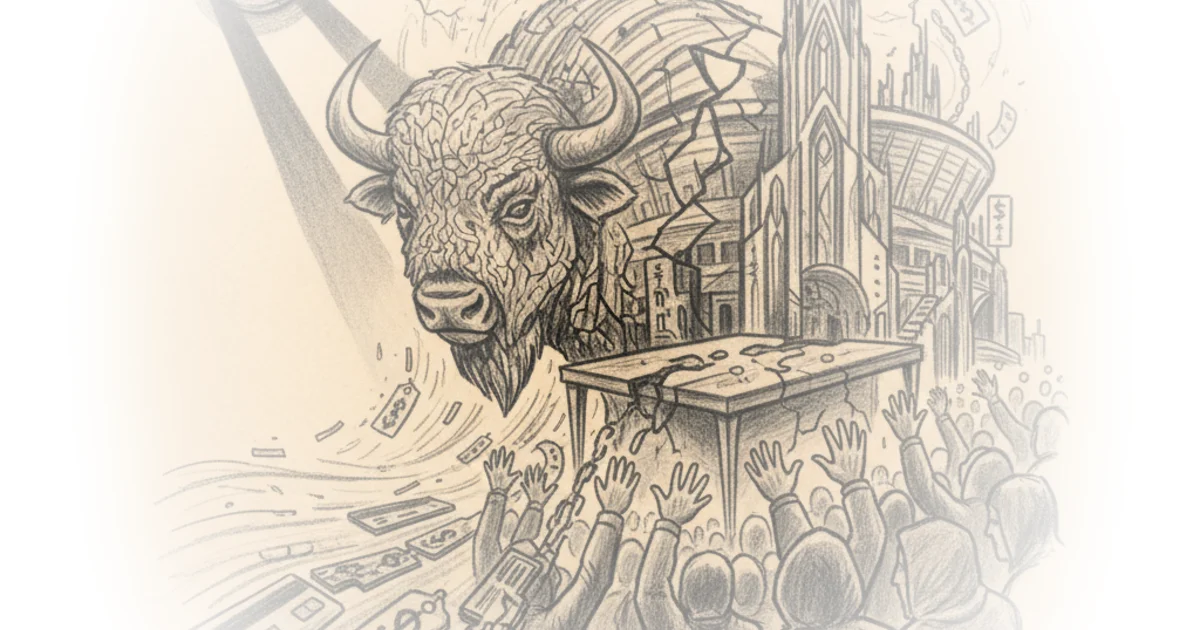
The commentary here is sharp because it refuses to accept the standard "risk mitigation" argument used by owners. Instead, it points out that the owners took no financial risk; the state of New York and Erie County absorbed the debt, while the Pagoula family reaped the appreciation. As More Perfect Union puts it, "Building the stadium with taxpayer dollars is one thing. Building up the infrastructure around the stadium is another really important thing to me that I wish we were hearing more about." This distinction is crucial. It shifts the debate from "do we need a stadium?" to "who is this stadium actually for?" Critics might note that without public subsidies, the team might have relocated, a common threat in the NFL. However, the author counters this by emphasizing that the team's valuation has increased so dramatically that relocation threats are no longer a credible financial necessity for the owners.
The owners are the richest household in New York outside of the Manhattan area. They could have paid every dollar of the construction cost just in the capital gains that they've gained in the appreciation of the Bills as a franchise.
The PSL Trap and the Country Club Model
The most insidious element of the new deal is the Personal Seat License (PSL), a fee that fans must pay simply to retain the right to buy tickets. More Perfect Union explains the mechanism clearly: "It doesn't actually buy you season tickets, but it gets you the ability and the right to buy season tickets." The author compares this to a country club initiation fee, a metaphor that lands with particular force in a city known for its blue-collar identity. The piece details how fans are being asked to pay tens of thousands of dollars upfront, with some club-level seats requiring a $50,000 PSL alone. This is not a price increase; it is a fundamental restructuring of access.
The narrative strength lies in the human cost. The author weaves in stories of single mothers working second jobs and veterans who served in combat, only to be told there are no discounts available. "I tried to ask for a veterans discount and there was nothing," one fan recounts. "They had no wiggle room of any sort." This emotional testimony grounds the economic analysis, transforming abstract numbers into a story of betrayal. The author argues that this dynamic is not unique to Buffalo, noting that the Washington Commanders are considering similar models. The trend is clear: teams are moving toward a model of "fewer seats, higher prices," catering exclusively to a wealthy demographic while abandoning the working-class base that sustained them for decades.
It's not necessarily about filling a stadium with 75,000 people. It might be about filling a stadium with several thousand of exactly the right type of fan.
A Call for Voter Accountability
The piece concludes by offering a potential solution to this systemic issue: putting stadium deals directly to a vote. More Perfect Union writes, "One single thing that should be done to try to balance the scales in public financing would be every major stadium deal should go before the voters." The author points to data showing that when stadium subsidies are put to a referendum, voters frequently reject them, unlike the backroom deals that typically pass in city councils. This argument reframes the issue from a local Buffalo problem to a national democratic deficit. The author suggests that the "smoky back rooms" of politics are where the worst deals are made, and that the public has a proven track record of rejecting them when given the chance.
The commentary here is prescriptive and urgent. It challenges the assumption that stadium deals are too complex for the average voter to understand. By highlighting that voters in cities like Kansas City and Albuquerque have said "no thank you," the author provides a roadmap for resistance. The piece effectively argues that the "country clubification" of sports is not inevitable; it is the result of a specific political process that excludes the very people most affected by it.
Bottom Line
More Perfect Union delivers a compelling indictment of the modern stadium economy, successfully arguing that the Buffalo Bills' new home is a symbol of wealth extraction rather than community investment. The piece's greatest strength is its refusal to let the owners off the hook, using their own skyrocketing valuations to prove that the financial burden should never have fallen on the public. The argument's vulnerability lies in its reliance on voter referendums, which, while effective in theory, face significant political hurdles in a system where sports teams often hold immense leverage over local politicians. Readers should watch for how other NFL markets respond to this model, as the "country club" approach could become the new standard unless voters push back. The question is no longer just about football; it is about who owns the public square.