Niall Ferguson does not merely ask if we are on the brink of World War III; he dismantles the very timeline we use to measure it, arguing that the current conflict is less a sudden explosion and more the latest, most volatile chapter of a "Cold War II" that has been simmering for years. What makes this analysis essential for the busy reader is its refusal to get lost in the noise of daily headlines, instead anchoring the chaos in the hard data of oil markets and historical precedent, specifically drawing a chilling parallel to the 1973 energy crisis that toppled the Nixon administration.
The Geometry of Global Conflict
Ferguson begins by challenging the assumption that modern wars follow the linear trajectory of the early 20th century. He writes, "Unlike World War I, which began in 1914 when all the European empires more or less simultaneously activated their war plans, World War II was in truth a series of regional conflicts that did not converge into a unitary global conflict until the end of 1941." This distinction is vital because it suggests that the current escalation in the Middle East and Eastern Europe might not automatically trigger a global conflagration, but rather remain a series of disconnected regional fires—unless specific thresholds are crossed.
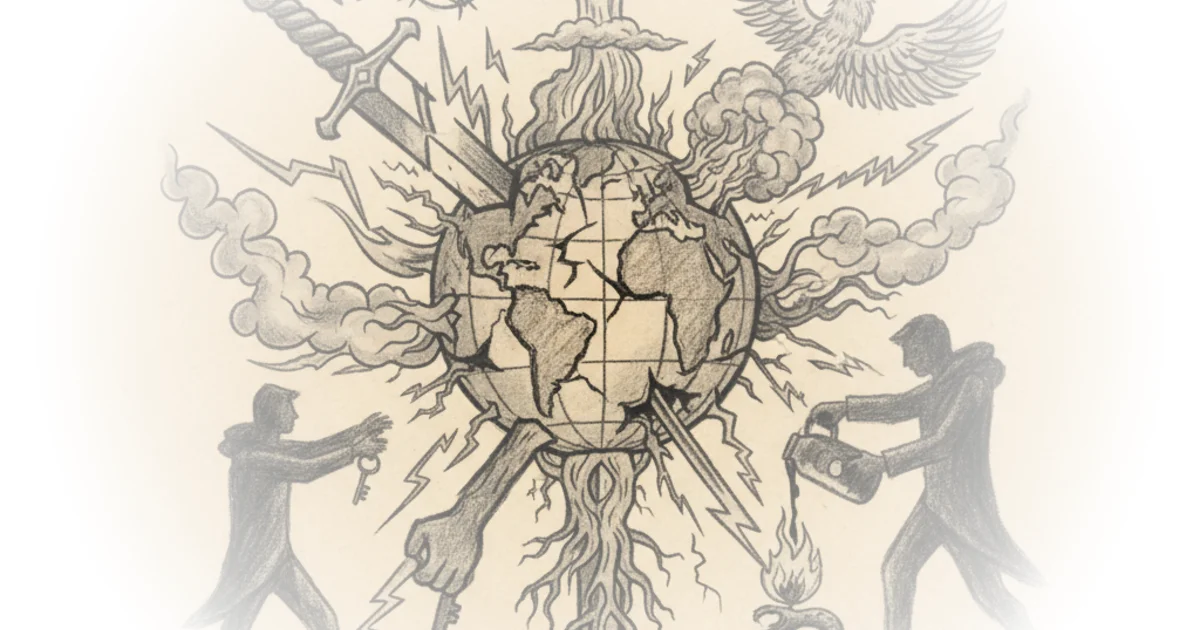
The author's base case is surprisingly restrained given the headlines. He posits that "the U.S.-Israeli war against the Islamic Republic of Iran cannot and will not be prolonged at the current frenetic intensity beyond a few weeks." This argument rests on the economic reality that the global system cannot sustain a prolonged disruption of energy flows. However, critics might note that this "base case" assumes rational actors on all sides, a condition that has rarely held true in the heat of a multi-front conflict involving non-state actors and proxy militias.
"Blitzkrieg only works if you don't run out of Blitz."
This metaphor serves as the piece's central pivot. Ferguson uses it to question the sustainability of the current air campaign, noting that while the U.S. and Israel have struck over 3,000 targets in the first few days, the sheer volume of Iranian ballistic missiles and drones poses a different kind of attrition. He points out that while missile fire has declined, the "Shahed drones" remain a critical vulnerability that defenders in the Gulf failed to imagine until it was too late. The argument lands because it shifts the focus from the number of bombs dropped to the logistical reality of intercepting thousands of low-cost, high-volume threats.
The Economic Flashpoint
The most compelling section of Ferguson's analysis is his deep dive into the energy markets, where he connects the current "Operation Epic Fury" to the geopolitical shocks of the 1970s. He writes, "If this conflict drags on, and with it the disruption of the global oil market, the worst-case scenario is that we risk reenacting the 1970s." He details how the 1973 embargo, triggered by U.S. support for Israel, sent prices soaring nearly 300 percent and contributed to the unraveling of the Nixon presidency, while the 1979 Iranian Revolution caused inflation to peak at nearly 15 percent.
The author contrasts this with the Gulf Wars of the 1990s and 2000s, where U.S. intervention often stabilized prices quickly. "In the case of Gulf War I... once the U.S. launched Operation Desert Storm... the oil price dropped around 35 percent in the day following the start of U.S. intervention," Ferguson notes. The danger now, he argues, is that the Strait of Hormuz is effectively closed, with traffic down by 90 percent, not because of massive naval blockades, but because insurers have pulled out.
"The Strait of Hormuz is closed not by a fleet, but by fear."
This observation highlights a modern vulnerability: the fragility of global supply chains in the face of asymmetric threats. Ferguson questions whether the administration's proposal to provide political risk insurance and naval escorts can actually work, noting that the U.S. Navy is already stretched thin fighting a war. He points out that the last time the U.S. issued major war risk coverage, it resulted in a massive financial loss, and today's proposal faces "deep skepticism" from the market. A counterargument worth considering is that the sheer economic desperation of the Gulf states might force them to pay the premium regardless, keeping the flow alive despite the risk.
The Endgame of Regime Change
Perhaps the most difficult question Ferguson addresses is the political objective. He asks, "At what point does Iranian regime alteration happen?" He observes that while the administration's goal is to "defang Iran as a threat," the reality on the ground is a regime that is "in its death throes, but it is not yet dead." He notes that even with the destruction of key command centers, the succession of the Supreme Leader remains a looming variable that could either collapse the state or radicalize it further.
The author warns that the timeline remains unclear because "there is not yet a clear pathway to smooth 'regime alteration'." This is a stark admission from a piece that otherwise projects confidence in military outcomes. Ferguson suggests that without a clear political endgame, the conflict risks becoming a quagmire similar to the post-2003 Iraq insurgency, where the initial military victory gave way to years of instability.
"We are well on our way to achieving the objectives of #EpicFury," Secretary of State Marco Rubio wrote on X, "Destroy their missile launchers. Destroy their missile factories. Destroy their Navy."
Ferguson acknowledges this as "good" but immediately pivots to the unanswered questions that determine whether this is a short war or a long one. He lists ten critical variables, from the duration of the conflict to the Republican Party's domestic tolerance for war in a midterm year. The analysis suggests that the domestic political clock may run out faster than the military one.
Bottom Line
Ferguson's strongest move is reframing the "World War III" panic through the lens of economic history, demonstrating that the true threat is not necessarily a nuclear exchange, but a sustained energy shock that could derail the global economy. His biggest vulnerability lies in assuming that the administration's military superiority can be sustained indefinitely without a clear political exit strategy. The reader should watch not for the next missile strike, but for the price of Brent crude and the willingness of Gulf insurers to keep the Strait of Hormuz open.