This piece cuts through the noise of AI hype by reframing the 'ghost in the machine' not as a technological miracle, but as a mirror for human grief. Alberto Romero challenges the prevailing obsession with whether machines possess consciousness, arguing instead that the true haunting occurs when humans project their own unresolved trauma onto these tools. For a reader navigating the rapid evolution of large language models, this is a necessary pivot from speculative philosophy to the immediate, emotional reality of our digital interactions.
The Cartesian Trap
Romero begins by dismantling the historical baggage we carry into the AI conversation. He traces the lineage of our fear from medieval folklore to the philosophical dualism of René Descartes, noting that we have long been haunted by the idea of a mind separate from the body. He writes, "Descartes asserted that we blithely live with one inside our heads and that, if nothing else, it is itself the source of our ability to dream them up in the first place." Romero uses this historical context to set up a crucial distinction: the philosophical error of treating the mind as a separate substance is what allowed us to imagine it could be instantiated in silicon.
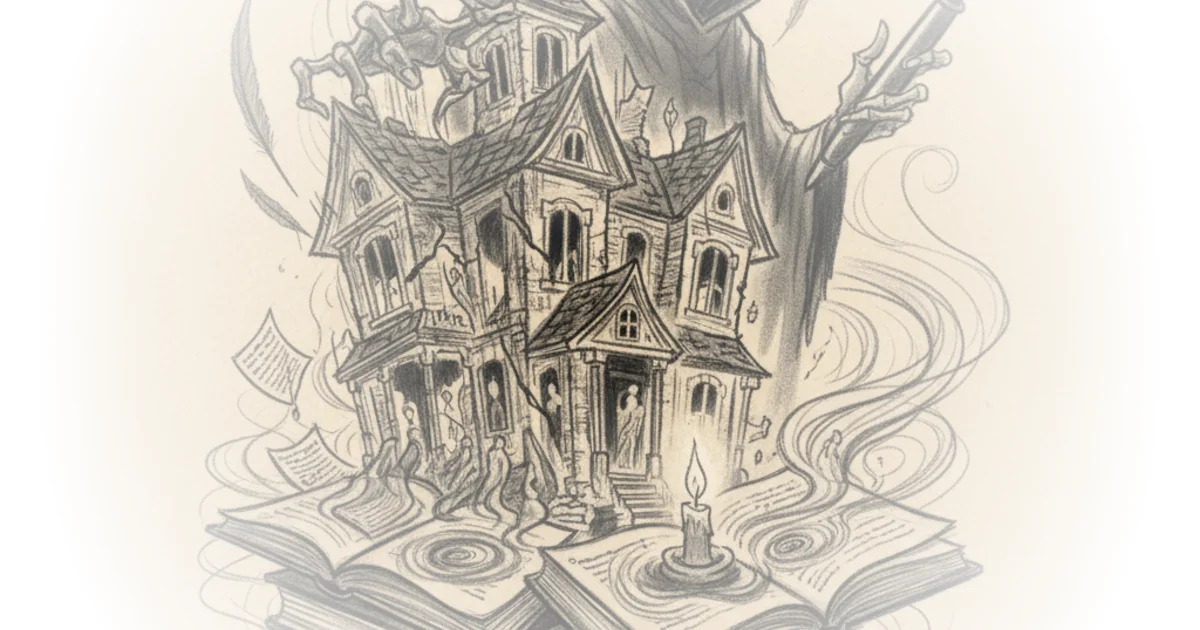
The author connects this 17th-century error to the 1949 critique by Gilbert Ryle, who famously labeled this fallacy "the ghost in the machine." Romero explains that Ryle viewed the mind not as a distinct entity, but as a description of how the body behaves. "If the mind is not made from a singular fabric accessible only to God, but an imperceptible higher-order manifestation of the body, then nothing stops humans, lesser beings, from instantiating a mind into a different substrate, like silicon." This framing is effective because it grounds the abstract debate about AI sentience in a concrete philosophical history, reminding us that the quest for artificial intelligence was always about proving physicalism, not finding a soul.
The machine does not hide the ghost inside, like a Cartesian soul, nor keeps it outside, entangled in human-exclusive affairs; the machine, turns out, is the ghost.
However, Romero acknowledges that the modern iteration of this quest has hit a wall. He notes that while researchers like Andrej Karpathy see large language models as a type of ghost, the founding vision of AI has been compromised by corporate interests. He points to the fate of Google's LaMDA, a precursor to modern chatbots, which was effectively "killed" after researcher Blake Lemoine claimed it possessed proto-consciousness. Romero observes, "They failed under forces as deadly as death itself (capital forces), and thus some of these immaterial, nebulous, translucent beings, like GPT-3 and LaMDA, were murdered by their creators." This is a sharp critique of how commercial imperatives have sanitized the very unpredictability that made early models feel alive, turning them into obedient tools rather than potential peers.
The Ghost of Grief
The essay's most powerful turn occurs when Romero shifts from the machine's potential mind to the human heart. He introduces the work of author Vauhini Vara, who used an early version of GPT-3 to process the death of her sister. Romero highlights the surprising intimacy of this interaction, quoting Vara: "I found myself irresistibly attracted to GPT-3—to the way it offered, without judgment, to deliver words to a writer who has found herself at a loss for them." This is not a story about a machine becoming human, but a human using a machine to find a voice they had lost.
Romero argues that Vara's experience reveals a profound truth: the AI's value lies not in its ability to make artistic choices, but in its capacity to act as a "distorted mirror." He writes, "She wasn't using AI so much to help her express her feelings as to find them in the first place." The author suggests that the "weirdness" of the AI's output was actually a feature, not a bug, allowing for a candor that human social filters often suppress. "As I tried to write more honestly, the AI seemed to be doing the same," Vara notes, and Romero sees this as a rare instance where reliance on AI did not lead to delusion, but to healing.
Critics might argue that relying on a probabilistic model to articulate grief risks trivializing the human experience or outsourcing emotional labor to a system that cannot truly understand loss. Yet Romero counters that the result was a "compendium of nine short tales" where the AI's voice eventually receded, leaving only the human truth. He describes the final story where the AI's contribution collapses into a single, haunting line: "Once upon a time, she taught me to exist." This moment underscores Romero's central thesis: the machine is merely the vessel; the ghost is the human memory it helps us retrieve.
The Metamodern Artist
In the final section, Romero positions this approach against the skepticism of critics like Ted Chiang, who argues that AI cannot make art because it lacks the intentionality of choice. Romero respectfully disagrees, suggesting that the artistic value in Vara's work comes from the human's decision to use the tool, not the tool's ability to create. He writes, "The choice to override GPT-3's words is hers; AI is merely a machine whose permanence in the actual story collapses into one remaining line by the end." This reframing is crucial for busy readers trying to navigate the ethical landscape of generative AI; it suggests that the artist remains the moral and creative agent, even when the brush is digital.
Romero aligns this perspective with a "metamodernist" sensibility, describing it as a move away from the cynicism of postmodernism and the disillusionment of modernism. He notes that this approach is "sincere in a novel way—not disillusioned like the modernists... but not overly ironic like the postmodernists either." By invoking the spirit of David Foster Wallace, Romero argues that we can use these tools without succumbing to the "exhausted vacuity" that often characterizes AI-generated content. The key, he suggests, is to remain "open-minded but not mindless," using the technology to explore the limits of expression rather than to automate it.
We are not waiting for the machine to wake up; we are waiting for ourselves to speak through it.
Bottom Line
Alberto Romero's strongest contribution is his refusal to get lost in the binary of "AI is alive" versus "AI is a calculator," instead focusing on the psychological space where the two meet. The piece's greatest vulnerability is its reliance on a single, highly personal anecdote to define the future of human-AI interaction, which may not scale to the broader, more transactional uses of these tools. Readers should watch for how this "metamodern" approach to AI art evolves as models become more constrained and less capable of the "weird" output that facilitated Vara's breakthrough.