The Binary That Built Western Aesthetics
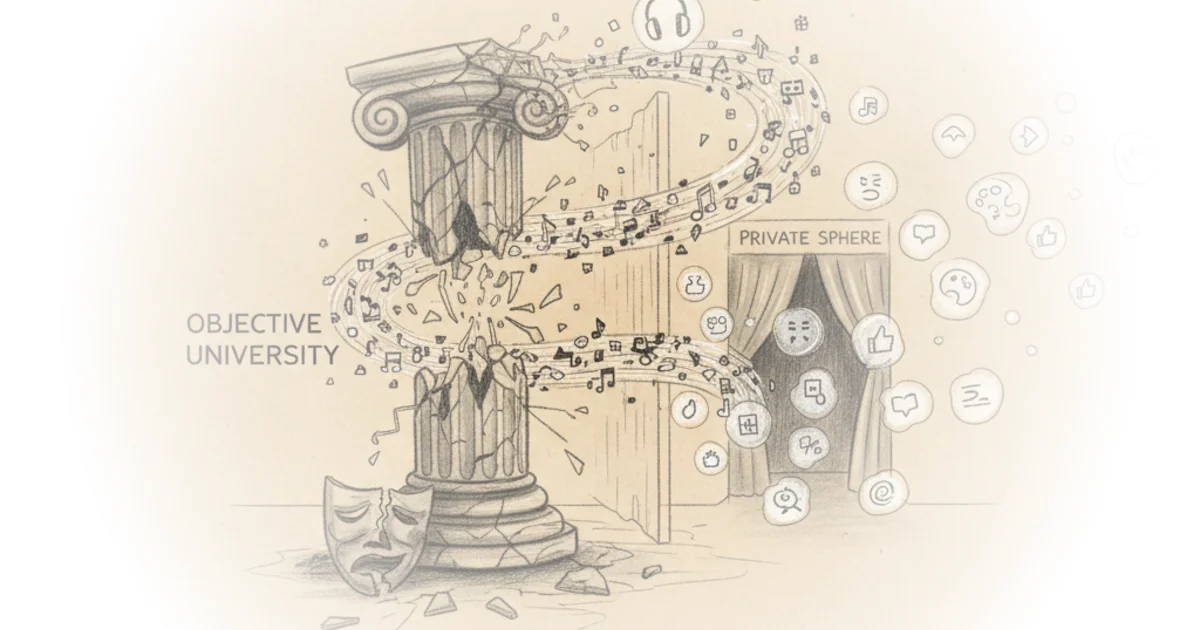
Robin James, a philosopher of art writing at Its Her Factory, argues that the traditional high/low culture binary -- fine art versus craft, pop versus serious -- is not merely outdated but structurally impossible in 2026. The framework that made those distinctions coherent, she contends, was the Enlightenment division between public and private spheres. With that division collapsed under decades of privatization, algorithmic personalization, and the erosion of shared civic space, the aesthetic categories it sustained have lost their foundation.
The political ontology that makes that aesthetic binary possible is obsolete.
The claim is sweeping. It is also, in its basic architecture, remarkably well-constructed. James traces a line from Kant's critical philosophy through Cold War geopolitics to 1990s welfare reform and arrives at a diagnosis of contemporary taste as fully privatized -- subjective without any pretense of universality.
Kant's Impossible Landing
James roots her argument in Kant's third critique, the one concerned with beauty. For Kant, aesthetic judgment was both personal and universal. To call something beautiful was simultaneously to declare that everyone else ought to agree.
Taste must be an ability one has in oneself, and whoever declares something to be beautiful holds that everyone OUGHT to give his approval to the object at hand and that he too should declare it beautiful.
James does not dwell on the mechanics of how Kant attempted to resolve this paradox. She is more interested in the fact that he tried at all. That the effort mattered enough to warrant what she calls "philosophical gymnastics" tells us something about how central shared aesthetic judgment was to the Enlightenment project. The public sphere required it. Liberal democracy assumed it.
The analogy James draws is clean: art maps to public, craft maps to private. Autonomy resides in the civil sphere; dependence and material need belong to the domestic one. Fine art claims the same freedom from everyday life that the liberal subject claims from the realm of necessity.
1989 as the Hinge
Drawing on Joshua Clover's study of that pivotal year, James argues that the fall of the Berlin Wall represented the apparent fulfillment of subjective universality. With the Cold War's structuring antagonism dissolved, liberal individualism understood itself as truly without Other. Clover captures this in a phrase James quotes approvingly.
The logic of "the end of history" is in some degree the logic of pop itself insofar as they both imagin[e] a single way of being, one that offers itself equally to everybody, into which all trajectories empty.
The argument is that once universality appeared to have been achieved in the civil sphere, the public lost its reason for existing as a site of aspiration. It could be shelved. And with it went the imperative for taste to perform universality. Subjectivity was unleashed.
James reads the musical evidence through Clover's framework. Gangsta rap replaced Black Power hip hop's outward-facing confrontation with white supremacy with what Clover describes as an internalization of struggle.
The shift from Black Power and Black Nationalist to gangsta rap, in and around the year 1989, can be rendered schematically as the turn from inter-group confrontation to intra-group conflict: the emergence of the internalization of struggle.
Grunge performed the same inward turn for white masculinity. Where punk aimed its negativity at political structures, grunge redirected rage at the self.
The Privatization of Grievance
The most original section of James's argument connects this cultural shift to the politics of affirmative action backlash. Drawing on Cheryl Harris's landmark 1993 article "Whiteness as Property," James argues that right-wing propaganda reframed systemic redistribution as a question of individual responsibility and personal injury. White masculinity adopted a posture of vulnerability -- not the stoic strength of earlier decades, but a performed woundedness that reinforced grievance against racial and gender minorities.
Grunge crossed over in the 1989 era because mainstream American white masculinity had made the same shift from public to private grievance -- grunge's once-countercultural performance of injured selfhood had, for entirely nonmusical reasons, become the norm.
This is the essay's sharpest insight. The connection between cultural taste and political economy is not metaphorical here. James is arguing that the same structural forces -- welfare reform, the Telecommunications Act, immigration enforcement -- that privatized public goods also privatized aesthetic judgment. The 1996 legislative trifecta she cites deregulated markets while intensifying the policing of identity, creating a world where freedom meant consumer choice and difference meant criminality.
Where the Argument Stretches Thin
The sweep of James's historical narrative is impressive, but it moves at a pace that sometimes outruns its evidence. The leap from Kant's third critique to gangsta rap to the Telecommunications Act covers enormous ground, and each link in the chain deserves more pressure-testing than a single essay can provide. In particular, the claim that the public/private binary has fully collapsed rather than merely been reconfigured invites skepticism. Public institutions, public discourse, and public accountability remain contested sites of enormous political energy in 2026 -- arguably more so than in the 1990s. The binary may be under strain without being obsolete.
Additionally, framing algorithmic personalization as a continuation of the same privatizing logic that produced welfare reform and corporate personhood risks flattening meaningfully different phenomena into a single narrative. Spotify's recommendation engine and Citizens United operate through different mechanisms of power, even if both can be described as "privatization" in some broad sense.
The Catalog of What Came After
James closes with a rapid inventory of the forms privatized taste has taken since 1989: omnivorousness, poptimism, algorithmic personalization, vibes, AI slop, looksmaxxing. The list is deliberately eclectic, spanning academic sociology and TikTok culture. Her point is that no single framework dominates.
Taste can be whatever so long as it is a vector for patriarchal racial capitalist accumulation and status.
The sentence is blunt and polemical. It is also the logical terminus of her argument. If universality no longer structures aesthetic judgment, then taste is freed from any obligation to transcend the individual. What remains is pure instrumentality -- taste as a tool for positioning within hierarchies that no longer pretend to be anything else.
The whole point is that there is no singular hegemonic construction of aesthetic taste: universals don't matter anymore.
Whether this represents a loss or a liberation depends on what one thinks the Enlightenment project was worth. James clearly regards the old universalism as a fraud that excluded most of humanity from its promises. But her essay also carries a note of unease about what replaces it. A world without shared aesthetic standards is also a world without shared grounds for argument, critique, or persuasion. Privatized taste is, by definition, beyond dispute.
Bottom Line
Robin James delivers a densely argued, historically grounded case that contemporary aesthetic fragmentation is not a cultural accident but the predictable consequence of political and economic privatization stretching back to the Cold War's end. The essay's strength lies in its refusal to treat taste as separable from political economy. Its weakness is the velocity at which it crosses disciplinary boundaries, sometimes asserting connections that deserve fuller argumentation. For readers interested in why "vibes" replaced critical consensus, or why algorithmic feeds feel like the natural order of things, James offers a structural explanation that is more rigorous than most -- and more unsettling.