In an era obsessed with optimizing comfort and eliminating friction, Stephen West of Philosophize This! makes a startling claim: the path to a meaningful life lies not in avoiding suffering, but in embracing the chaos that modern rationality tries so desperately to sanitize. This piece stands out by reframing ancient Greek tragedy not as a relic of despair, but as a rigorous training ground for the modern mind, offering a philosophical toolkit to dismantle our addiction to predictable, moralistic narratives.
The Socratic Trap and the Illusion of Order
Philosophize This! begins by dismantling the legacy of Socrates, arguing that his relentless pursuit of rational definitions has inadvertently created a "life-denying" framework for Western thought. The author suggests that Socrates effectively "denies the whole Dionysian side of what reality is—the chaos, the passions, the emergent, context-dependent side of reality." This is a provocative inversion of the standard narrative that credits Socrates with saving philosophy from myth; instead, West posits that his method forces us to ignore the messy, uncontrollable nature of existence in favor of a neat, rational order that simply doesn't exist.
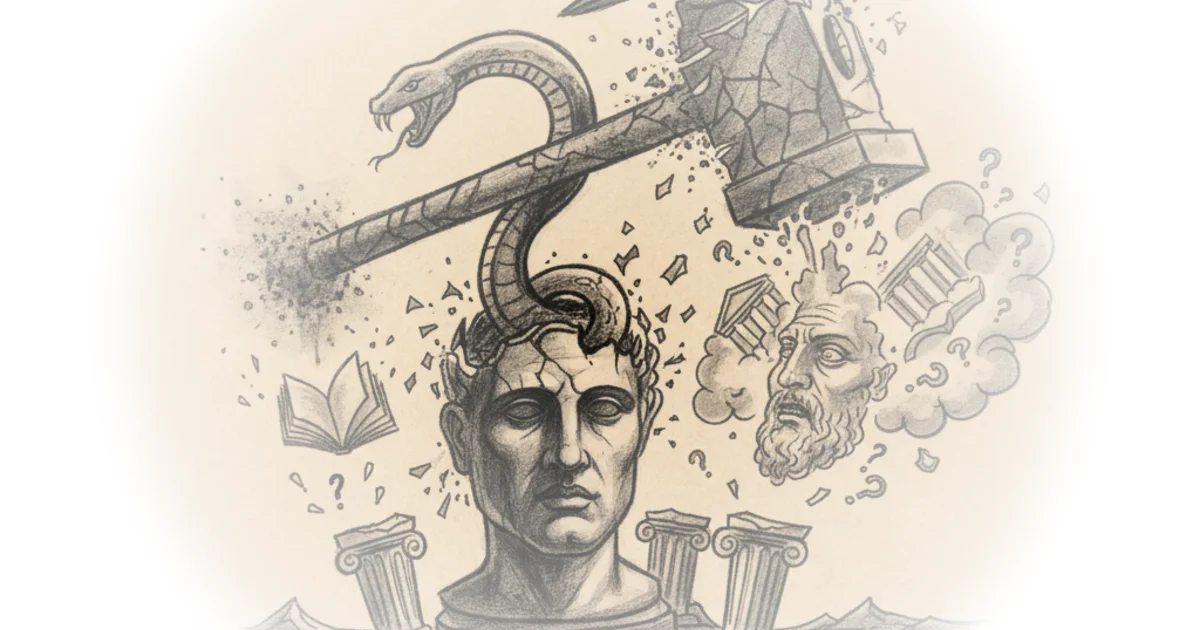
The commentary highlights how this approach sets people up for failure. When we demand perfect definitions for complex concepts like justice or beauty, we are inevitably disappointed because, as the author notes, "rational categorization is going to fall short." The piece argues that we have inherited a protocol-driven mindset where discomfort is viewed as a bug to be fixed rather than a feature of life. West writes, "If you renounce suffering, if you live life seeing comfort as the default state of life, then any discomfort you feel—you have to ration it or justify it to yourself in some way." This framing is powerful because it shifts the burden of resilience from the individual to the philosophical system that taught them to fear pain.
Critics might argue that this dismissal of rational inquiry throws the baby out with the bathwater, ignoring the genuine progress science and logic have made in understanding the world. However, the author's point is not to reject reason, but to reject the hubris that reason can fully capture the human experience.
"Definitions—rational representation more generally as it's gone on throughout the entire history of philosophy—is fundamentally, for Nietzsche, a process of taking the emergent chaos of reality in full, and then trying to reduce it into something that human minds can comprehend and work with."
The Renaissance of the Tragic Perspective
To counter this rationalist decay, Philosophize This! turns to the pre-Socratic Greek culture, specifically the era of Thucydides and the ancient tragedies. The author contrasts the modern Hollywood narrative—linear, morally binary, and ending in a tidy resolution—with the brutal ambiguity of Greek tragedy. In a typical movie, "the good character knows what they must do... then after they destroy their enemy, the good character holds the trophy up over their head." West argues that this structure reinforces a dangerous delusion: that life is a story where the protagonist is always right and evil is always defeated.
In contrast, the tragic perspective accepts that the world is in a constant state of flux. The author brings in the work of Simon Critchley to deepen this analysis, noting that for Critchley, "Tragedy gives voice to what suffers in us and in others, and how we might become cognizant of that suffering, and work with that." This is a crucial distinction. Tragedy isn't about wallowing in sadness; it is about recognizing the "war" of existence—the tension between our desires and the indifferent, changing world. By studying these plays, we learn to stop looking for a moral justification for every event and start accepting the harsh reality of power dynamics and human fragility.
The piece effectively uses Nietzsche's admiration for Thucydides to illustrate this point. Unlike other historians who attributed events to divine will or moral failings, Thucydides focused on "power dynamics of the time, pragmatic moves that are made by cultures, and he doesn't shy away from talking about the harsh reality." This historical lens provides a sobering antidote to the modern tendency to moralize every political or social conflict.
"If you grew up in a society where this is the type of story you had crammed into your head from the moment you were born then of course it's going to be easier for you to think of your life in terms of you being a main character in a movie that's always the morally good person."
Affirming the Unavoidable
The ultimate goal of this philosophical shift is what Nietzsche called amor fati, or the love of fate. Philosophize This! argues that this is not a passive resignation but an active affirmation of life's necessary components, including pain. The author writes, "Discomfort is not some sacrifice you have to pay. It's in some other real sense just the set of directions for how to get to somewhere you want to be." This reframing transforms suffering from an obstacle into a navigational tool, a necessary sensation on the journey toward a desired outcome.
This section of the commentary is particularly strong in its application to modern life. It suggests that the anxiety and dissatisfaction many feel stem from a refusal to accept the tragic nature of existence. By adopting the tragic perspective, we stop fighting the current of reality and start learning to swim in it. As West concludes, "The point for Nietzsche becomes: If you want something, if you have that voice inside of you that won't shut up about it— sometimes discomfort is just the set of sensations you are in, on the way to getting that thing. Why not affirm that journey then as you're on it?"
"To Nietzsche: you just say yes to it. You affirm that which is necessary, or as he articulates it pulling from earlier thinkers: amor fati."
Bottom Line
Philosophize This! delivers a compelling case that the ancient tragic perspective offers a vital corrective to our modern obsession with comfort and rational control. The strongest element of the argument is its ability to reframe suffering not as a failure of the system, but as an intrinsic part of the human condition that, when embraced, leads to greater resilience. The piece's biggest vulnerability lies in its potential to be misread as an endorsement of passivity in the face of injustice, rather than a call to engage with reality as it is. Readers should watch for how this philosophy translates into political action, where the line between accepting fate and enabling oppression can be dangerously thin.