Then & Now reframes capitalism not as an inevitable force of nature, but as a sudden, explosive historical anomaly that transformed human existence in a mere generation. The piece's most arresting claim is that the system we consider "the water we swim in" is actually a recent invention that replaced a static, feudal world where 80% of humanity was trapped in subsistence farming. This detective-story approach to economic history offers a vital corrective to the assumption that our current reality is the natural order of things.
The Puzzle of Origins
Then & Now begins by dismantling the idea that capitalism has a single intellectual lineage like communism or fascism. "Unlike say communism or fascism or even something like physics or chemistry you can't neatly point to a tradition of thinkers like say Marx and musolini or Newton or Einstein that kind of Drew out and delineated the framework of how we think about an ideology," the author writes. Instead, capitalism is portrayed as something that "bubbled up surrounded by other junk from a number of different components but from a bit of a murky depth."
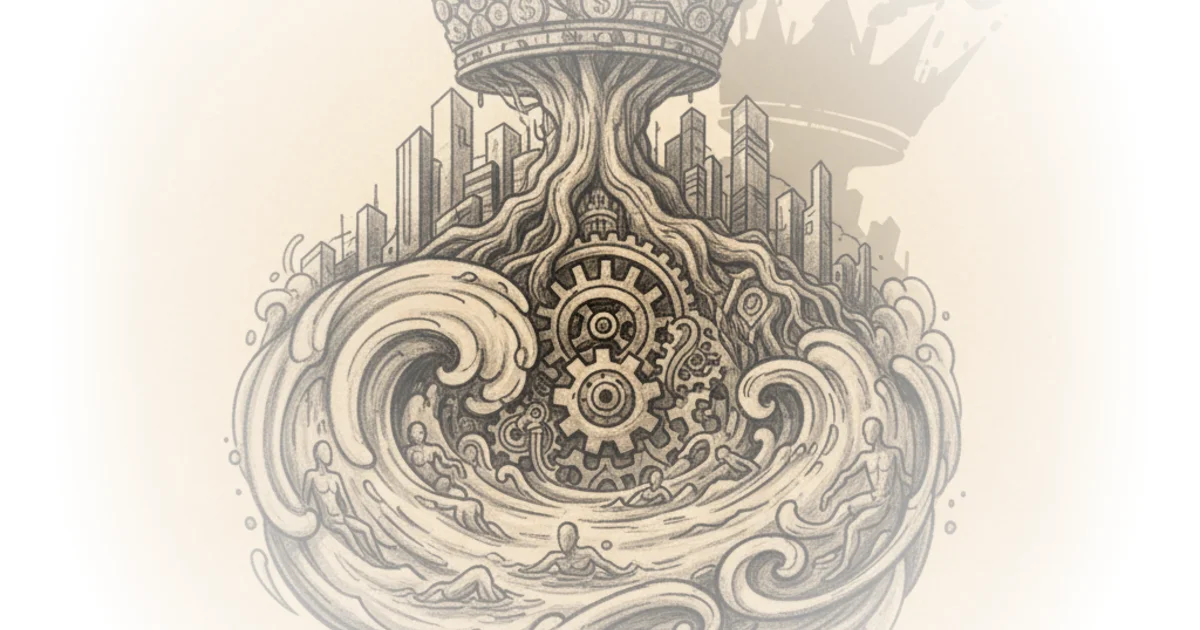
This framing is effective because it shifts the focus from abstract theory to messy, practical evolution. The author argues that understanding this system requires treating it like a machine that needs to be taken apart while it is still running. "Analyzing capitalism telling this story is like deconstructing a fast car while you're speeding along in it," Then & Now notes. This metaphor captures the urgency and difficulty of the task: we are trying to understand the engine of our lives while being driven by it at breakneck speed.
"The puzzle is one that historians have poured over for decades if not centuries in one form or another and it's the question of how where from who and why this thing we call capitalism developed."
Critics might argue that this "murky depth" narrative downplays the deliberate role of state power and colonial violence in constructing early markets, but the piece compensates by emphasizing the sheer speed of the transformation.
The Feudal Baseline
To appreciate the magnitude of the shift, Then & Now forces the reader to inhabit the mental landscape of a medieval peasant. The author highlights a staggering statistic: "the global population in 1600 was around 500 million but about 94% of people lived agricultural lives and 80% of these were peasants of some form." This figure is presented as the most important data point in the entire history of capitalism, illustrating a world where the vast majority of human energy was consumed simply to keep people alive.
The coverage paints a picture of a "very closed down system" where social mobility was non-existent and life was defined by rigid obligations. Then & Now describes the feudal landscape as a "patchwork of principalities dukedoms Empires free cities kingdoms all with different setups of different kinds," creating a reality of "intense confusion of powers and Perpetual overlaps of unequal jurisdiction." The author uses the example of a French village to show how specific and burdensome these obligations were, noting that villagers owed their lord "85 L of barley 28 of wheat 880 bottles of olive oil 18 chickens 4 pound of beeswax four partridges and one rabbit."
This detailed accounting of feudal dues serves a crucial rhetorical purpose: it makes the pre-capitalist world feel claustrophobic and fragile. The author notes that even in this static system, "famine was an everpresent threat," citing the "seven ill years in Scotland between 5 and 15% of the population died from famine." By grounding the abstract concept of "feudalism" in the visceral reality of starvation and rigid hierarchy, the piece sets the stage for the coming explosion.
The Industrial Explosion
The narrative then pivots to the moment the "fast car" was built. Then & Now presents a figure that is difficult to comprehend: "in 1760 that's before the Industrial Revolution really took off Britain was processing around 2.5 million pound of raw cotton... by 1840 that figure that amount of cotton had grown to a staggering 366 million P." The author emphasizes that this was not steady growth but an "explosion by a factor of of 160."
The commentary moves beyond dry statistics to explore the human implications of this shift. "I want to think about what having 16 times more available clothes and building materials tools and transport food is like for ordinary people," Then & Now writes. This focus on the tangible improvements in daily life—being "a little bit warmer a little bit more satiated watered a little bit healthier a little bit Freer"—avoids the trap of purely ideological debate. The author acknowledges the dark side of this progress, asking "what happens to the rest of the world when one part gets immeasurably richer and more powerful too," specifically noting how this wealth allowed for warships and tanks to be "rolled out like clockwork on an industrial scale."
The piece draws on historical metaphors to describe this era, referencing David Landis's concept of "Prometheus Unbound." The author describes this image as "a kind of God who stole something someone with a Janus face the image of fire and steel and oil and power and energy Conquering the world a kind of Frankenstein that we've created and sometimes does things that we don't expect it to." This framing is powerful because it captures the dual nature of the industrial age: it was a source of liberation and a source of unprecedented destruction.
"It's a story of what some historians have called the Conquering Bourgeois... the speed and veracity with which it changed the entire world was astonishing."
The Bottom Line
Then & Now succeeds in making the familiar strange, forcing the reader to see capitalism not as a natural law but as a specific, rapid historical event that upended a thousand years of stasis. The strongest part of the argument is the use of concrete data—like the cotton figures and the 80% farming statistic—to ground the abstract concept of "capitalism" in physical reality. The piece's biggest vulnerability is its reliance on a Eurocentric timeline for the "explosion," though it gestures toward the global consequences of this shift. For the busy reader, the takeaway is clear: the world we live in is a recent, fragile construct, not an eternal truth, and understanding its origins is the only way to navigate its future.