In a cultural moment often defined by binary shouting matches, Wayfare offers a startlingly nuanced reclamation of the word "feminism," arguing that the movement's true power lies not in mimicking corporate masculinity, but in elevating the undervalued "craft" of community building. The piece challenges the prevailing narrative that women have "ruined" the workplace by reframing the debate: it suggests that the real crisis is a society that refuses to value the relational labor that sustains us all. This is not a defense of the status quo, but a radical proposal to expand our definition of worth beyond the paycheck.
The Hierarchy of Value
The commentary opens with a personal anecdote that serves as a potent metaphor for the entire argument: the author was once arrested for selling stained glass because an officer deemed it a "craft" rather than "art," stripping it of First Amendment protection. Wayfare uses this incident to define the core conflict: "I would define craft as art deemed 'women's work' that the consumer economy has chosen to devalue." This distinction is crucial. The piece argues that the separation between high art and domestic craft is not an aesthetic judgment, but a gendered one that systematically undervalues the work women have historically done in community.
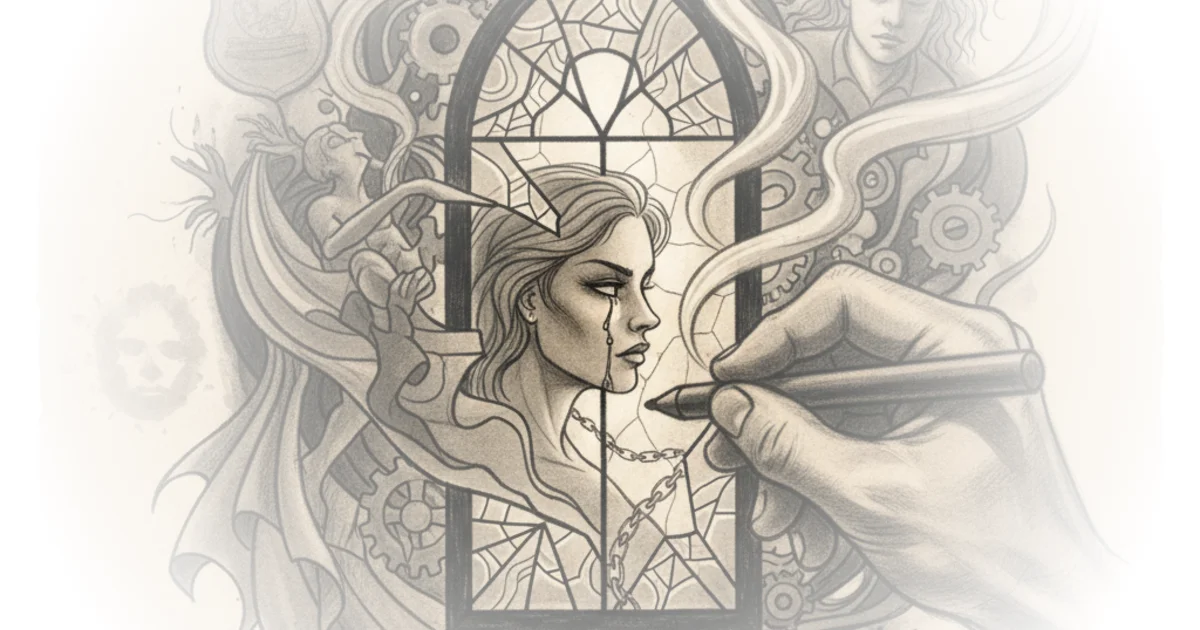
To illustrate the depth of this tradition, the text draws a parallel between modern quilting bees and the Tapa cloth traditions of Samoa, where women stamp and paint ceremonial cloth to carry sacred meaning. Just as the Arts and Crafts movement of the late 19th century sought to restore dignity to manual labor against the dehumanizing effects of industrialization, this piece suggests that "crafting is about creativity and beauty—in other words, art—but it is also fundamentally about community, relationship-building, and love." The argument lands with force because it refuses to apologize for the domestic sphere; instead, it posits that these activities are "profoundly feminist" precisely because they prioritize connection over capital.
"Crafting is about creativity and beauty—in other words, art—but it is also fundamentally about community, relationship-building, and love. All of which makes it, to me, profoundly feminist."
The "Great Feminization" Hypothesis
The piece then pivots to a rigorous engagement with a controversial recent debate sparked by a New York Times podcast and an essay by Helen Andrews. Andrews posits the "great feminization hypothesis," claiming that the influx of women into the workforce has weakened institutions by replacing meritocracy with "emotionality" and "cancel culture." Wayfare does not dismiss this critique but dismantles its premises with data from the medical field. The author, a pediatrician, notes that while statistical differences in group dynamics exist, they do not support the idea that women are a liability.
The commentary highlights a striking contradiction in the "feminization" argument. While Andrews claims women bring "cancel culture" to the workplace, Wayfare points out that "female physicians, for instance, are more likely than male physicians to follow evidence-based practice and clinical consensus guidelines in patient care, medicine's form of 'rule of law.'" Furthermore, the piece cites studies showing that female surgeons have fewer complications and that female clinicians achieve lower mortality rates. The argument is that "women have not ruined the practice of medicine, they have improved it."
Critics might note that focusing solely on medical outcomes could overlook the structural barriers that still prevent women from reaching leadership roles in other sectors. However, the piece effectively counters the notion that "feminine" traits are inherently antithetical to institutional success. It argues that the ideal workplace is not a homogenized male environment, but one that leverages "the competitiveness, risk-taking, focus on profits, and over-confidence of the average man, as well as the caring, creativity, collaboration, caution, and idealism of the average woman."
Beyond the Binary of Liberal and Conservative
Perhaps the most distinctive move in the article is its rejection of the rigid "liberal vs. conservative" feminism dichotomy often used to silence debate. Wayfare argues that the knee-jerk reaction to dismiss conservative feminists proves the very point the critics are making: a narrow definition of feminism is being used to "shut down debate by dismissing anyone with a opposing view." The piece asserts that "conservative feminists do exist, along with many other types of feminists, all of whom add to the rich tapestry of conversation."
This section weaves in a broader philosophical critique of how we value work. Citing Don Thompson's The $12 Million Stuffed Shark, the author contrasts the inflated value of branded contemporary art with the invisible worth of relational labor. The text notes that in our consumerist society, "Works of art, which represent the highest level of spiritual production, will find favor in the eyes of the bourgeois only if they are presented as being liable to directly generate material wealth." This insight reframes the entire discussion: the problem isn't that women are changing the workplace, but that the workplace has become a place where only marketable output counts.
"You are nobody in contemporary art until you have been branded."
The piece concludes by connecting this economic critique to a spiritual and familial framework, noting that even within patriarchal structures, the work of building families is the "foundational, enduring structure" upon which society rests. It argues that "medicine is yet another scaffold that exists primarily to support the central structure of families," and that the "non-income-generating work done by families and to a large degree by women" is the true engine of human thriving.
Bottom Line
Wayfare's strongest contribution is its refusal to accept the premise that "feminism" must mean a singular pursuit of corporate power, offering instead a vision where the "craft" of care is recognized as essential to a functioning society. Its biggest vulnerability lies in its reliance on the medical field as a primary case study, which may not fully translate to high-stakes, competitive industries where risk-taking is the primary currency. However, the piece successfully shifts the conversation from "did women ruin the workplace?" to "why do we refuse to value the work that keeps the world turning?" Readers should watch for how this redefinition of "worth" challenges not just gender norms, but the very metrics we use to measure success in the 21st century.