Most political analysts treat off-year elections as crystal balls, but Eli McKown-Dawson argues they are often just mirrors reflecting the noise of the moment. This piece cuts through the frenzy surrounding the Virginia attorney general race to ask a sharper question: in an era of hyper-partisanship, do individual scandals still possess the power to kill a campaign, or has the electorate become too numb to care? For busy observers trying to discern signal from static, the answer lies not in the headlines, but in the quiet mechanics of ticket-splitting and the specific, brutal calculus of Virginia voters.
The Scandal That Should Have Ended a Race
McKown-Dawson begins by dismantling the assumption that the recent explosion of controversy around Democratic candidate Jay Jones would be a simple story of electoral suicide. The author details the gravity of the situation: Jones, a former state delegate, was convicted of reckless driving for speeding at 116 mph in a 70 mph zone, but the real firestorm erupted over text messages he sent to a Republican legislator. The texts included violent rhetoric about killing House Speaker Todd Gilbert, with one message chillingly stating, "Gilbert, hitler, and pol pot... Gilbert gets two bullets to the head." Even more disturbing, Jones allegedly wished for Gilbert's wife to watch her child die to force a change in gun control policy.
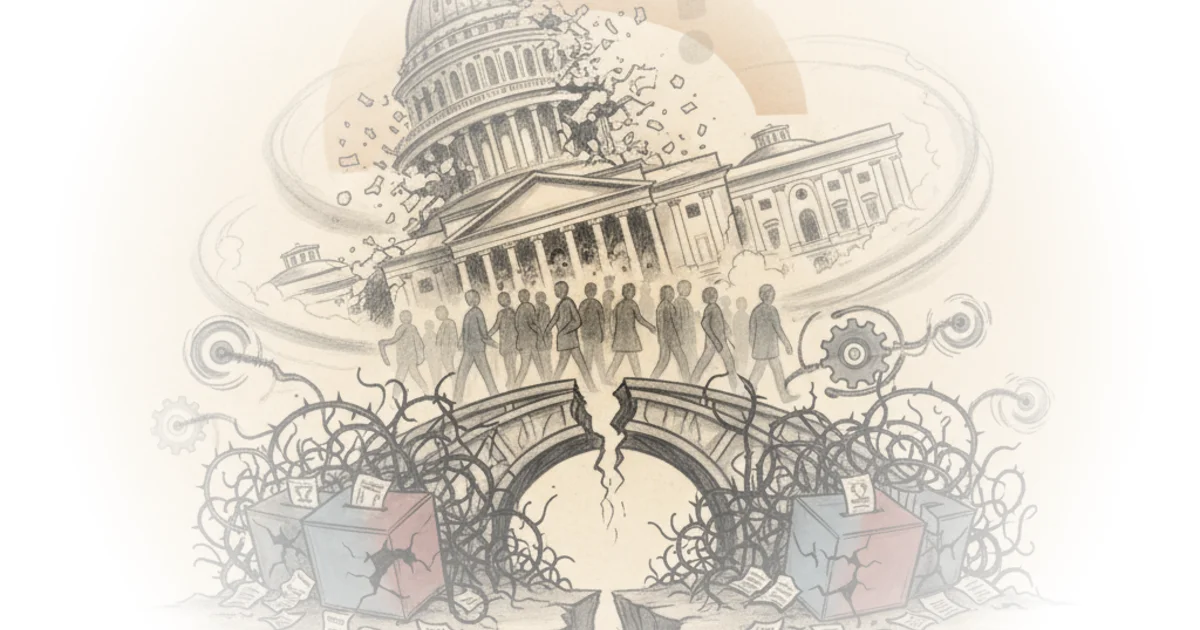
The author notes that this is "an especially damaging scandal at a time when people are understandably more sensitive to political violence." Yet, the piece argues that the immediate reaction from the Democratic establishment was notably muted. While Jones apologized, top figures like gubernatorial candidate Abigail Spanberger stopped short of demanding he drop out. McKown-Dawson writes, "It feels unnecessary to say, but this is an especially damaging scandal at a time when people are understandably more sensitive to political violence." This observation is crucial; it highlights a disconnect between the moral weight of the texts and the political reality of a race where the party out of power typically gains ground.
Critics might argue that the author underestimates the long-tail damage of such rhetoric, suggesting that while the immediate polls might hold, the stain could linger into future cycles. However, the data presented suggests a different reality: the scandal has indeed shifted the attorney general race, with Jones dropping from a lead to a deficit, but it has failed to drag down the rest of the Democratic ticket.
The core question isn't whether the texts are horrific—they are—but whether they are enough to override the structural advantages of a mid-cycle election.
The Limits of the 'Spillover' Effect
The most compelling section of McKown-Dawson's analysis challenges the conventional wisdom that a scandal at the bottom of the ticket inevitably drags down the top. Despite the ferocity of the attack on Jones, the gubernatorial race remains largely untouched. As the author puts it, "There's no sign of post-text movement toward Republicans in the top-of-the-ticket polls." The margin for Spanberger has shifted by a mere 0.5 percentage points since the scandal broke.
The piece leans on historical context to explain this resilience. McKown-Dawson points out that Virginia has a history of polling errors, noting that in 2017, Ralph Northam was expected to lose but won by nearly 9 points. Conversely, in 2013, Terry McAuliffe's lead evaporated. The author argues that "the historical average polling error in Virginia is about 4 points," suggesting that Spanberger's current lead is mathematically safe even if the scandal creates a slight drag. This framing is effective because it moves the conversation away from emotional reactions to the texts and toward the cold, hard arithmetic of state-level polling.
The author also introduces the concept of the "undervote," where voters might choose to skip the attorney general race entirely rather than vote for a candidate with such a dark record. "I also think there's an under-discussed issue of undervotes, where some people who vote for Spanberger will just skip the attorney general race," notes Virginia politics expert Sam Shirazi, a voice McKown-Dawson integrates to bolster the argument. This suggests a nuanced voter behavior: one can reject a candidate without necessarily switching allegiance to the opposition.
The Republican Dilemma: Go All In or Split the Ticket?
McKown-Dawson then pivots to the strategic nightmare facing Republicans. They have a candidate, incumbent Jason Miyares, who is now favored in the polls, but they face a difficult tactical choice. Do they try to use Jones's scandal to bring down Spanberger, or do they accept that the governor's race is lost and focus entirely on winning the attorney general seat? The author highlights a quote from Republican strategist Zack Roday, who sees the texts as proof that "Democrats have lost the plot on common sense."
However, the piece argues that the Republican strategy is likely to be one of containment rather than expansion. "The point of this strategy isn't to use Jones to drag Spanberger down, but just the opposite: to convince Spanberger voters to split their tickets and vote for Miyares," McKown-Dawson explains. This is a sophisticated read of the political landscape, acknowledging that in a state where the party in the White House struggles, Republicans cannot rely on a wave. Instead, they must rely on the specific, localized appeal of Miyares and the specific, localized failure of Jones.
The author also touches on the financial dynamics, noting that while Spanberger has a massive ad spend advantage in the governor's race, Miyares has outspent Jones significantly in the attorney general contest. "Miyares's cash advantage has only increased as Republican donors have been energized by the text scandal," the piece observes. This financial disparity, combined with the scandal, has created a scenario where the race is competitive, but the path to victory for Republicans requires a very specific type of voter behavior: ticket-splitting.
The Historical Context of Ticket-Splitting
To ground the argument, McKown-Dawson weaves in historical data that adds depth to the current analysis. The author notes that while ticket-splitting is often declared dead, Virginia has a history of it. "Donald McEachin underperformed the Democratic gubernatorial candidate by a whopping 26 points in 2001," the piece recalls, while in other years, Democratic attorney generals ran ahead of their gubernatorial counterparts. This historical perspective is vital; it reminds the reader that Virginia politics has never been a monolith and that voters have long been willing to separate their choices based on the specific merits of the candidates.
The author also draws a parallel to the broader national context, referencing the "social-desirability bias" that often skews polling. In the context of the Access Hollywood tape and other scandals, voters have shown a willingness to separate personal misconduct from political utility. The piece suggests that while the texts are heinous, the "modal Virginian" might still view the election as a referendum on the administration in Washington rather than the character of a local candidate.
In most states, you might assume the national tide is the only thing that matters. But Virginia is a politically engaged state that has historically prided itself on decorum, and the polls back up the assumption that the texts are unacceptable.
Bottom Line
Eli McKown-Dawson's strongest contribution is the refusal to treat the Jay Jones scandal as a simple narrative of moral collapse; instead, the piece presents a complex interplay of polling mechanics, historical precedent, and strategic calculation. The argument's greatest vulnerability lies in its reliance on historical polling averages, which may not fully account for the unique volatility of a post-truth political era where norms are constantly shifting. Readers should watch for the final election night results not just to see who wins, but to measure the precise extent of the ticket-splitting that this piece so convincingly predicts.