Noah Smith challenges a comforting economic myth: that China's state control insulates it from the stagnation that paralyzed Japan in the 1990s. Instead of dismissing historical parallels, he argues that Beijing is actively replicating Tokyo's worst mistake—keeping dead companies alive through "evergreening" loans—and that this strategy is now strangling China's own productivity.
The Anatomy of a Zombie
Smith begins by dismantling the skepticism often held toward Japan-China comparisons. He acknowledges the structural differences but zeroes in on a specific mechanism: the refusal to let failing firms die. He points to Daiei, once Japan's top retailer, which survived for decades only because banks kept lending it money at below-market rates to pay off old debts.
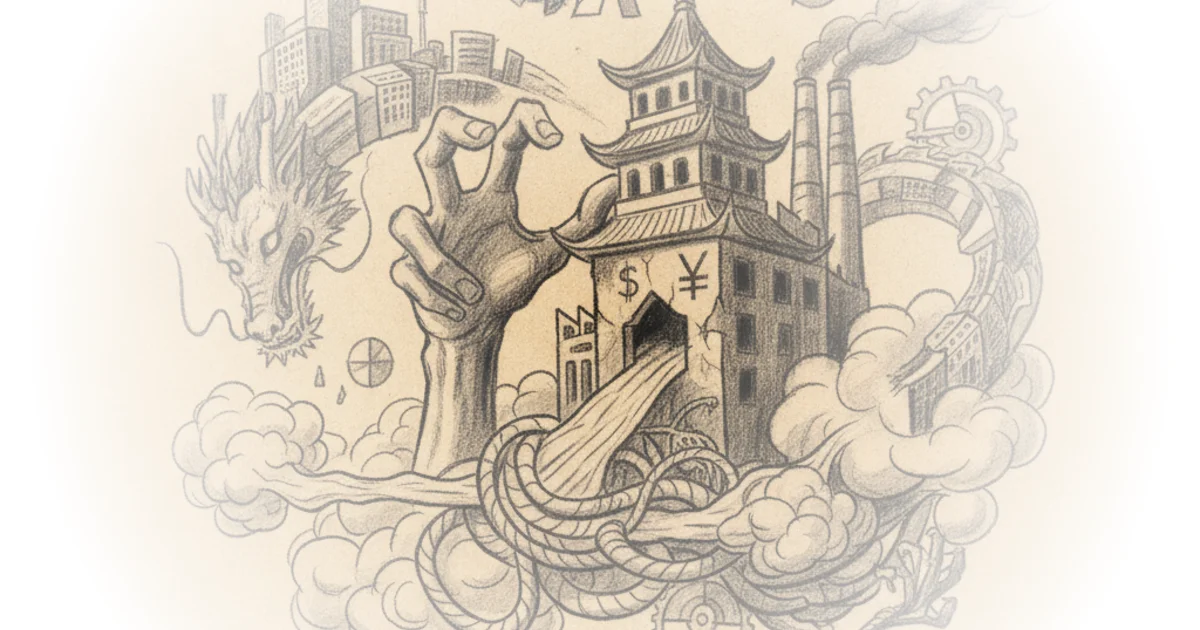
"The basic story is that after 1990... companies that used to be profitable were no longer profitable," Smith writes, explaining how banks faced a choice: admit losses and risk regulatory trouble, or lend more to failing borrowers. The result was "evergreening," a process where new loans mask old bad debt.
This framing is crucial because it shifts the focus from individual corporate failure to systemic financial engineering. By citing Caballero, Hoshi, and Kashyap's 2008 research, Smith highlights that this wasn't just a banking issue; it was an economy-wide resource trap. "Evergreening kept a bunch of companies afloat... that had utterly broken business models," he notes. The consequence was not stability, but stagnation: scarce capital and top-tier talent were locked inside doomed enterprises.
Critics might argue that China's state-owned banks operate under different incentives than Japan's private sector did in the 1990s. However, Smith effectively counters this by noting that the Japanese government was deeply entangled with its banks, directing them to maintain employment and avoid social unrest—a dynamic that mirrors Beijing's current priorities.
The Data Behind the Silence
The piece strengthens its case by moving from historical analogy to hard data. Smith points out a glaring contradiction in China's financial reporting: while official non-performing loan (NPL) ratios have dropped since 2021, the share of loss-making companies has actually risen.
"Some concrete data points suggest that China's evergreening of debt is more widespread than is commonly the case in most market economies," Smith observes. He leans on a Rhodium Group report to expose the gap between official numbers and reality: "The National Audit Office recently claimed... that 16 of 43 audited banks last year had NPL levels that were double the officially reported figure." This suggests a massive volume of unrecognized bad debt.
The financial system served as a shock absorber, channeling resources to enterprises facing losses to maintain output and prevent the defaults and bankruptcies that occurred in market economies.
Smith uses this evidence to argue that China is not avoiding the zombie problem; it is merely delaying the reckoning. He draws on Dallas Fed data showing that many Chinese firms, particularly in real estate, cannot even cover their interest payments. "Banks have taken a bunch of losses, but have refused to recognize those losses, using a flood of cheap debt to keep their borrowers afloat," he summarizes.
The Cost of Artificial Stability
The most compelling part of Smith's argument is his analysis of the downstream effects. Even if the government can prevent a banking collapse by forcing loans to continue, it cannot stop the economic distortion. Zombie companies compete for labor, raw materials, and energy, driving up costs for healthy firms.
"They compete with them for other resources," Smith writes, noting that workers are stuck in unproductive roles rather than moving to growing sectors. This dynamic fuels "involution," a term describing intense competition where companies slash prices to survive despite losing money on every unit sold. In high-priority sectors like electric vehicles and solar panels, Smith cites Alicia Garcia-Herrero's finding that the share of zombie companies has hit 30 percent.
"Without real productivity advances, [zombies] still join the price-slashing frenzy to stay in the game," Smith explains. The result is a race to the bottom that erodes profit margins across the entire industry, hurting even the most efficient players.
Bottom Line
Smith's strongest move is reframing China's export dominance not as a sign of economic strength, but as a symptom of internal decay driven by state-sponsored inefficiency. The argument's vulnerability lies in its assumption that Beijing will eventually be forced to address these distortions; the state has shown remarkable resilience in managing crises without immediate pain. However, if productivity continues to stall, the long-term growth ceiling becomes undeniable. Readers should watch for any shift in Chinese regulatory rhetoric regarding loan rollovers or a sudden spike in corporate bankruptcies, which would signal the end of the "evergreening" experiment.