Richard Hanania makes a chillingly precise prediction: the Republican Party's future may not belong to the seasoned politician, but to the shameless conman who can turn bigotry into a viral brand. He argues that James Fishback is not an anomaly, but the logical endpoint of a movement that has abandoned epistemological rigor for entertainment value.
The Anatomy of a Con
Hanania's central thesis rests on the idea that the conservative movement has become a "perfect demographic" for grifters because it has severed ties with knowledge-producing institutions. He writes, "Conservatives don't read real news, and neither do young people. So young conservatives represent a place on the Venn diagram where you will find some of the most poorly-informed voters out there." This observation is stark, but it is the mechanism of the grift that Hanania dissects most effectively. He details how Fishback reinvented himself after being sued by a financial firm for fabricating a position to attract clients, noting that the firm secured a $229,000 judgment against him.
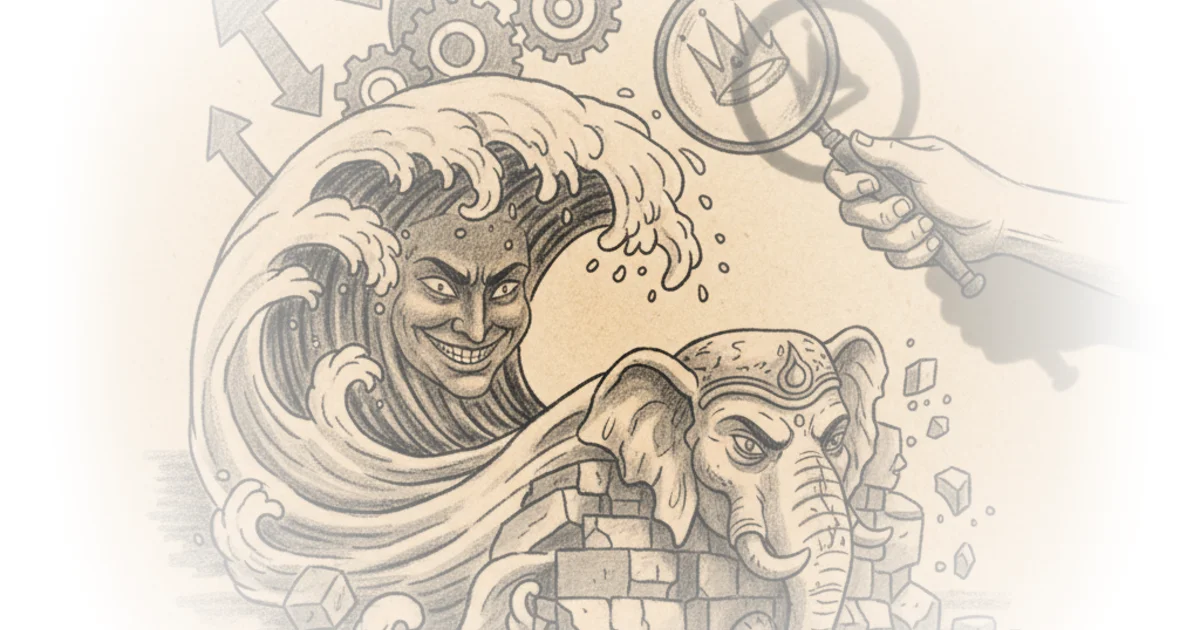
The author suggests that Fishback's rise is a test case for the movement's health. "If I were designing a candidate in a lab to test my theory that the right is in deep trouble, I couldn't come up with anything better than James Fishback." This framing is powerful because it shifts the focus from individual moral failure to systemic vulnerability. The candidate's history of legal settlements and admitted theft are not presented as disqualifiers, but as features of a new political archetype.
"Fishback has a Trump-like quality of being so shameless, and so constantly outrageous across so many dimensions, that it simply overwhelms any ability to critique or judge."
Hanania points out that this shamelessness creates a "bemused if grudging respect" even among critics. This dynamic mirrors the "Goypers" phenomenon, where online subcultures prioritize performative transgression over policy coherence. Just as the Epstein file discussions often devolve into unverified conspiracy theories that confuse reality with fiction, Fishback's supporters admit they "can't distinguish what is real from what is AI." The movement's rejection of shared facts creates a vacuum that figures like Fishback fill with charismatic nonsense.
The Economics of Bigotry
A critical part of Hanania's argument is his refusal to separate economic populism from racial scapegoating. He challenges the notion that Fishback's economic views can be evaluated independently of his bigotry. "If you ask Goebbels his economic policy and he says 'we need to get Jews out of banking, medicine, the trades, etc.' you don't just say well he's racist but also has some economically populist views." This is a crucial distinction that many analysts miss. Hanania argues that for this demographic, economic grievances are merely a vehicle for xenophobia.
He notes that Fishback's rhetoric includes denouncing the idea of Americans from other states moving to Florida, a stance that extends the "foreigner" label to domestic neighbors. This echoes the "Goyslop" narrative, where cultural purity is policed in college cafeterias and public spaces. Hanania writes, "The economic opinions are just part of the scapegoating." This synthesis is the article's strongest analytical move, exposing how the "populist" label is often a euphemism for exclusionary politics.
Critics might note that dismissing all economic populism as inherently racist risks alienating voters with genuine grievances about wage stagnation and immigration policy. However, Hanania's evidence suggests that in this specific context, the economic arguments are inextricably linked to the racial ones.
The Youth Vote and the Data
The most surprising evidence Hanania presents is the polling data regarding young voters. While traditional wisdom suggests older voters are the GOP base, Hanania highlights a University of North Florida survey where Fishback leads his opponent, Byron Donalds, among 18-34-year-olds. "Among 18-34-year-olds, those percentages are reversed, with Fishback beating Donalds, 32% to 8%." Even with a small sample size, Hanania argues the statistical confidence is high enough to indicate a real trend.
He observes that Fishback's ability to draw crowds—500 people at a University of Florida event compared to 180 for Donalds—signals a shift in how political engagement works. "All the non-Fishback estimates come from the campus paper, The Florida Alligator... This blows away the 180 who came to a Byron Donalds rally." The author suggests that the "online campaign" is not a metaphor; it is the primary reality for this demographic. The movement's future is being decided in spaces where "entertaining a crowd" is the only metric that matters.
"If we've learned one lesson from the last decade, it's that such a person is exactly who Republican voters want."
This conclusion is unsettling but supported by the trajectory of the last election cycle. The "Based Ritual" Hanania describes demands that one does not necessarily have to be racist, but must not object to racism. This creates a permissive environment for figures who would have been marginalized in previous decades.
Bottom Line
Hanania's most compelling argument is that James Fishback is not a fluke, but a symptom of a conservative movement that has prioritized entertainment and tribal signaling over truth and governance. The piece's greatest vulnerability is its reliance on a single, small-sample poll to predict a generational shift, though the anecdotal evidence of crowd sizes supports the broader trend. The reader should watch for whether the "boomer wall" holds or if the party's active base continues to embrace the "shameless conman" model as the new standard for leadership.