Dan Carlin's Hardcore History episode takes on one of history's most fraught topics—the Atlantic slave trade—with a twist that many listeners may not anticipate. Rather than offering a chronological account, he frames this as an exploration of ideas: what factors drove the massive forced migration of Africans to the Americas? What did slavery look like across civilizations before Columbus arrived? The answer is far more complex than the simple narratives that dominate modern discourse.
The Zeitgeist Problem
Carlin opens with a warning from historians that this topic "is not going to go well"—no matter what approach he takes. He immediately quotes Ohio State University historian Robert C. Davis: "history is often present politics projected on to the past." This meta-framing is crucial because it signals to listeners that Carlin knows he's wading into contested territory. He's not naive about the political stakes; he's actively trying to navigate them while still giving his audience a foundational knowledge base they can build on.
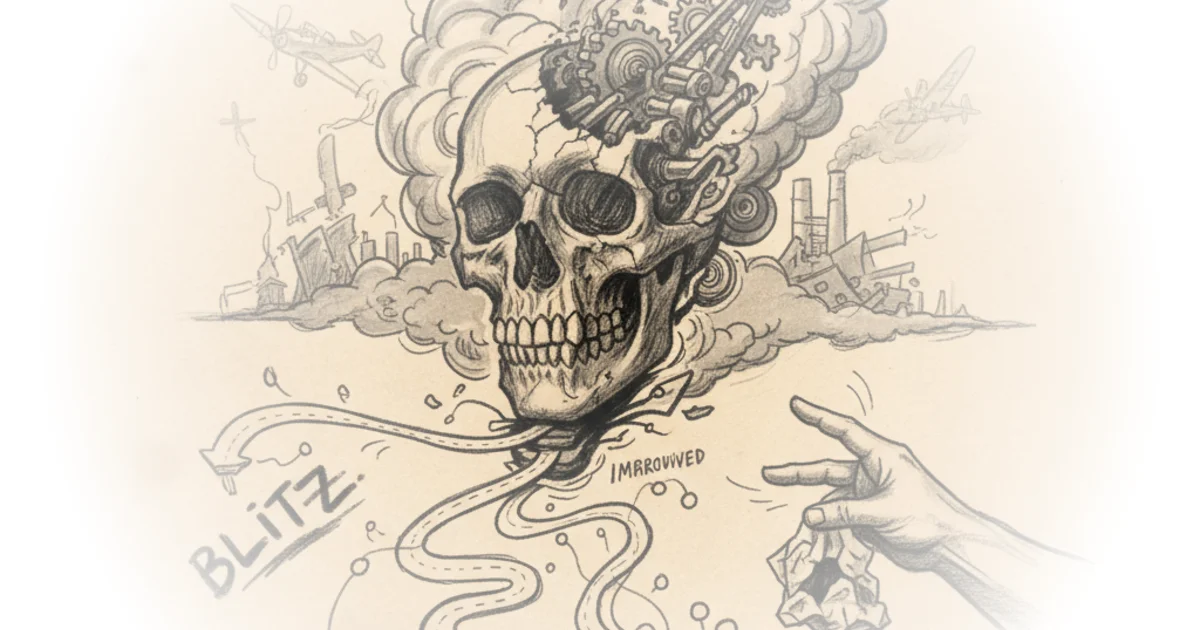
The framing works because it acknowledges something many podcast hosts avoid: the act of discussing slavery is inherently political, and anyone who touches this topic will face criticism. By naming that tension upfront, Carlin earns credibility with listeners who suspect their favorite history podcasts might be sanitizing or ideologizing this subject.
History is often present politics projected on to the past.
Carlin's approach to the Blitz format—diving in and out, highlighting what he finds most interesting rather than following a timeline—isn't accidental. He explicitly rejects "a compare and contrast sort of deal" that would be too intellectually demanding for his listeners. This self-awareness about his audience is part of why this episode feels like a genuine conversation rather than a lecture.
The Labor-Saving Device
The most provocative claim Carlin makes comes from his reading of enslaved peoples' perspectives in ancient societies: "Slavery is one of the original labor-saving devices." He follows this with a description that sounds almost comedic to modern ears—describing how slave owners connected slavery to "the highest aspirations of mankind" because slaves "free up the people that push society forward and think and write."
This framing is effective because it forces listeners to confront what slavery actually functioned as within economic systems. He's not moralizing; he's describing how societies themselves understood the value proposition of owning other people. The example of Athens—"an enormous slave state" that was simultaneously "the shining city on the democratic hill"—hits particularly hard because it disrupts the mythologized version of classical democracy that many people carry.
It was an enormous slave state, a nice chunk of its population was enslaved.
Carlin then pivots to modern data: there are more than 40 million people classified as slaves right now. This statistic—"if true would make it almost certainly this period in human history where there were the most slaves"—is meant to unsettle listeners who think of slavery as a historical artifact. He's asking: when did it actually end?
The Gradient of Slavery
Carlin's most sophisticated analytical contribution is his "slavery gradient" concept. He distinguishes between wage slavery, debt bondage, indentured servitude, and the lowest rung—chattel slavery. This framework matters because it complicates the binary thinking that dominates modern discussions: either you're free or you're enslaved.
The sliding scale he describes—from people who are trapped in jobs that don't pay enough to live, all the way down to human beings treated "like some sort of animal you'd find on a farm"—isn't meant to be trite. It's meant to reveal how slavery operated historically and continues to operate today in different forms.
Chattel slavery is where we take human beings and we make them things... that's the kind of slavery that the world had going on when Christopher Columbus found the new world.
This matters because it challenges listeners to think about whether certain forms of labor in their own society might count as a form of bondage. Carlin doesn't belabor this point—he lets the comparison sit and trusts his audience to make the connection themselves.
The World Columbus Came From
Carlin's description of Columbus's era is perhaps the most historically grounded section: "Columbus was a bad guy... when you look at his conduct as judged by the people of his day at the same time it's hard to imagine somebody else showing up and behaving radically different." He follows this with a visceral list: "They break people on the wheel, the executions are public... what sort of person was going to show up in the new world and just by modern standards behave right that was an ugly world they were coming from."
This is powerful because it contextualizes Columbus without excusing him. Carlin acknowledges the moral horror while simultaneously refusing to project modern morality onto a medieval person—which would be historically naive. The point isn't to defend Columbus; it's to understand what kind of human being would do these things in that era, and why.
That was an ugly world they were coming from.
The Equal Opportunity Atrocity
Carlin's most counterintuitive claim comes next: "And as I said not... it's tempting these days people will blame it on Europe but i mean this is the way it is in north africa what's now the middle east europe of course russia china the mongolian area india i mean this is a shared understanding of man's inhumanity to man and things like slavery well it's everywhere."
He's arguing that slavery was universal—not unique to one region, not unique to one race. Before the Atlantic trade, "the peoples were more likely to care about the slaves religious affiliation than their skin color"—which flips the entire modern narrative about why this system operated the way it did. The point isn't that the transatlantic slave trade wasn't horrific; it's that understanding what came before helps us understand what came after.
It's everywhere and it's an equal opportunity atrocity.
This framing is important because it complicates the simplistic narratives that often dominate modern discussions about slavery—where it becomes exclusively framed as something one civilization did to another. Carlin is suggesting that this topic requires understanding multiple civilizations, not just one.
What Critics Missed
The biggest vulnerability in Carlin's argument isn't his historical claims—it's his assumption that listeners can handle the complexity he's presenting. He frames many of these questions as "the obvious things to ask and no one asks them"—which might sound condescending to some. He's essentially daring his audience to engage with material they've likely never encountered in a school setting.
Critics might note that his approach risks flattening important distinctions between different forms of bondage—the wage slavery he describes is qualitatively different from chattel slavery, and bundling them together on a "gradient" obscures more than it reveals. But Carlin seems to be making exactly this point: the gradient itself is the analytical tool, not the moral equivalence.
Bottom Line
Carlin's strongest contribution is his refusal to simplify. The Atlantic slave trade wasn't just one civilization's atrocity—it was a global system that drew on centuries of practices across multiple continents. His weakest move is perhaps his framing—suggesting this knowledge should be "foundational" as if everyone automatically needs it, when really he's describing something most people don't know.
The episode works best when he describes what the world looked like before Columbus arrived: anyone could become a slave regardless of skin color, and religious affiliation mattered more than phenotype. This historical complexity is exactly why this episode deserves attention from smart listeners who think they already understand this topic.