A Crown Jewel Under Siege
The Okavango Delta, a UNESCO World Heritage Site and one of the planet's most extraordinary inland ecosystems, faces a threat that reads like a corporate thriller: a small Canadian oil company, grand promises to investors, and drilling rigs rising over one of southern Africa's last great wildernesses. Caspian Report's documentary lays out the stakes with characteristic clarity, tracing ReconAfrica's petroleum exploration licenses across 35,000 square kilometers of the Kavango Basin in Namibia and Botswana. The picture that emerges is one of breathtaking ecological recklessness, compounded by allegations of financial fraud.
The Ecosystem at Risk
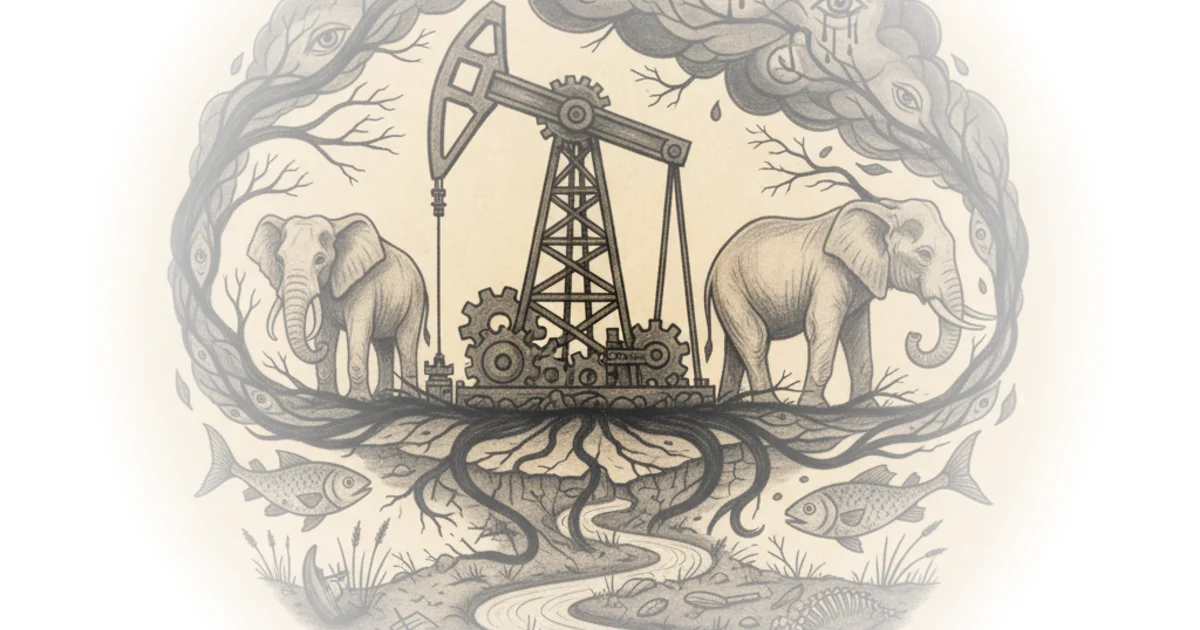
The documentary excels in communicating just how interconnected this landscape is. The Okavango is not simply a scenic wetland; it is the hydrological engine for an enormous stretch of otherwise arid Kalahari Desert. The pristine water flowing from Angola's highlands sustains what the film calls "Africa's greatest concentration of wildlife," from savannah elephants to endangered African wild dogs. The elephants themselves function as ecological architects, carving the channels through which floodwaters travel, creating the mosaic of islands and micro-ecosystems that define the delta.
The engineers however, the ones who keep everything in shape, are the majestic savannah elephants. They come to the so-called panhandle for water and act as a sort of landscape architect, carving channels and leaving behind a mosaic of rivers for a rich and diverse ecosystem.
ReconAfrica's licensed exploration areas sit directly athwart elephant migration corridors, sandwiching and abutting three national parks. The potential for infrastructure sprawl, including rigs, pipelines, pumping stations, and roads, to sever these corridors is not speculative; it is the predictable consequence of any significant petroleum development in the region. Africa's largest remaining population of savannah elephants depends on uninterrupted movement between water sources and feeding grounds. Disrupting that movement would cascade through the entire delta ecosystem.
The Fracking Question
Perhaps the most contentious element of the story is whether ReconAfrica intends to use hydraulic fracturing. The company's official position is unambiguous: no fracking. Yet the documentary marshals considerable circumstantial evidence to the contrary. Investor presentations have referenced "unconventional play" in the fine print. The company's own commissioned research report includes unconventional extraction scenarios. And the leadership team reads like a fracking all-star roster.
Scott Evans, ReconAfrica's CEO, has decades of technical and operational experience fracking oil in the USA. While working for Halliburton, Craig Stanky was involved in several fracking activities in Spain and Mexico. And then Nick Steinsberger, the so-called father of fracking, he's the SVP for drilling and completions.
Hiring the inventor of slick water fracking as your senior vice president for drilling while insisting that fracking is off the table requires a generous reading of corporate intentions. The documentary notes that ReconAfrica has quietly scrubbed the word "fracking" from its vocabulary without actually changing its production estimates, which remain predicated on unconventional extraction. The Namibian government has stated it has not granted permission to frack, only an exploration license, but exploration licenses have a way of becoming production licenses when money and political pressure are applied.
A Counterpoint Worth Considering
It is worth noting what the documentary does not fully explore. Namibia and Botswana are sovereign nations with their own development priorities, and petroleum revenue could fund infrastructure, education, and healthcare in some of the poorest communities on the continent. The villagers who woke up to find a drilling tower in their midst may have legitimate grievances about consultation and consent, but blanket opposition to resource extraction in developing nations can itself carry a whiff of paternalism. The question is not simply whether to drill, but who benefits, who decides, and what safeguards exist.
That said, the environmental risks of fracking in a semi-arid region dependent on a single river system are categorically different from drilling in, say, the Gulf of Mexico. Over a million gallons of water are required to frack a single well. The chemicals involved can contaminate groundwater through inadequately constructed wells or improper wastewater storage. In a region where water is already the defining scarcity, the calculus is stark. There is no redundancy here, no backup water supply. If the Okavango's water is poisoned, the ecosystem collapses.
The Fraud Allegations
The documentary devotes significant attention to a May 2021 National Geographic report, based on a leaked document from a whistleblower, alleging that ReconAfrica engaged in securities fraud. The company's valuation quintupled to over one billion dollars on the strength of claims about test well results that, at the time, were supported by essentially no seismic data.
According to the same report, the company raised millions through fraudulent means, with several top executives selling their shares while ReconAfrica promoted their stock through fake or invalid announcements.
The practice described, known as stock scalping or pump-and-dump, is a serious crime. The documentary is careful to note that no executives have been charged or convicted, and that the allegations originate from a single leaked document. Still, the pattern is troubling: bold public claims about an "incredible business opportunity," stock prices soaring on thin evidence, and insiders reportedly cashing out. Whether ReconAfrica is an environmental villain, a financial scam, or both, the local ecosystem and indigenous communities bear the risk either way.
Indigenous Communities as Afterthought
The documentary mentions the indigenous San people only in passing, which is itself revealing. The San, among the oldest continuous cultures on Earth, have been dispossessed repeatedly over centuries. Oil exploration in their homeland follows a depressingly familiar pattern: decisions made in boardrooms in Calgary and offices in Windhoek, with the people who actually live on the land learning about it when the drilling tower appears. Free, prior, and informed consent, the international standard for indigenous land rights, appears to have been treated as an afterthought at best.
The Deeper Pattern
What makes this story resonate beyond southern Africa is its typicality. A junior resource company secures exploration rights in a developing country, makes extravagant claims to investors, begins operations before the full environmental picture is understood, and relies on the gap between exploration licenses and production regulations to advance its position. The playbook is well-established from the Niger Delta to the Ecuadorian Amazon. The outcomes for local ecosystems and communities are, historically, grim.
It's one of the very few places left on earth where giants can roam freely, where their offspring can trust in the future of their species. It's the crown jewel of this planet and its future is entirely in our hands.
The documentary's emotional appeal is effective precisely because it is grounded in ecological fact. The Okavango Delta is not merely beautiful; it is functionally irreplaceable. There is no engineering substitute for two trillion gallons of annual freshwater flow sustaining a web of interdependent species across thousands of square kilometers. Once disrupted, such systems do not recover on human timescales.
Bottom Line
Caspian Report presents a case that is simultaneously an environmental alarm and a financial cautionary tale. ReconAfrica's Kavango Basin venture threatens one of Earth's most significant remaining wilderness areas while exhibiting the hallmarks of speculative resource plays that enrich insiders at the expense of investors and local communities alike. Whether the greater danger is ecological devastation or securities fraud remains an open question, but for the elephants, the San people, and the delta itself, the distinction is academic. The drilling has already begun.