Jeannine Ouellette reframes the creative process not as a solitary act of genius, but as a biological imperative rooted in our deepest evolutionary needs. By weaving together ancient philosophy, modern neuroscience, and the visceral reality of social rejection, she makes a startling claim: the pain of isolation is not metaphorical, but a physical wound that reshapes the very architecture of our art and our selves.
The Biology of Belonging
Ouellette anchors her argument in the fundamental nature of human connection, moving quickly from Aristotle's definition of humans as "political animals" to the hard science of neurochemistry. She writes, "Our capacity for sustained emotional attachment to other members of our species reflects a neurochemistry that makes connection, for us, feel as essential as food." This is a crucial pivot; she is not asking readers to be more social for the sake of politeness, but to recognize that bonding is a survival mechanism as critical as breathing.
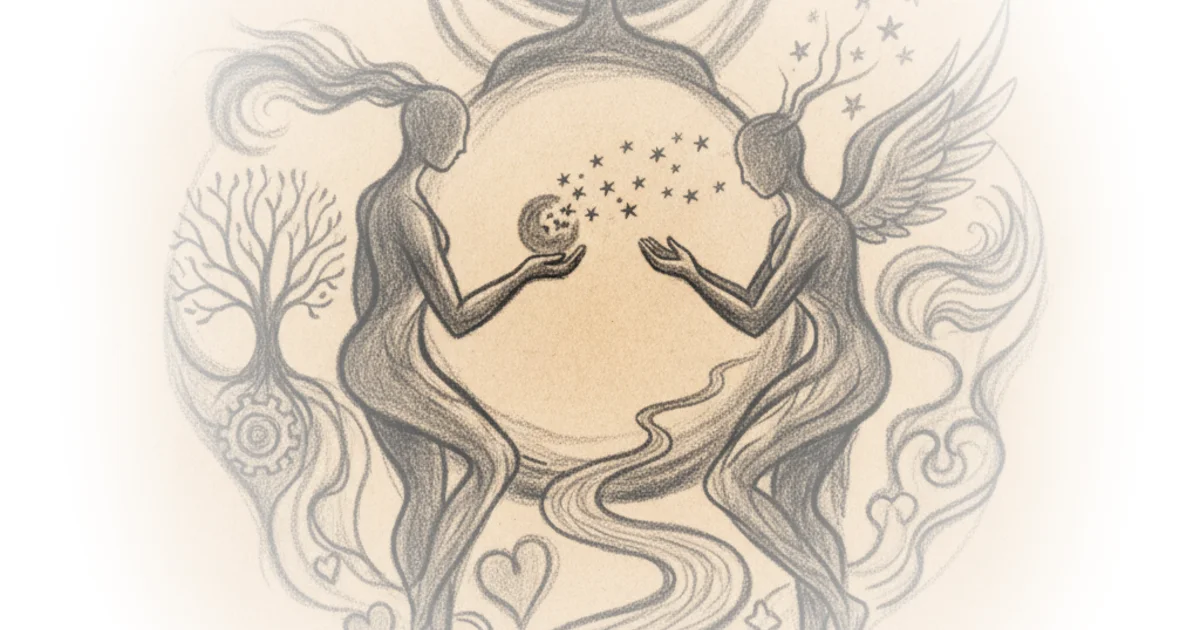
The essay draws a direct line from the evolutionary purpose of oxytocin—originally for birth and lactation—to our modern need for friendship. Ouellette notes that the hormone "first evolved to facilitate the muscle contractions of birth and lactation... But evolution expanded that system for something larger: the warm, pull toward other beings." This framing effectively strips away the sentimentality often associated with "love," replacing it with a functional, biological necessity. The argument holds up well against the backdrop of the "Cyberball" experiments she references, where the brain's reaction to being left out of a game is indistinguishable from physical trauma.
The pain of rejection and heartbreak feel the same as physical wounds, and we know this unequivocally based on the signals in our brains.
This biological reality explains why the pandemic's enforced isolation was so devastating. Ouellette observes that "loneliness, sustained long enough, damages the body as much as smoking a pack of cigarettes a day." While some might argue that this equates a psychological state with a carcinogen too loosely, the underlying data on cortisol levels and immune suppression supports the severity of the claim. The author uses this to dismantle the myth of the lone genius, suggesting that "no matter how introverted we might be, human beings are not built for emotional solitude."
The Neuroscience of Rejection
The piece deepens its analysis by examining the specific neurological pathways of social pain. Ouellette details the 2003 study by Dr. Naomi Eisenberger, which utilized functional MRI to show that social exclusion activates the dorsal anterior cingulate cortex. This is the same region linked to the sensation of physical pain. The historical context here is vital; the study was prompted by a real-world "waiting room" incident where a psychologist was excluded from a Frisbee game by strangers, an event that felt "shocking" and "humiliating."
By connecting this to the broader concept of the anterior cingulate cortex, Ouellette provides a scientific basis for the old adage that "rejection hurts." She writes, "In other words, the idea that 'rejection hurts' isn't a metaphor. The pain is physical." This is the essay's most powerful rhetorical move, transforming a cliché into a medical fact. It forces the reader to reconsider how they treat others, not out of moral obligation, but out of an understanding that social exclusion inflicts genuine, measurable damage.
Critics might note that focusing heavily on the pain of rejection could inadvertently minimize the resilience humans show in the face of adversity. However, Ouellette counters this by introducing the concept of neuroplasticity. She reminds us that while our earliest attachments form a template, "the original architecture and perception shaped by our childhoods can be reshaped by future experience." This offers a hopeful counterbalance to the grim reality of social pain, suggesting that our neural pathways are not fixed prisons but malleable landscapes.
The Mirror Neuron and the Artistic Act
The commentary then shifts to the practical application of these findings for artists and writers. Ouellette argues that because of the mirror neuron system, discovered in macaques in the 1990s and confirmed in humans, we "innately feel what others feel not as a choice or an act of imagination but as a neurological fact." This suggests that the act of writing or observing art is a form of shared experience, a simulation of another's life that occurs automatically in the brain.
She illustrates this with the turbulent but generative relationship between Frida Kahlo and Diego Rivera. Ouellette writes, "I did not know it then, but Frida had already become the most important fact in my life," quoting Rivera to show how their art and their relationship were "too intertwined to separate." Similarly, she highlights the literary friendship of Ann Patchett and Elizabeth McCracken, noting that their decades-long exchange of pages is "one of the conditions that makes their work possible."
We are shaped by relationships, formed within them carried by them into every room we enter, every interaction we undertake, and every page we write.
This section effectively bridges the gap between hard science and the messy reality of creative work. It suggests that the "sticky, very human work" of relationships is not a distraction from art, but the very fuel for it. The author posits that "long relationships can give us depth, brief ones might spark intensity, difficult ones lead to certain insight and self-knowledge, and lost ones expose us to the softening of grief." This nuanced view acknowledges the complexity of human bonds without romanticizing them.
Bottom Line
Ouellette's most compelling contribution is her synthesis of neuroscience and creative practice, proving that our relationships are not just emotional supports but the structural foundation of our identity and our art. The piece's greatest strength lies in its refusal to treat loneliness as a mere mood, instead presenting it as a physiological threat that demands a creative and communal response. The only vulnerability is the risk of overwhelming the reader with the weight of this biological responsibility, though the promise of neuroplasticity offers a necessary path forward.
The pain of rejection and heartbreak feel the same as physical wounds, and we know this unequivocally based on the signals in our brains.