Dan Carlin has a way of making the past feel urgently personal — and in this episode, he's using 1968 to explain why we should be paying attention to what's happening now. His argument isn't simply that history matters; it's that history doesn't teach lessons the way people think it does. The Munich example is his proof.
Carlin opens with a sharp observation about how we treat the humanities: "the value of a history education among several Humanities... are sort of at a low E because a whole bunch of factors." He's pointing at something real — the practical calculus of student loans, the ROI mindset that treats education like an investment rather than a formation. But it's his deeper point about how history works that's most interesting here.
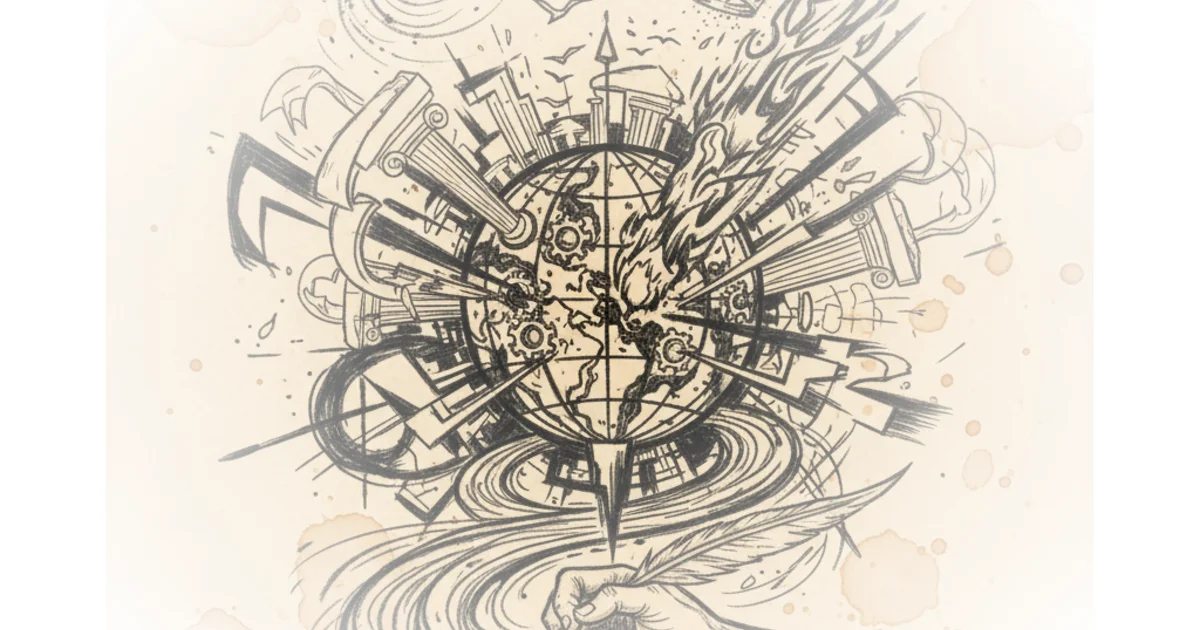
Carlin writes that "there are bazillion variables and all those variables make the situation you know that you're using that 1938 example to you know make an argument." This is his core thesis: people assume history repeats itself predictably, but actually every situation involves millions of variables that make it unique. The Munich argument "doesn't work that way" — it's a variable, not a rule.
Carlin then delivers what might be the most important correction in this episode. He quotes George Santayana incorrectly used by almost everyone who invokes it: "those who cannot remember the past are condemned to repeat it." But here's what he finds interesting — the actual quote is about "progress far from consisting in change depends on retentiveness." He's pointing out that the famous version we all use isn't even the real Santayana. It's a misquote that's been flattened by decades of careless repetition.
History doesn't teach lessons but it does teach what can happen — because it's happened before.
Carlin's "put your hand on a hot stove" analogy is his most effective device. He argues that history teaches us what's possible — not as prediction, but as warning. When you burn your hand, the lesson isn't "stoves are dangerous always." It's "this particular kind of heat in this particular circumstance burned me." The scar lasts, but context matters more than rule.
He's now drawing parallels between 1968 and current political chaos: Biden dropping out, Trump assassination attempt, a country "pregnnant with disaster" — his word is "pregnant." He's asking whether we can see the reflection of that period in what's happening now. He writes about how he noticed these parallels back in 2013-2014, nearly a decade ago.
Carlin's use of Thomas Jefferson is deliberately provocative: "I hold it that a little Rebellion now and then is a good thing." He's setting up the revolutionary period he's going to discuss — 1967 through 1972. The country experienced more than 150 violent riots in one year, more than 170 bombings or bombing attempts.
Critics might note that Carlin's argument about history not teaching lessons could be read as counsel for inaction. If every situation is unique because of those bazillion variables, why study anything? His response is that history teaches what can happen — it's experiential, not predictive. The hand on the hot stove analogy works, but some readers may want him to go further in explaining exactly which "stressors" from the 1950s are repeating now.
Carlin's strongest move in this episode is the Santayana correction — he's doing something almost nobody does with that quote, which is actually about progress depending on memory retention. It's a subtle point that reveals how shallow our historical thinking usually is.
The funhouse mirror reflection between 1968 and today isn't just academic. The assassination of Kennedy in 1963, the country exploding by 1968 — Carlin is arguing we can see what's coming because we've seen it before. But he's careful: "I could be completely misreading everything." That's the honest admission that makes this worth listening to.
Bottom Line
Carlin's argument about history not teaching lessons is actually his strongest defense of why history matters. The Munich example reveals how shallow popular historical thinking really is — people reaching for simple causation when reality is infinitely more complex. His biggest vulnerability is that he's sometimes arguing against the very act of learning from history while simultaneously using 1968 as a lens to see today. That tension never fully resolves, and it's where this piece is most alive.