Natural Selections delivers a rare, visceral account of field research that transcends the typical scientific memoir by exposing the raw vulnerability of human ingenuity against the indifferent power of nature. Rather than focusing on data points or species counts, the piece zeroes in on a single, terrifying moment where a falling tree threatens to crush a research team's only shelter, forcing them to confront the stark reality that their survival depends on improvisation rather than institutional support.
The Illusion of Control
The narrative begins with a sudden, violent disruption of the rainforest's rhythm. Natural Selections reports, "First there was just noise, a thunderous, splintering collapse of a massive old tree, breaking the expectations of daytime rainforest sounds." This immediate shift from the mundane to the catastrophic sets the stage for a story about the fragility of human constructs in the wild. The piece argues that the team's initial reaction reveals a deep-seated, almost comical reliance on Western problem-solving methods that simply do not translate to the local context. When the guide, Augustin, suggests, "What we must do... is go into town, acquire a team of men and a lot of good rope," the authors note the absurdity of the proposal. The editors highlight the disconnect: "Strong rope couldn't be found on Madagascar. Certainly not in town... with no planes due for several days."
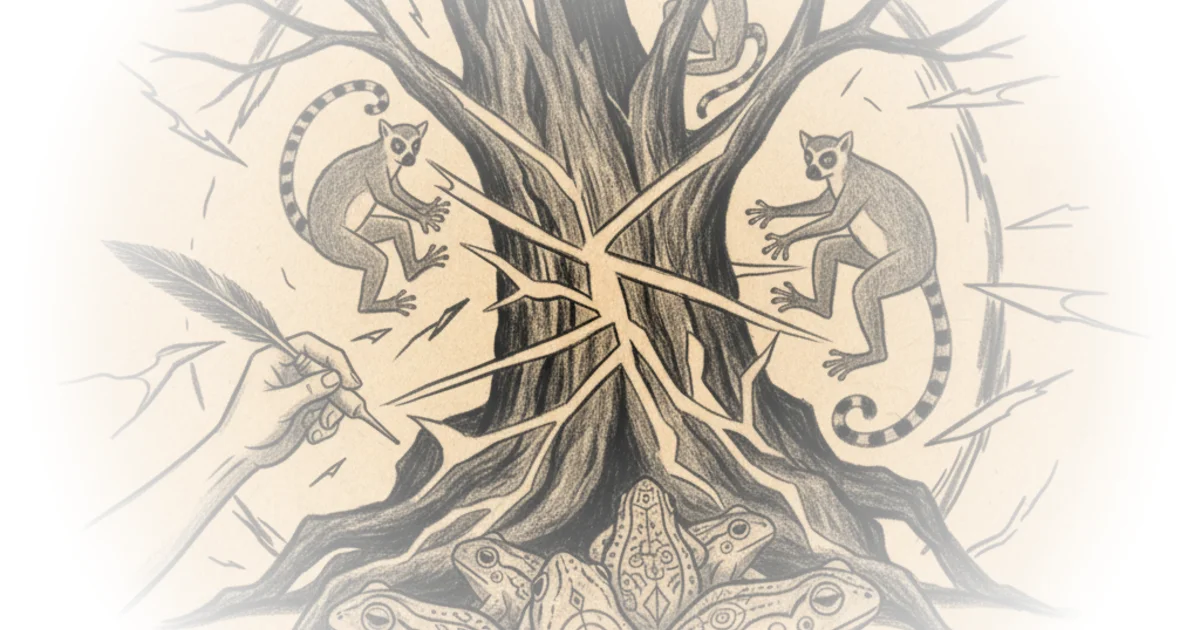
This moment serves as a powerful critique of the assumption that resources are universally available. The team realizes they are isolated, with "only what northeastern Madagascar could offer, which mostly amounted to brain power and a lot of rice." The commentary here is sharp: the piece effectively dismantles the romanticized notion of the expedition, replacing it with a gritty reality where a 50-foot length of climbing rope, initially dismissed as unnecessary baggage, becomes the single most critical piece of equipment on the island. It is a reminder that in remote environments, preparedness is not about having the right tools from a catalog, but about carrying the unexpected.
The tent platform had to be saved, solely with our ingenuity and strength. We had nowhere else to sleep.
Improvisation as Survival
As the team attempts to secure the precarious tree, the narrative shifts to a study in cultural dynamics and resourcefulness. The piece details how the local guides, initially hesitant, reveal a depth of skill that the researchers had overlooked. Lebon, described as "usually quiet and inactive," becomes the hero of the hour, wielding an axe that had been hidden from view for months. The editors note the surprise: "Lebon pulled an axe from out of thin air, or so it seemed." This revelation underscores a central theme: the researchers are not the sole experts in the room. The local knowledge and physical prowess of the Malagasy team members are the true assets that allow the operation to proceed.
The plan to cut the tree in increments, supported by a rope tied to a distant tree, is described with a dose of grim humor. "We rated the probable success of this plan at about 40%. But we didn't have a better one." This admission of uncertainty is refreshing in a genre often dominated by confident posturing. The piece captures the tension of the moment, where a wrong move could result in the destruction of their home or, worse, death. The rain begins to fall, adding another layer of danger, yet the team presses on, driven by the necessity of finding shelter.
Critics might argue that the narrative leans too heavily on the "white savior" trope, with the researchers ultimately directing the rescue. However, the text counters this by emphasizing that the solution relied entirely on local tools (the axe) and local labor (Lebon's strength), with the researchers merely providing the rope and the plan. The dynamic is one of forced collaboration, where the hierarchy of expertise is flattened by the immediate threat.
The Cost of Displacement
When the initial attempt is halted by rain, the team is forced to retreat to the "lab," a dilapidated structure that offers little protection. The description of their new living conditions is stark and unglamorous. Natural Selections writes, "Sleeping in a tent inside a rotting building, where rats come out at night and the air is stifling, ten degrees hotter even than the tropical air just outside, is not my idea of a good time." This passage strips away any remaining romance of field research, replacing it with the physical discomfort and psychological toll of displacement.
The piece effectively uses this discomfort to highlight the resilience required in scientific work. The researchers are not just observing nature; they are fighting to maintain a foothold within it. The final scene, where the narrator returns from the field to find the platform still standing, provides a moment of relief, but the victory is tempered by the knowledge of how close they came to disaster. The editors conclude the chapter with the image of the platform, "Still standing," a testament to the team's ability to adapt and survive against the odds.
Bottom Line
The strongest element of this piece is its unflinching portrayal of the gap between academic preparation and the chaotic reality of field work, where a single piece of rope can mean the difference between life and death. Its biggest vulnerability lies in the potential for the narrative to romanticize the struggle, though the text largely avoids this by focusing on the physical and mental exhaustion of the participants. Readers should watch for how this theme of improvisation continues to shape the team's approach to their research in the coming chapters, as the line between observer and survivor blurs.