Jonathan Rowson challenges the very framework he helped popularize, arguing that the phrase "a time between worlds" has become a conceptual trap that paralyzes action rather than inspiring it. While many thinkers use this idea to describe the collapse of modernity, Rowson suggests we are suffering from "conceptual fatigue" that turns a profound historical diagnosis into a hollow tribal slogan. This is not just an academic adjustment; it is a plea to stop waiting for the future to arrive and start generating the new realities we desperately need.
The Trap of Descriptive Ontology
Rowson begins by acknowledging the intellectual weight behind the "time between worlds" concept, originally developed by Zak Stein and grounded in the metahistorical models of Peter Turchin and Immanuel Wallerstein. The premise is that we are living through a rare convergence of secular cycles and cultural evolution where the old order is dying and the new one has not yet formed. However, Rowson admits that despite the theory's robustness, he feels a growing "incredulity, discomfort, and perhaps even vainglory" when he repeats the phrase.
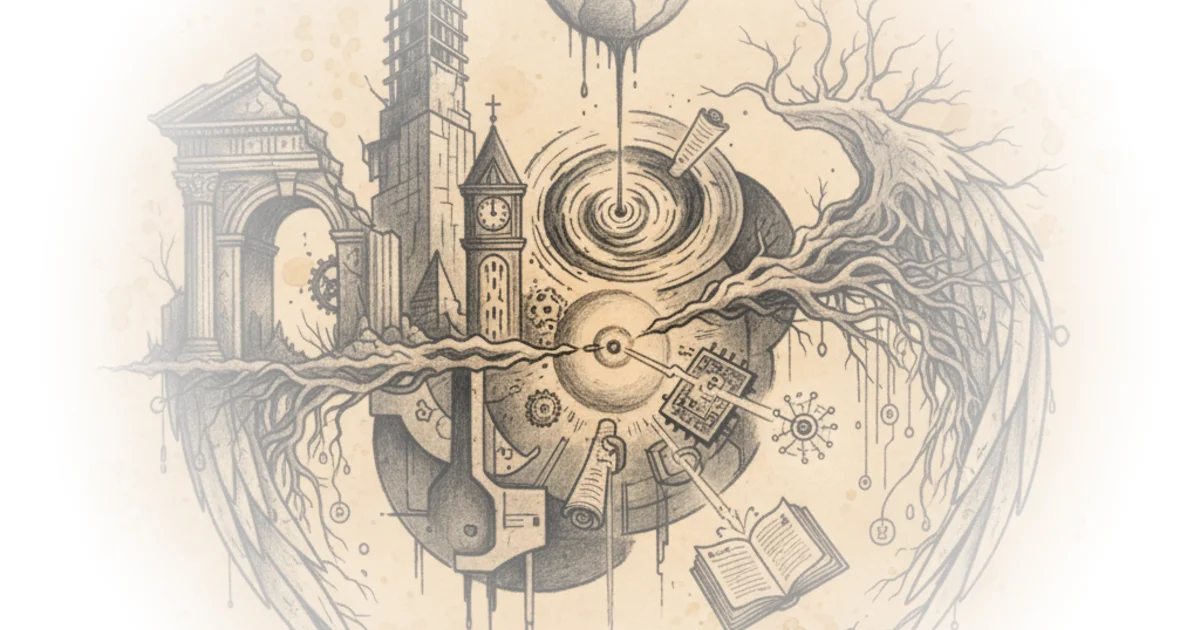
He identifies a critical flaw in how the idea is currently deployed: it has shifted from a tool for understanding to a "coercive framing." Rowson writes, "To function with a time between worlds as a premise is a kind of 'conceptual practice'... take away the idea in terms of which those norms and reasons are articulated, and the practice collapses." The danger, he argues, is that this practice has become a way to dismiss the urgency of the present. He observes that the phrase can sound like a command to acquiesce to the end of modernity, as if we are "kicking modernity out the door and on to the street, as if taking control in a house party that got a bit wild."
This framing is effective because it exposes the performative nature of much contemporary intellectual discourse. By labeling the current era as "between worlds," thinkers can feel they are part of an elite group that "sees clearly," while simultaneously absolving themselves of the responsibility to act in the messy, incomplete present.
"We should not conflate aesthetic reactions to the use of terminology with the intellectual coherence of the underlying idea."
Critics might argue that Rowson is being too harsh on a metaphor that has successfully mobilized a global network of thinkers. However, his distinction between "descriptive" and "generative" ontologies offers a necessary correction. A descriptive ontology simply catalogs the chaos, saying, "this is how things are." A generative ontology, which Rowson advocates for, seeks to "produce new realities." The former risks fatalism; the latter demands moral imagination.
The Aesthetic of Liminality
The piece also tackles the "aesthetic dimension" of the problem. Rowson notes that ideas have half-lives, and the phrase "time between worlds" has lost its power through overuse. It has become a "conceptual modifier" used to confer false gravitas on mundane activities, leading to the comic potential of "Eating bananas in a time between worlds." This over-familiarity has dulled the edge of the concept, making it feel less like a profound insight and more like a tired cliché.
Furthermore, Rowson highlights the emotional toll of this framing. He recounts a conversation in Mexico City where a translator described the Nahuatl concept of Nepantla (betweenness) as distinctly negative. This challenges the Western tendency to romanticize the "in-between" as a space of potential. Rowson writes, "Regardless of the objective basis of the between-worlds claim, some find the idea of being 'in-between' inherently discomforting, perhaps optional, or even gratuitous, and they prefer not to start from there: 'I am not between anything. I am here! Now! Let's go!'"
This is a crucial pivot. The romanticization of liminality can easily slip into a "pre-tragic" wishful thinking, where the suffering of the present is justified as merely the "birth pangs of a better world." Rowson warns against this, comparing it to the absurdity of Beckett's Waiting for Godot. If we are merely waiting for the new world to emerge, we risk becoming passive observers of our own demise.
"The premise of this series is that the myriad forces that shape global history are now burgeoning to such an extent that our conventional patterns of collective understanding, sentiment and expectation are failing to make sense of how we should act."
Rowson argues that the failure of our current "social imaginary"—a term borrowed from Charles Taylor to describe the shared understanding that makes society possible—is the real crisis. We are struggling to make sense of a world where metrics like GDP and IQ seem "quaint" and where international law looks "insipid" against transnational financial power. Yet, he insists that within this disorientation, there is an "ambient potentiality" arising. New patterns like bioregionalism and post-growth economics are emerging, but they lack the political capital to coalesce.
From Caterpillar to Butterfly
The most compelling part of Rowson's argument is his re-evaluation of the "ending" of modernity. He questions whether "ending" is the right word, invoking the metaphor that "what a caterpillar sees as the end of the world, a wise person sees as a butterfly." However, he adds a necessary caveat from philosopher Bonnitta Roy: "the caterpillar has to die to allow for the transformation to happen."
This distinction is vital. It acknowledges the genuine loss and anxiety felt by millions, rather than glossing over it with optimistic metaphors. Rowson notes that "many millions of people do not feel it at all," which creates a dangerous disconnect between the intellectual elite and the general populace. The shift from "modernity" to something else is not a clean trade-in; it is a chaotic, epochal transformation that encompasses subjective, objective, and inter-subjective realities.
"These philosophical considerations may appear niche, but they are about our place in the evolution of consciousness and history's great cosmic unfolding."
Rowson's analysis holds up well because it refuses to offer a simple solution. Instead, it calls for a shift in "conceptual practice." We must move from merely describing the collapse to actively generating the new. This requires a "generative ontology" that does not just wait for the future but enacts it in the present. The danger of staying in the "descriptive" mode is that it becomes a "holding pattern" rather than a "direction."
Bottom Line
Rowson's strongest contribution is his diagnosis of how intellectual language can become a barrier to action, turning a profound historical moment into a passive waiting room. The piece's greatest vulnerability lies in its reliance on abstract philosophical distinctions that may be difficult for non-specialists to translate into immediate political strategy. Readers should watch for how the "generative" approach Rowson advocates actually manifests in policy and culture, moving beyond the comfort of the "time between worlds" label to the hard work of building the new.