Cory Doctorow delivers a stinging indictment of the current administration's economic paralysis, arguing that the pursuit of lower costs for working families is structurally impossible without dismantling the wealth of the very oligarchs who fund the political machine. The piece's most provocative claim is not that the administration lacks the power to fix prices, but that it possesses the power and simply refuses to use it because every potential solution requires goring a protected ox owned by the ruling class.
The Oligarchic Conundrum
Doctorow frames the situation as a zero-sum game between the electorate and the elite. He writes, "You can keep billionaires happy, or you can fight the cost of living crisis, but not both." This binary sets the stage for a deeper analysis of why populist rhetoric often fails to translate into populist policy. The author argues that the administration's base demands relief from inflation, yet the administration's actions—such as union-busting and immigration crackdowns—only exacerbate the economic strain on those same workers.
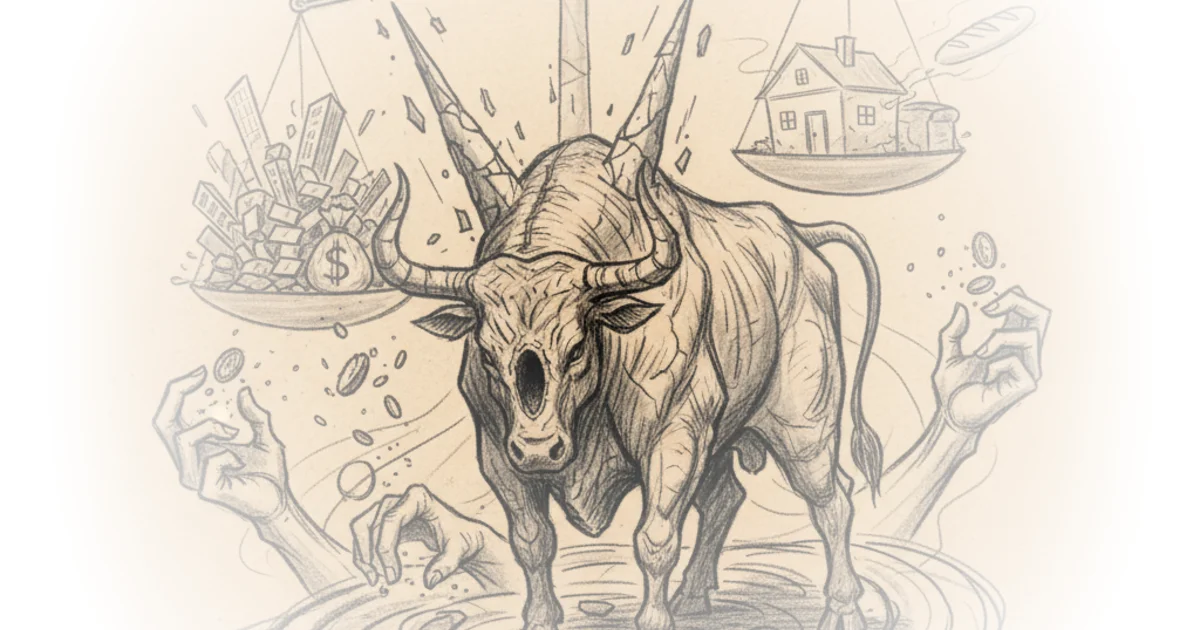
The core of the argument rests on the idea that the cost of living crisis is not a natural market phenomenon but a manufactured one. "The oligarchs' wealth bonanza caused the cost of living crisis," Doctorow asserts, noting that "alleviating our suffering will reduce their pleasure." This framing is effective because it shifts the blame from abstract economic forces to specific actors with agency. Critics might argue that global supply chains and external shocks play a larger role than domestic price-fixing, but Doctorow's evidence suggests that domestic monopolies are the primary drivers of recent inflation spikes.
"Trump would dearly love to find an ox he can safely gore, but all the good oxen are owned by his oligarch chums."
The Mechanics of Price Gouging
Doctorow moves from theory to specific case studies to illustrate how these "oxen" are protected. He points to the egg market, where Cal-Maine, a monopolist controlling the vast majority of egg brands, jacked up prices despite stable supply costs. This connects directly to the broader concept of enshittification, where platforms and processors extract maximum value from users and suppliers. The author notes that "grocery store owners hold earnings calls with their investors where they boast about the fact that they can raise prices far in excess of their increased costs."
This section is particularly damning because it highlights the transparency of the fraud. Companies are not hiding their profits; they are celebrating them. Doctorow writes, "They boast about their 'personalized pricing' swindles, whereby they use surveillance data to figure out how desperate you are and jack up the prices you see in their apps." The administration's failure to act on these clear violations of antitrust principles reveals the depth of the regulatory capture. While some might suggest that market competition will eventually correct these prices, the consolidation of the industry makes that unlikely without aggressive government intervention.
The Meat Cartel and the Agri Stats Scandal
Perhaps the most detailed evidence comes from the meatpacking industry, where four major packers control 85% of beef processing. Doctorow explains how these companies use a "price consultancy" called Agri Stats to coordinate price hikes without explicitly meeting to fix prices. "Every week, the packers send a detailed list of all their costs and prices into Agri Stats, and Agri Stats 'advises' them all to raise all their prices at once." This mechanism allows for illegal collusion to be laundered through a third party.
The administration's response to this scandal is where the argument reaches its peak. Despite the Biden Department of Justice bringing a clear antitrust case against Agri Stats, the current administration settled the case in a way that effectively rewards the cartel. Doctorow writes, "Under the terms of the settlement, Agri Stats must 'allow' restaurants, farmers, and other parts of the supply chain to pay it for the data it consolidates. This will allow more parties to collude to rig prices." The result, as David Dayen notes, is that the company has been "sentenced to make money." This outcome underscores the futility of relying on the executive branch to police the very industries it is beholden to.
"Trump has the power to put a stop to all of this, but still, he can't, because his oligarch pals would squeal, and when they squeal, Trump jumps."
The Path Forward
With the federal government seemingly paralyzed by its own dependencies, Doctorow looks to state-level actors for a solution. He highlights the Tunney Act, which gives state Attorneys General the power to challenge federal settlements that are not in the public interest. "There are dozens of Democratic state Attorneys General who can kill Trump's sweetheart deal for Agri Stats using the Tunney Act," he notes. This is a crucial pivot in the argument, moving from a critique of federal inaction to a potential strategy for state-level resistance.
However, the political will for such action remains uncertain. Doctorow acknowledges that while it would be "very good politics" for these officials to intervene, the path to political power in America often requires navigating the same oligarchic pressures. The piece concludes with a sobering realization: the administration's inability to address the cost of living is not a failure of competence, but a feature of the system.
Bottom Line
Doctorow's strongest argument is the unmasking of the administration's "fruitless search" as a deliberate choice to protect oligarchic wealth over working-class stability. The piece's biggest vulnerability is its reliance on state Attorneys General to fill the void left by federal inaction, a strategy that may face its own legal and political hurdles. Readers should watch for whether state-level challenges to the Agri Stats settlement gain traction, as this will be the true test of whether the cost of living crisis can be addressed outside the current federal framework.