Matthew Yglesias reframes the modern Democratic Party not as a collection of interest groups, but as the realization of a specific ideological vision first articulated by Jesse Jackson decades ago. The most surprising claim here is that the party's current structure is the direct result of a failed 1988 primary campaign, suggesting that history often bends toward the vision of the outsider long after the insider has won the nomination.
The Cost of Coalition Building
Yglesias begins by grounding his analysis in the messy, often painful reality of the 1980s, specifically the friction between Black political leaders and Jewish liberals. He notes that New York served as "essentially the Waterloo of Jesse Jackson's primary campaign," where a "solid wall of Jewish hostility" led by Mayor Ed Koch derailed his momentum. This hostility was rooted in Jackson's 1979 trip to Beirut to meet with the Palestine Liberation Organization leadership, an act that was "extremely spicy" before the Oslo Accords reshaped the diplomatic landscape.
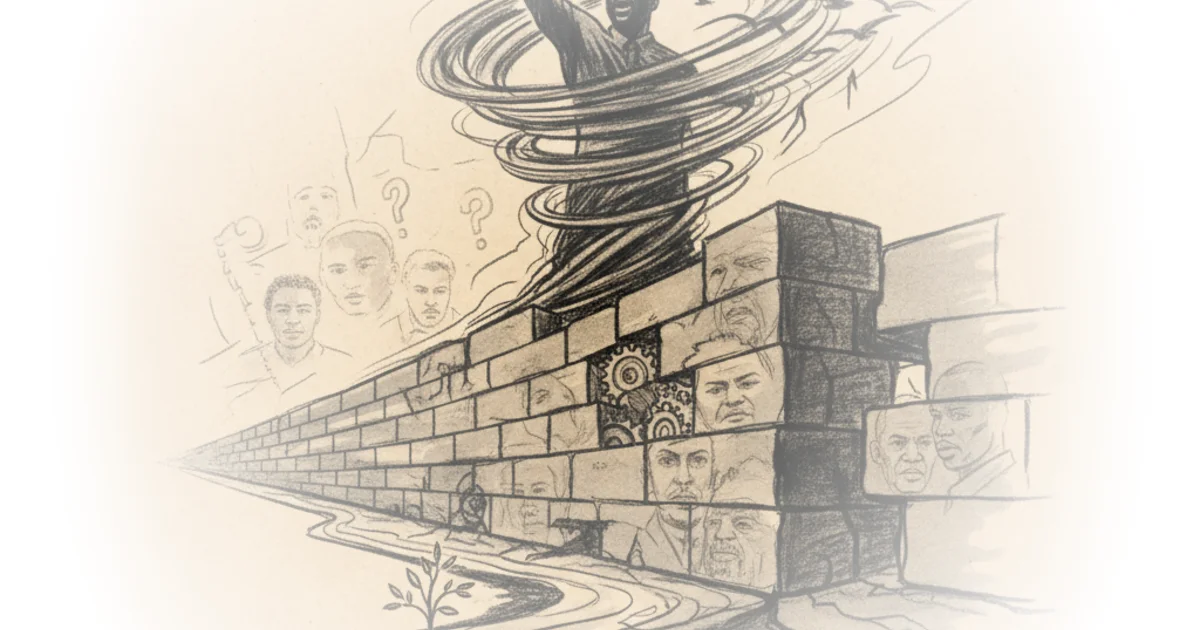
The author highlights how Jackson's struggle reflected a deeper theoretical conflict: whether to follow the "logic of a coalition logroll with liberal American Jews" or the "logic of anti-colonial theory, which links Palestinian and Black liberation." This tension was not merely academic; it had real-world consequences. Jackson's campaign was further damaged by the revelation of his private use of slurs and his association with Louis Farrakhan, a figure whose influence on Black nationalism is explored in companion deep dives on Operation Breakthrough. Yglesias argues that while Jackson "never pivoted to Lewis/Jeffries-style pro-Israel politics," he successfully "mended fences" later in life, earning tributes from establishment figures like Rahm Emanuel and Chuck Schumer.
This historical context is crucial because it illustrates the difficulty of holding a coalition together when moral imperatives clash. Critics might note that Yglesias glosses over the specific pain caused by the slurs Jackson used, focusing instead on the eventual reconciliation. However, the author's point remains valid: the arc of history has bent toward Jackson's conception of the party, even if the specific policy debates on the Middle East remain unresolved.
"The perception that Jackson was antisemitic dealt his campaign a blow and helped crush his momentum."
The "Goldwater Moment" That Didn't Happen
The core of Yglesias's argument is a comparison between the Republican and Democratic parties. He observes that the right successfully executed a "Goldwater moment," creating a coherent ideological vehicle starting with the founding of National Review in 1955 and culminating in Ronald Reagan's 1980 victory. In contrast, the Democrats of the 1980s remained a "loose, largely non-ideological set of coalitions."
Yglesias writes that Jackson, in his 1984 convention speech, argued that "we cannot be satisfied by just restoring the old coalition" and that Democrats needed to become an ideological party that would "dream of a new value system." The author suggests that while Jackson lost the nomination, he effectively laid the blueprint for the party's future. The establishment forces controlled the party for decades, yet the modern Democratic Party is "clearly the one that Jackson called for in his campaigns."
This framing is effective because it challenges the narrative that the party is simply a reaction to the right. Instead, Yglesias posits that the party has been actively constructing a "counter-ideology" to match the conservative movement. He notes that Bernie Sanders, who endorsed Jackson in 1988, came close to achieving a similar "Reagan moment" in 2016, but the establishment held firm.
"The establishment was never toppled by progressive insurgents, but this is very much the blueprint for 21st century Democrats."
Sewing the Ideological Quilt
Perhaps the most evocative section of the piece is Yglesias's analysis of Jackson's 1988 metaphor of the quilt. Jackson described his grandmother sewing a blanket from scraps, a "thing of beauty and power and culture," and applied this to the political coalition. Yglesias quotes Jackson's speech directly: "Farmers, you seek fair prices and you are right — but you cannot stand alone... Women, mothers, who seek Head Start, and day care and prenatal care on the front side of life, rather than jail care and welfare on the back side of life, you are right — but your patch is not big enough."
Yglesias argues that the modern party has successfully "constructed an ideological quilt" that binds these disparate groups together. This is not just a list of grievances but a unified vision. The author points out that the fundraising landscape has shifted, with small donors and even large donors now holding views that are "much more liberal than Democratic citizens on social issues." This structural change has allowed the progressive agenda to thrive in ways it couldn't in the 1980s.
However, Yglesias also offers a sharp critique of the current progressive leadership. He suggests that because the party has largely adopted Jackson's vision, activists on the outside are "asking for more" without realizing they have "won the battle." He writes, "If the leaders of the party are actually going to do what you tell them, then you need to be a little more careful and responsible."
"The disagreements are marginal, and a lot of my biggest criticisms of the quilters stem from the fact that I don't think they've really internalized the fact that they won the battle."
The Human Cost of the Mission
Finally, Yglesias returns to the moral core of Jackson's message, emphasizing that his focus was on poverty and economic justice rather than identity politics. He quotes Jackson's haunting description of his childhood: "I wasn't born in the hospital. Mama didn't have insurance. I was born in the bed at the house... My mother, a working woman, so many of the days she went to work early, with runs in her stockings."
This section serves as a reminder that the "ideological quilt" is not just a political strategy but a response to human suffering. Yglesias notes that Jackson's mission statement was to "feed the hungry, to clothe the naked, to house the homeless, to teach the illiterate, to provide jobs for the jobless." The author suggests that while the specific risks have changed since the Cold War, the mission remains "broadly excellent."
Critics might argue that the modern party has drifted too far into identity politics, losing the class-based focus Jackson championed. Yet Yglesias counters that the current infrastructure of nonprofits and advocacy groups is the direct result of Jackson's vision, even if the execution is imperfect. The piece concludes that the "perfect mission" Jackson outlined is still the guiding light for the party, even if the path to achieving it is fraught with internal debate.
"We are called to a perfect mission … to feed the hungry, to clothe the naked, to house the homeless, to teach the illiterate, to provide jobs for the jobless."
Bottom Line
Yglesias makes a compelling case that the modern Democratic Party is the unintended but successful legacy of Jesse Jackson's 1988 campaign, transforming a loose coalition into a coherent ideological force. The argument's greatest strength is its historical depth, connecting the dots between 1980s primary battles and today's policy landscape, though it risks underestimating the ongoing friction between the party's economic and identity-based wings. Readers should watch for how the "quilt" holds together as the party faces new economic realities that test the limits of this coalition.