The Machinery of Escalation
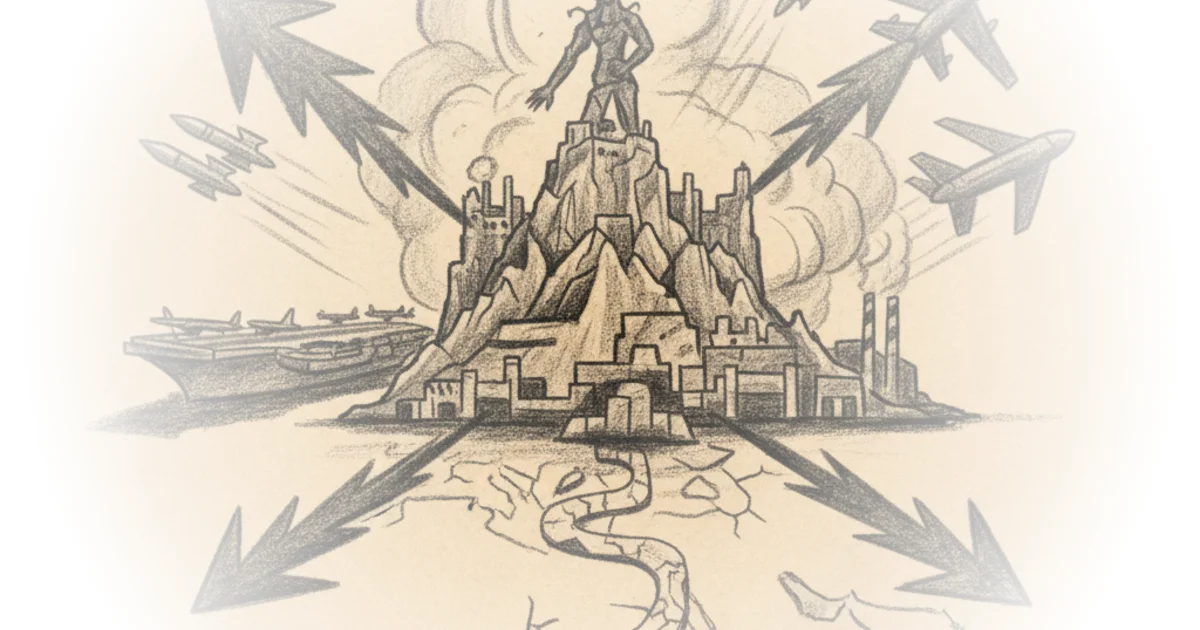
Caspian Report's Shirvan has laid out a detailed operational picture of what a U.S. military strike on Iran might look like, and the analysis cuts through the political noise with a clarity that most commentary lacks. The piece arrives at a moment when the Pentagon is visibly repositioning assets across the Middle East, satellite imagery confirms base evacuations, and diplomatic channels appear to be running on fumes. What emerges is not a prediction of war but a taxonomy of escalation, one that deserves serious scrutiny.
The most important observation in the piece is also the most underappreciated: the absence of a clearly defined American objective. As Shirvan frames it:
The first and foremost question to ask is not what the Pentagon can do, but what it seeks to achieve. Strategy must precede action.
This is the crux of the matter. The Trump administration's goals range from destroying nuclear sites to full regime change, and the distance between those two objectives is enormous. A targeted strike on enrichment facilities is a fundamentally different military operation than an attempt to collapse a government that has survived four decades of external pressure and internal upheaval. Conflating them, or worse, sliding from one to the other mid-campaign, is precisely the kind of mission creep that has defined American military misadventures since Vietnam.
The Nuclear Arithmetic
The report's claim about missing enriched uranium provides the most concrete rationale for military action. According to the analysis, roughly 400 kilograms of 60% enriched uranium were unaccounted for after the first U.S. strike on Iranian nuclear sites. At 90% enrichment, that stockpile could yield enough fissile material for nine nuclear weapons.
As long as that stockpile remains missing, as long as Iran retains even the slightest ability to build a bomb, the war is unfinished.
This framing is useful but incomplete. The leap from 60% to 90% enrichment is technically straightforward, yes, but weaponization involves far more than fissile material. Miniaturizing a warhead, mating it to a delivery system, and establishing a credible deterrent are engineering challenges that Iran has not demonstrably solved. The "nine weapons" figure, while alarming, assumes a linear path from enriched uranium to deployed nuclear capability that ignores significant technical and organizational hurdles. It is worth noting that Western intelligence agencies have repeatedly revised their estimates of Iranian nuclear timelines, and the track record of such projections is mixed at best.
The Assassination Fallacy
One of the stronger sections of the analysis deals with the temptation to pursue decapitation strikes against Iranian leadership. Shirvan correctly identifies why this approach would likely backfire:
Any kinetic attack that kills or removes a figure like the supreme leader or a senior military official would certainly create shock, but it would also play into the Shia Islam martyrdom culture and thereby galvanize unity.
History supports this assessment. The U.S. assassination of Qassem Soleimani in January 2020 produced exactly the dynamic described here: a brief period of international alarm followed by Iranian retaliation and, ultimately, no meaningful change in the strategic balance. The Islamic Republic's institutional depth is routinely underestimated by Western analysts who assume that authoritarian systems depend on individual personalities rather than bureaucratic structures. The IRGC is not a personality cult. It is a sprawling economic, military, and political enterprise with deep roots in Iranian society.
Iran's political machine is highly institutionalized, and the IRGC has a contingency plan to move into position and consolidate control over the clerical security elite.
The parallel to the Venezuelan operation that captured Maduro is instructive but ultimately misleading. Caracas sits near a coastline; Tehran is landlocked and fortified. The logistical impossibility of a helicopter-based extraction operation echoes the ghosts of Operation Eagle Claw, the 1980 hostage rescue disaster that haunts American military planning in the region to this day.
Three Corridors, One Problem
The geographic analysis of potential attack vectors is where the report shines brightest. The breakdown of northern, central, and southern approach corridors is methodical and reflects genuine operational thinking. The northern route through the Caucasus risks Russian detection. The central route through Jordan and Iraq is tested but predictable. The southern corridor via the Indian Ocean offers the most flexibility but requires extensive logistical preparation.
The weight of evidence suggests that it could be a combination of the central and southern corridors.
What the analysis does not fully reckon with is the diplomatic cost of any of these options. Flying through Iraqi airspace without permission, even with stealth aircraft, amounts to a violation of sovereignty that would further erode what remains of the U.S. relationship with Baghdad. The refusal of Saudi Arabia, Turkey, Qatar, and Kuwait to grant airspace access is not merely a logistical inconvenience. It signals that America's regional partners have calculated that the costs of association with this campaign outweigh the benefits. When your closest allies in the region decline to participate, that is not a detail to note in passing. It is a strategic verdict.
The Israeli Variable
Perhaps the most provocative element of the analysis is the scenario in which Israel exploits a post-regime-change power vacuum to obliterate Iran's military infrastructure. The precedent cited is Israel's rapid destruction of Syrian military assets following Assad's fall:
At the fleeting moment of hope, while Iranians celebrate the revolution and the military command is in disarray, Israeli jets will make short work of Iran's air defenses, missile launchers, drone factories. Israel will take out everything regardless of whether the new government is friendly or not.
This scenario is plausible precisely because it aligns with documented Israeli doctrine. But it also illustrates the fundamental contradiction at the heart of any U.S. regime change effort: the day after matters more than the day of. If a new Iranian government emerges only to find its military capacity destroyed by a foreign power, the resulting nationalist backlash would likely produce a regime even more hostile to Western interests than the current one. The argument that this would "paralyze" Iran into geopolitical irrelevance assumes that 88 million people in a resource-rich nation with deep civilizational identity will simply accept permanent strategic subordination. That assumption has never held anywhere it has been tested.
What the Protests Are and Are Not
The report is admirably blunt about the relationship between Iranian street protests and American military planning:
The protests are just a pretext for military action. Iranians in the streets may certainly want democracy, but Trump has no real concern for any of them because ultimately this isn't about promoting democracy or freedom.
This candor is refreshing and necessary. The instrumentalization of democratic movements abroad to justify military operations has a long and inglorious history. Recognizing this does not diminish the courage of Iranian protesters. It does, however, clarify the strategic calculus: the protests provide political cover, not a casus belli. Any analysis that conflates genuine popular grievances with great-power maneuvering is doing a disservice to both.
Bottom Line
Caspian Report delivers a rigorous operational breakdown of how a U.S. strike on Iran might unfold, and the geographic and military detail is genuinely informative. Where the analysis is weaker is on the question of consequences. The piece acknowledges that "half measures won't do" and that sustained campaigns carry enormous costs, but it does not fully grapple with the historical record of American military interventions producing outcomes worse than the problems they were designed to solve. The most dangerous sentence in the entire piece may be the truest: strategy must precede action. The evidence presented suggests that strategy is precisely what remains undefined, and that gap between capability and purpose is where catastrophes are born.