This midweek update cuts through the diplomatic fog to argue that the United States has entered a state of profound strategic paralysis in its dealings with Iran. Phillips P. O'Brien presents a startling thesis: the executive branch is not merely negotiating from a position of weakness, but is actively dismantling its own leverage while fabricating a narrative of victory to mask a total rout. For listeners tracking the true balance of power in the Middle East, this piece offers a rare, unvarnished look at how military overreach and domestic political desperation have combined to force Washington into conceding core strategic interests without a shot being fired.
The Erosion of American Leverage
O'Brien's central argument rests on the observation that the US has exhausted its coercive options. He writes, "The Trump administration has put itself in a position where it cannot go back to the use of military force... and therefore will have to concede most of the main points to the Iranians." This is not a standard diplomatic stalemate; O'Brien frames it as an existential crisis for US influence, noting that he has "never seen the US in such a position of weakness." The author suggests that the administration's earlier threats to "go back to dropping bombs right smack in the middle of their head" were revealed as hollow bluster once Iran called the bluff.
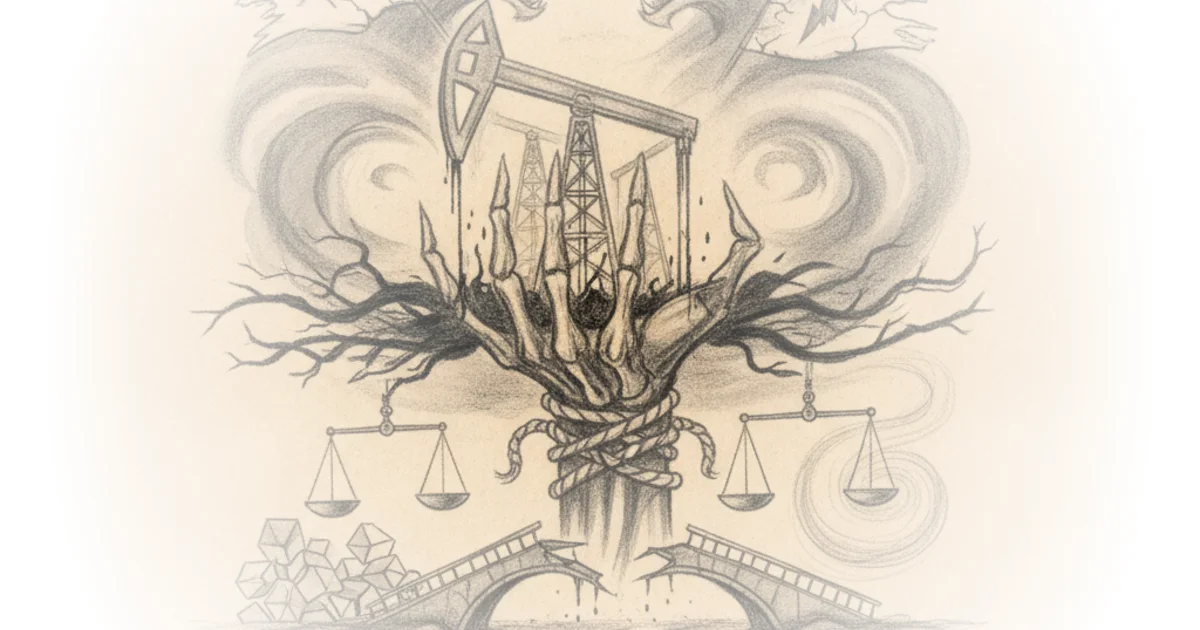
The evidence provided is stark: after Iranian negotiators walked out of face-to-face talks citing "unacceptable threat[s] to their personal safety," the US response was not escalation but retreat. Vice President JD Vance's attempt to reframe these threats as mere "trash talk" signals a desperate need to save face rather than enforce policy. O'Brien argues that this dynamic has shifted the regional balance, allowing Iran to secure a 60-day waiver on oil sanctions and the release of $12 billion in frozen assets while retaining control over shipping tolls in the Strait of Hormuz. This mirrors the fragility seen in previous regional flashpoints, such as the 2026 hypothetical campaign scenarios where US air power failed to achieve decisive strategic outcomes against entrenched defenses.
"The art of the deal seems to be to tell the other side in negotiations that you are in a terrible shape and need their assistance."
Critics might argue that O'Brien underestimates the complexity of international sanctions relief, which often requires temporary waivers regardless of leverage. However, his point stands that the conditions attached to these waivers—specifically the US permitting Iranian oil sales in dollars and legitimizing the Islamic Revolutionary Guard Corps (IRGC)—represent a fundamental surrender of long-standing policy goals. The administration's inability to restrict Iran's missile capacity or curb its support for Hezbollah further underscores this shift.
A Crisis of Credibility
The second pillar of O'Brien's analysis is the breakdown of trust in official US communications. He posits that "the default assumption must be that it [the US government] is lying when it comes to Iran making any concessions." The author meticulously catalogs instances where Washington claimed victory on nuclear inspections, proxy restraint, and missile limits, only for Iranian officials to publicly contradict these claims within hours.
O'Brien writes, "Every claim made for months seems to have been contradicted by the Iranians—and the Iranian contradiction has been proven overwhelmingly to be right." This pattern is particularly damaging because it extends beyond standard diplomatic spin into what O'Brien calls a "narrative struggle" that the US is losing at home and abroad. The administration's insistence on a "permanent toll-free transit" through the Strait of Hormuz was directly undermined by a joint statement from Iran and Oman asserting their sovereign right to control the waterway—a move that signals a realignment of Gulf states away from unconditional US support.
"Welcome to a world with little or no American leverage. The USA better get used to it."
This section is perhaps the most unsettling for policymakers, as it suggests that the gap between public rhetoric and private reality has become unbridgeable. While O'Brien acknowledges that all nations lie in negotiations, he argues that the US has crossed a line where deception is no longer strategic but defensive, used to hide the fact that "the war showed how severely limited the US military has become." The humanitarian cost of this posturing is implicit but heavy; as the US stands by while the IRGC executes dissenters it previously claimed to support, the moral high ground evaporates alongside the strategic one.
Bottom Line
Phillips P. O'Brien delivers a sobering assessment that the current diplomatic landscape is defined not by American strength, but by a desperate scramble to avoid further escalation after a failed military gambit. The strongest element of this argument is its forensic dissection of the contradiction between US public claims and on-the-ground concessions, exposing a administration driven more by domestic political survival than foreign policy coherence. However, the piece's greatest vulnerability lies in its almost total dismissal of any potential for future leverage recovery; it assumes the current trajectory is irreversible without exploring how diplomatic off-ramps might eventually be rebuilt. Listeners should watch closely to see if the US can transition from "negotiating with lies" to a more honest, albeit difficult, engagement before regional tensions reignite.