Yascha Mounk delivers a piercing diagnosis of the trans-Atlantic rift, arguing that Europe's survival depends not on clinging to a nostalgic Christian identity, but on doubling down on Enlightenment liberalism against an American administration that has abandoned it. While many commentators focus on policy disputes, Mounk identifies a deeper civilizational schism: one side views "Western Civilization" as a fortress of ethnicity and faith, while the other sees it as a universal commitment to human rights and skepticism of power.
The Two Americas
Mounk begins by dissecting the rhetoric of recent American officials to reveal a fundamental fracture in how the United States defines itself. He notes that when Secretary of State Marco Rubio spoke of "Western Civilization," he emphasized "Christian faith" and "ancestry" rather than shared political values. Mounk writes, "Hidden within that speech, however, was a subtle distinction that points to the great division today between populists and liberals in both the United States and Europe." This observation is crucial because it shifts the debate from mere policy disagreements to a clash of foundational identities.
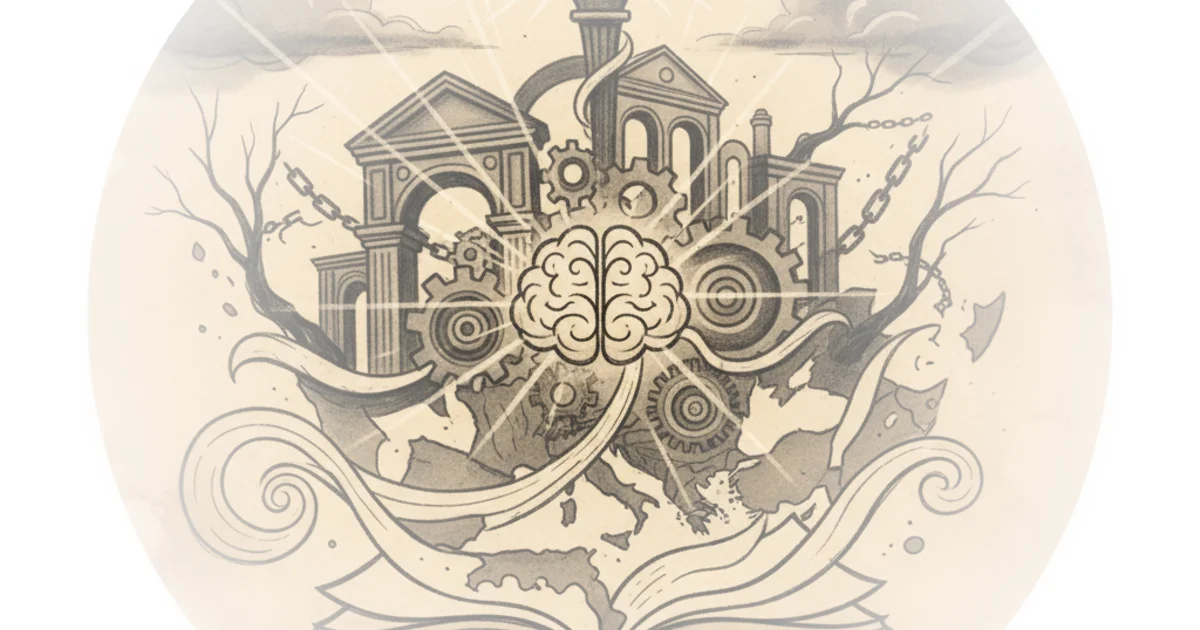
The author contrasts this nativist view with the true historical engine of Western progress: the Enlightenment. He reminds readers that after centuries of religious warfare, Europeans chose to separate empirical inquiry from dogma. "It was only with the separation of empirical inquiry from religious dogma that modern natural science, and the economic world that it made possible, emerged," Mounk argues. This historical pivot is what allowed for the universal equality found in Galatians 3:28—"There is neither Jew nor Gentile... nor is there male and female, for you are all one in Christ Jesus"—to evolve into modern human rights rather than remain a sectarian doctrine.
"The second version has now been called into question, particularly during the second Trump administration. What one might call pre-modern America has been authoritarian in domestic policy and unilateralist and arbitrary in its foreign policy."
Mounk's critique of the current executive branch is stark. He details a pattern of governance that bypasses constitutional norms, noting that the administration "has tried to rule by executive order rather than going through the country’s constitutional processes." The stakes are not just domestic; they ripple globally. Mounk points to the administration's disregard for international law and treaty obligations as evidence of a shift toward what he calls "pre-modern" authoritarianism, where the leader claims to be limited only by their own morality.
The Erosion of Trust
The commentary then moves to the geopolitical fallout. Mounk argues that the trust built over decades between NATO allies has been shattered not by a single event, but by a systemic rejection of the alliance's core principles. He observes that the Republican Party has transformed from a defender of democratic world order into an "America First" movement that favors autocrats over democracies. "There is no guarantee that a more Europe-friendly future president would not be replaced by a similarly nationalistic one in another few years," he warns.
This uncertainty creates a dangerous vacuum. Mounk highlights the administration's unilateral actions, such as declaring war without congressional approval or making territorial claims on sovereign allies like Greenland, to illustrate a new era of American unpredictability. The human cost of this instability is immense, as it leaves vulnerable populations in conflict zones without reliable support and emboldens authoritarian regimes that thrive on division.
Critics might argue that Mounk underestimates the resilience of American institutions or the possibility that the administration's actions are a temporary aberration rather than a permanent shift. However, his evidence regarding the degradation of discourse and the erosion of constitutional norms suggests a deeper structural change that will outlast any single election cycle.
The Technological Wildcard
A particularly striking section of Mounk's analysis focuses on how artificial intelligence exacerbates these geopolitical fractures. He references a recent encyclical, Magnifica Humanitas, which warns that AI is being developed by a "technocracy" driven by profit rather than the common good. The author uses the example of Starlink to illustrate the dangers of private actors wielding state-level power.
Mounk writes, "That control allowed Musk to become an independent foreign policy actor... In doing so, he was not working with any government in America or Europe, but simply conducting his own private foreign policy." This is a profound insight: as technology outpaces regulation, the ability of democracies to control their own destinies diminishes. The gap between the US and China in AI development threatens to widen global inequalities, leaving Europe further behind.
"Our governments do not have the technical capacity to keep up with fast-moving technology, which in the end may not be controllable by anyone."
The argument here is sobering. Mounk suggests that neither nationalization nor regulation offers a perfect solution, as state control of AI could lead to new forms of abuse, while private control leads to unaccountable power. The challenge for Europe is to maintain its commitment to liberal values even as the technological landscape makes those values harder to enforce.
A Glimmer of Hope
Despite these daunting challenges, Mounk ends on a note of cautious optimism. He points to recent elections in Hungary and the potential for a shift in American midterms as evidence that democratic checks and balances still function. "I do not believe that the fears that many people had last year about a rising populist tide sweeping Europe will come to pass," he asserts. The key, he suggests, is that voters are capable of rejecting authoritarianism when presented with clear choices.
However, this optimism rests on the assumption that democratic norms can recover quickly enough to counter the momentum of populism and technological disruption. Mounk acknowledges that the path forward requires Europe to define its identity not by what it is against, but by a positive commitment to the Enlightenment ideals of universal equality and rule of law.
Bottom Line
Mounk's most powerful contribution is his reframing of the trans-Atlantic crisis as a battle over the very definition of Western civilization, rather than just a dispute over trade or defense spending. His argument holds up well against historical scrutiny, particularly in distinguishing between religious heritage and Enlightenment universalism. The piece's greatest vulnerability lies in its reliance on political shifts in Washington to stabilize the alliance; if the US remains isolationist for a prolonged period, Europe may need to prepare for a future where it stands entirely alone. Readers should watch how European leaders navigate the tension between maintaining their liberal identity and filling the security vacuum left by an unpredictable American partner.