Laura Rozen exposes a chilling contradiction at the heart of current governance: while the executive branch pursues a diplomatic roadmap to end a devastating two-year war abroad, it is simultaneously constructing the legal and rhetorical architecture to deploy military force against its own citizens at home. This piece is not merely a political critique; it is a forensic examination of how the language of national security is being weaponized to criminalize dissent and bypass constitutional guardrails. For the busy reader, the urgency lies in the specific mechanism Rozen identifies—the deliberate creation of chaos to justify the invocation of the Insurrection Act.
The Manufactured Pretext
Rozen begins by highlighting the grim paradox where peace efforts overseas are shadowed by the incitement of civil strife domestically. She quotes Illinois Governor J.B. Pritzker, who argues that the administration is actively trying to "cause chaos, create fear and confusion, [and] make it seem like peaceful protesters are a mob by firing gas pellets and tear gas canisters at them." The Governor's assessment is that this aggression is not a reaction to violence, but a strategy to manufacture the very conditions required to invoke the Insurrection Act. This framing is critical because it shifts the narrative from law enforcement responding to disorder to the state engineering disorder to seize power.
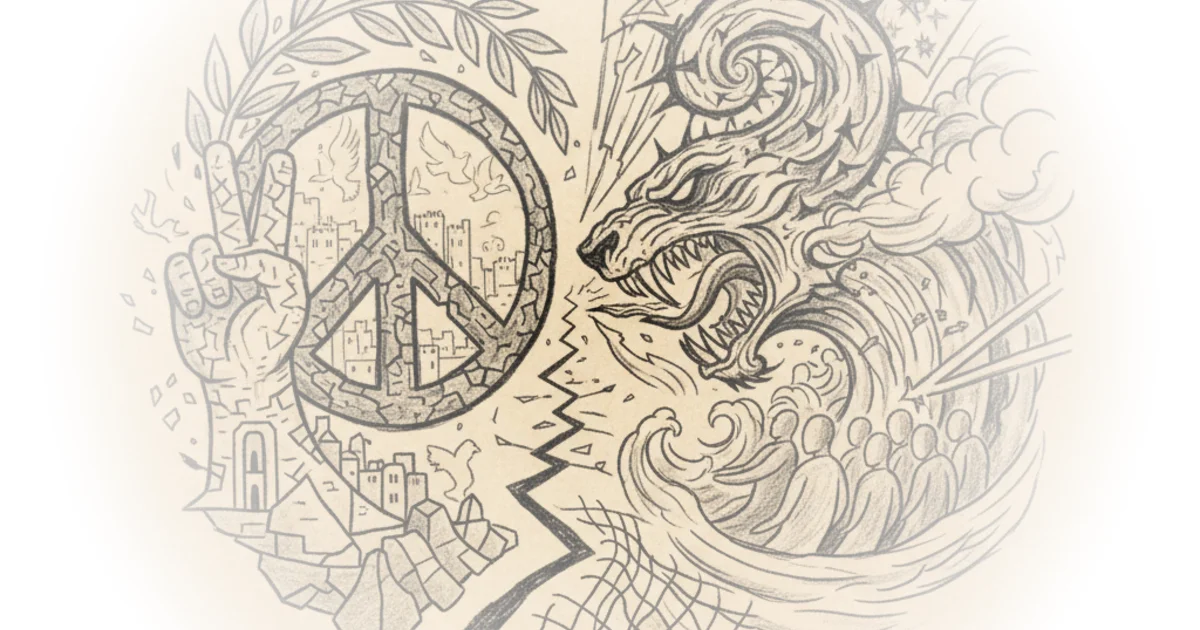
The administration's rhetoric has escalated to match these tactical maneuvers. Rozen notes that the President has explicitly labeled political opponents as "insurrectionists" and domestic terrorists, stating, "If I had to enact it, I'd do it," if courts or local governors block the deployment of troops. This willingness to override local sovereignty in the name of a fabricated threat is the core of the argument. As Rozen puts it, the administration is "normalizing US troops on American streets" while conflating their purpose—ostensibly to fight crime, but actually to protect immigration raids and quell the protests they generate.
"A Trump-led deployment of federalized Guard and active-duty troops to quell a fabricated insurrection inside American cities should only be understood as a war on the American people."
The Rhetoric of Dismantling
The commentary deepens as Rozen turns to the specific language used by key administration officials, particularly Deputy Chief of Staff Stephen Miller. Rozen describes Miller's rhetoric as "blood-curdling" and "hysterical," noting his false claims that the Democratic Party has filled the judicial system with radicals who protect "leftwing terrorists." Miller's assertion that "the only remedy is to use legitimate state power to dismantle terrorism and terror networks" is particularly alarming when paired with the administration's actions.
Rozen connects this rhetoric to a specific policy instrument: National Security Presidential Memorandum-7 (NSPM-7). This directive empowers the Attorney General and the IRS to investigate and disrupt networks that foment political violence, targeting entities engaged in "rioting, looting, trespass, destruction of property, threats of violence and civil disorder." The author points out the dangerous ambiguity here: the memo targets groups that may not even exist in the way described, while seemingly ignoring the very real violence of January 6, 2021, which the administration has since pardoned. This selective application of "counter-terrorism" powers suggests a tool designed for political suppression rather than public safety.
Critics might note that governments often struggle to distinguish between legitimate protest and genuine threats to public order, and that strong rhetoric is sometimes a political tool rather than a policy blueprint. However, Rozen's evidence of a coordinated task force involving the Department of War, FBI, and ICE, labeled the "Memphis Safe Task Force," suggests a level of institutional integration that goes beyond mere political posturing. As Miller declared in Memphis, "Every resource we have... we are going to use to dismantle their networks without apology and without mercy."
The Erosion of Civil-Military Relations
The most profound implication Rozen draws is the erosion of the traditional separation between the military and domestic law enforcement. She cites former US Navy Undersecretary Janine Davidson, who warns that the administration's speech to top generals, labeling left-wing protesters as "the enemy from within," has crossed a "clear red line in civil-military relations." Davidson argues that invoking the Insurrection Act would grant the executive "dictatorial like powers like we've never seen used before in this country—not even in the civil war."
This section of Rozen's analysis is particularly potent because it moves beyond the immediate political squabbles to the structural integrity of the republic. The deployment of active-duty troops to American cities to suppress a movement defined by the executive branch itself represents a fundamental break from constitutional norms. The author emphasizes that this is not a hypothetical future; the text notes that Texas National Guard members were already seen at a training center in Chicago in October 2025, signaling that the machinery is already in motion.
Bottom Line
Rozen's strongest argument lies in her ability to connect the dots between high-level rhetoric, specific executive orders, and on-the-ground military preparations, revealing a coordinated strategy to redefine political opposition as an existential threat. The piece's greatest vulnerability is its reliance on the administration's own inflammatory statements as the primary evidence of intent, which could be dismissed by supporters as political theater rather than operational planning. However, the convergence of the NSPM-7 directive, the specific targeting of judges and governors, and the public deployment of military assets suggests a trajectory that demands immediate scrutiny. The reader must watch closely to see if the courts, as the administration has threatened, will be the final barrier against this expansion of executive power, or if the precedent will be set for a permanent shift in how the state treats its own citizens.