Cyril Hédoin delivers a chilling diagnosis for the modern era: the very concept of 'economic sovereignty'—often championed as a shield for the common citizen—is rapidly becoming the primary weapon for elite collusion. In an age where the global rule-based order is fracturing, Hédoin argues that the push to reclaim national control over trade and industry is not a populist victory, but a sophisticated mechanism for political and business leaders to entrench their power at the expense of the public. This is not just a critique of policy; it is a warning that the tools we use to resist globalization may be the same ones used to dismantle our freedom.
The Illusion of Control
Hédoin begins by dissecting the three layers of sovereignty, quickly narrowing the focus to the economic variety. He defines this not merely as a nation's ability to set its own taxes, but as the control over supply chains and industries that underpins national security. "Talks about 'reindustrialization' betray the belief that a nation cannot be economically sovereign if most of the goods and services it needs are produced elsewhere by foreign economic agents," Hédoin writes. This framing is crucial because it exposes the emotional core of the current political shift: the fear that dependency equals vulnerability.
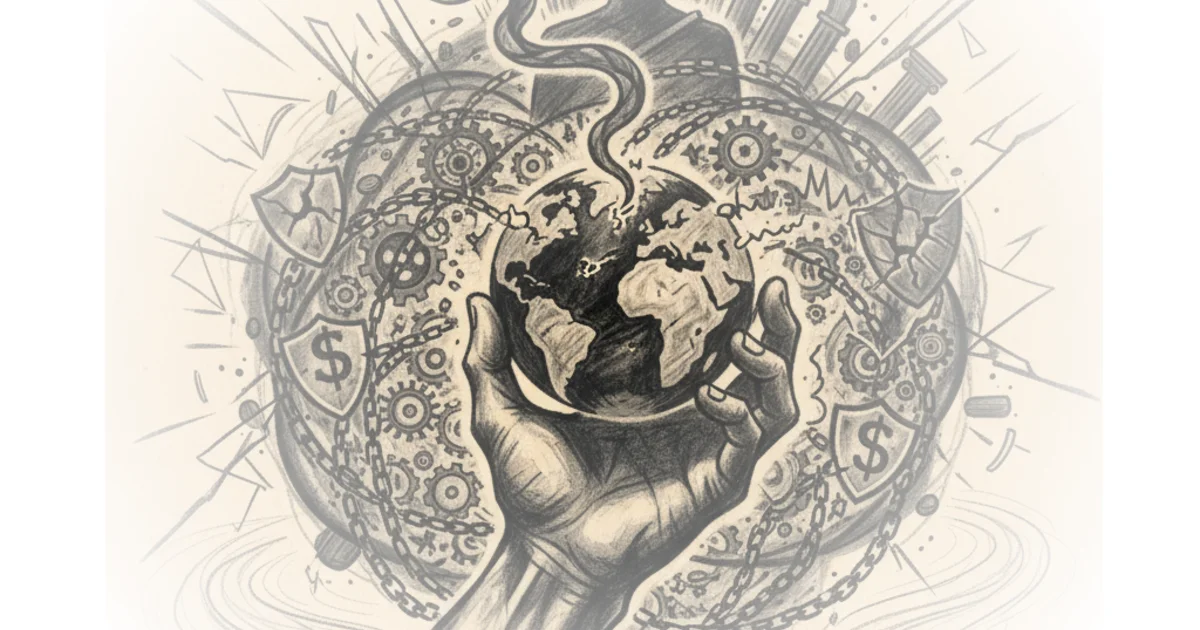
The author acknowledges the traditional economic argument that globalization, despite its costs like job displacement, offered a net benefit through efficiency. However, he notes that the pendulum has swung. "The process of globalization has been put to a halt," he asserts, replaced by what he terms new political capitalism. This is the essay's central pivot. Hédoin describes a system where "economic and political elites develop promiscuous and mutually advantageous relations through which they can pursue their aims." The language here is deliberate and sharp; "promiscuous" suggests a lack of boundaries and a reckless intimacy between sectors that were meant to check one another.
"The economic elite uses the government and the state to achieve, protect, and strengthen economic advantages over competitors – when competitors are not simply eliminated."
This dynamic is not entirely new. Hédoin draws on the work of Mancur Olson to explain why this happens so easily: because the economic elite is small and concentrated, it is significantly easier for them to cooperate to influence the political elite, leading to regulatory capture. He references Olson's logic that this collusion is a major impediment to development, yet historically, some societies managed to avoid the worst harms by maintaining "open social orders" with robust competition. The tragedy, as Hédoin sees it, is that the very integration of the global economy once helped contain this politicization by reducing the leverage of any single national government. Now, that containment is gone.
The Return of the Predator
The most provocative section of the piece is Hédoin's application of this theory to the current Western landscape. He argues that political capitalism is returning, but with a dangerous twist: it is now thriving in societies that had previously succeeded in limiting it. He points to the United States as the prime example, noting how the convergence of tycoons and politicians has become a symbol of the new order. "The presence of all the major U.S. economic tycoons at Trump's presidency inauguration, seated in the front row, is a symbol of the extreme politicization of the U.S. capitalist economy," Hédoin observes. While the article avoids focusing on the personality of the leader, it uses the event to illustrate the structural shift: the executive branch has become a playground for a "modern spirit of conquest."
Hédoin introduces the concept of "predators"—a term borrowed from Giuliano da Empoli—to describe the politicians and businessmen who are now "aspiring to take over the world by destroying any form of rule-based order at the national and global level." This is a stark departure from the old imperialistic models. The difference lies in the context: "Economies have never been so integrated with high levels of wealth concentration," Hédoin writes. "Control over digital infrastructure creates new forms of sovereignty that don't map onto traditional national boundaries."
Critics might argue that Hédoin underestimates the genuine security risks that drove nations to seek supply chain independence, such as reliance on adversarial states for critical minerals or medical supplies. However, his point remains that the method of achieving this independence often empowers the very elites who promised to dismantle the establishment.
"New political capitalism is deeply intertwined with a modern spirit of conquest. It is the playground of those whom the Italian-French writer Giuliano da Empoli calls 'predators,' i.e., politicians and businessmen who aspire to take over the world by destroying any form of rule-based order at the national and global level."
The consequences of this shift are already rippling outward. As the U.S. attacks the global economic order to reaffirm its sovereignty, it forces other powers, particularly in Europe, to reconsider their own independence. Hédoin warns that this creates a paradox: "Europeans are becoming obsessed with guaranteeing their independence... because they understand that, under new political capitalism, their dependence on American products and technologies could make them politically vulnerable." The risk, he notes, is that this defensive maneuver will only "favor in Europe new forms of entanglement between economic and political elites as well to counteract American dominance."
The Irony of Populism
The essay concludes with a devastating irony. Populism, which claims to be an attack on the elites of the liberal order, is actually the vehicle for their resurgence. "Populist politics has been grounded on a systematic attack on the elites of the liberal order," Hédoin writes. "However, not only will populism not make elites disappear, but it will empower them with new opportunities to capture power at the expense of the rest of the population."
This is the piece's most sobering insight. The rhetoric of reclaiming national destiny is being used to justify policies that deepen the grip of a small, interconnected class of rulers. Hédoin suggests that the only viable counter-measure might be a "genuinely competitive European federalism," which could distribute power and make collusion less stable. Yet, he remains pessimistic, predicting that "new political capitalism will inevitably spread and will further strengthen nationalist obsessions."
"Economic sovereignty risks becoming again an excuse for harmful abuse by economic and political elites."
The historical parallel to the interwar period, where economists like Randall Holcombe noted the rise of political capitalism in fascist Italy and Nazi Germany, looms large here. While the current context is different, the mechanism of elites using the state to secure domination remains the same. The "sleep of reason," as Goya famously warned, produces monsters, and Hédoin suggests we are waking up to a new breed.
Bottom Line
Cyril Hédoin's strongest contribution is reframing the current obsession with economic sovereignty not as a defense of the nation, but as a trap for the citizen. The argument's greatest vulnerability lies in its potential fatalism; while the risks of elite capture are real, it assumes that the alternative to globalized chaos is inevitably a return to predatory nationalism, leaving little room for a reformed, regulated global order. Readers should watch closely as nations move from rhetoric to policy: the next decade will reveal whether 'sovereignty' becomes a shield for the many or a sword for the few.