Most science fiction treats space travel as a backdrop for adventure, but Rohin Francis flips the script to ask a terrifying biological question: what happens to the human body when it is forced to grow up without gravity? Drawing on his unique background as a space medicine specialist, Francis argues that the long-term colonization of the solar system isn't just an engineering challenge—it is a biological impossibility with our current understanding of human development.
The Bone and Muscle Crisis
Francis begins by dismantling the romanticized image of the "Belter" from The Expanse—tall, slender humans adapted to zero gravity. While the show's creators acknowledged that casting exclusively tall actors was unfeasible, Francis points out that the physiological reality of growing up in microgravity would be far more dire than simple height. He notes that while adult astronauts temporarily grow a few centimeters due to spinal decompression, a child developing in space faces a catastrophic failure of skeletal formation. "Without gravity stimulating osteoblasts, the activity of osteoclasts that destroyers outstrips them and bone can be very rapidly broken down," Francis writes, describing a scenario akin to severe rickets but driven by the absence of mechanical load rather than just vitamin deficiency.
The argument gains weight when Francis connects this to the fundamental mechanics of bone density. He explains that impact stimulates bone growth, which is why pediatricians recommend high-impact exercise. In the vacuum of space, that stimulus is gone. "For a growing child this could be catastrophic," he warns, suggesting that Belter children would likely be short, deformed, and prone to kidney stones. The show's depiction of Belters being unable to stand on Earth is not just dramatic license; it is a medically sound prediction of a body that has never known the resistance of gravity. Critics might note that future genetic engineering could theoretically bypass these issues, but Francis rightly emphasizes that we are currently decades away from such solutions.
"The combination of a brittle osteoporotic and denervated skeleton and weak unused musculature mean that the torture scene where a belter is just hung from hooks in Earth's gravity is probably very accurate."
The Cardiovascular and Neurological Toll
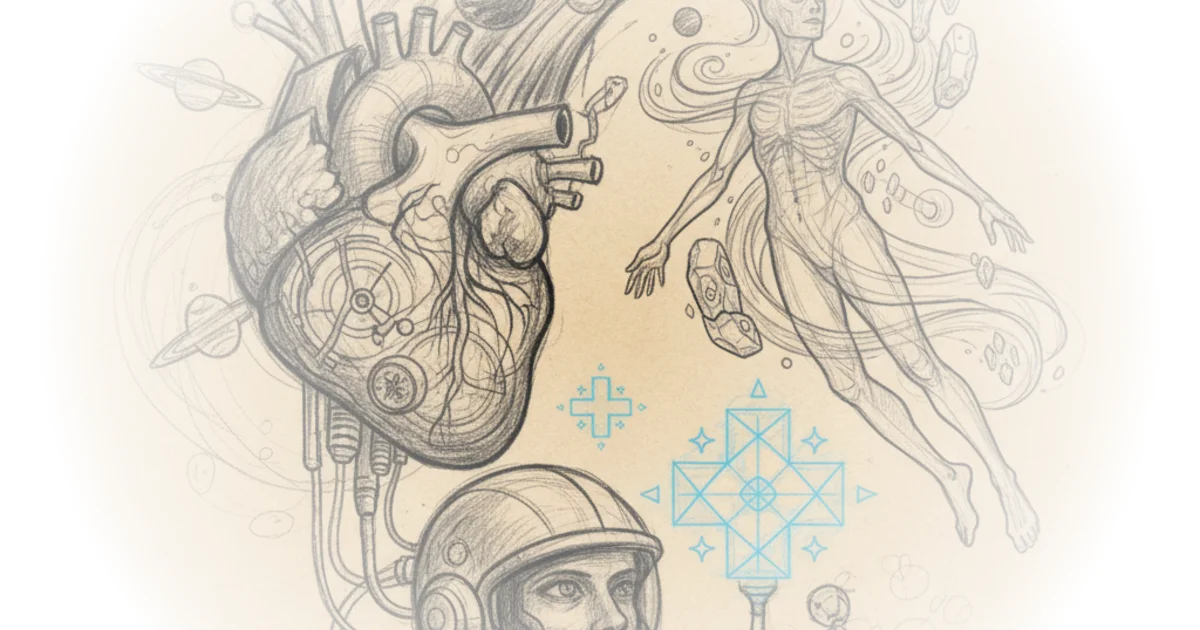
Beyond the skeleton, Francis turns his attention to the heart and the brain, arguing that the cardiovascular system would atrophy just as severely as the muscles. He describes a heart that becomes "rounder and smaller" because it no longer needs to pump against gravity, leading to a potential inability to generate enough pressure to sustain life on a planet like Earth. This isn't just about weakness; it is about a fundamental mismatch between the organism and its environment. "A cardiovascular system that has grown up in microgravity might be completely unable to generate enough pressure to pump blood to the organs," Francis states, predicting that a Belter returning to Earth would likely suffer cardiogenic shock and multi-organ failure.
The neurological implications are equally unsettling. Francis details how microgravity alters the composition of grey and white matter and disrupts the neurovestibular balance system. Even if a space-born human could survive the physical transition to Earth, their cognitive abilities would likely be compromised. "They'd probably just stumble around like a drunk just came home," he quips, highlighting the disorientation that would plague anyone trying to navigate a gravity well after a lifetime in weightlessness. This framing effectively grounds the high-concept sci-fi in the gritty reality of human physiology.
Reproduction and the Radiation Wall
Perhaps the most chilling section of Francis's analysis concerns reproduction. He dismantles the assumption that humans can simply breed in space, citing studies where sperm moved too fast to fertilize eggs effectively and mammals in space consistently miscarried. "Unless we find a way around these problems we won't be able to reproduce in a weightless environment," he concludes, noting that we still do not know if a fetus could even develop normally in zero gravity.
Even if reproduction were possible, the environment itself poses a lethal threat. Francis points out that cosmic radiation outside the protective Van Allen belts delivers lethal doses that can cause irreversible damage to ovaries and induce premature menopause. He draws a parallel to the show's fictional "Maya Skelton" syndrome, a form of premature immune senescence, and argues it is a realistic extrapolation of chronic stress and inflammation in a resource-poor, high-radiation environment. "Chronic stress and inflammation also negatively impacts the thymus which is a key organ in the immune system," he explains, suggesting that the immune systems of space-dwellers would age rapidly and fail.
"Unless we find a way around these problems we won't be able to reproduce in a weightless environment."
Francis acknowledges that the show attempts to solve this by having Belters travel to Ganymede for its small amount of gravity and magnetosphere, but he remains skeptical about the long-term viability of such workarounds. The question of whether humans will evolve to adapt to these conditions remains open, but Francis argues that the evolutionary timescale is too slow to help the first few generations, who would likely face extinction or severe disability.
Bottom Line
Rohin Francis's analysis is a masterclass in applying real-world medical constraints to speculative fiction, effectively arguing that the human body is too fragile to simply "adapt" to the cosmos without radical intervention. While his focus on the immediate biological barriers is compelling, the argument leaves open the possibility that future biotechnology could rewrite the rules of human development. The strongest takeaway is not that space colonization is impossible, but that it will require a fundamental re-engineering of what it means to be human.