This piece from Natural Selections offers a rare, unvarnished look at the psychological toll of the pandemic's social enforcement, moving beyond the binary of "pro" and "anti" to explore the quiet tragedy of capitulation. It is not a policy critique, but a visceral account of how institutional rigidity can fracture the very families it claims to protect, forcing a personal betrayal of instinct that lingers long after the mandates vanish.
The Architecture of Distrust
The narrative begins by establishing a deep-seated skepticism toward medical intervention, rooted not in conspiracy but in a lifetime of observing institutional overreach. Natural Selections reports, "Since early childhood I've had a horror of taking anything foreign into my body. I prefer the headache or fever to the paracetamol." This personal history frames the subsequent vaccination decision not as a rejection of science, but as a collision between individual autonomy and what the author perceives as a "one-size-fits-all mentality." The piece draws a sharp parallel between the author's experience with obstetricians in 1994 Spain—who dismissed her home birth plans because she had only "read books"—and the later mass vaccination campaign. The argument suggests that the medical establishment often prioritizes the advancement of knowledge over the preservation of individual health, a tension that echoes the historical debates surrounding the Hippocratic Oath, where the duty to "do no harm" has frequently clashed with the drive for technological intervention.
"In my eyes the clear objective of Medicine with a capital M is to advance medical knowledge, not necessarily keep us healthy."
The author describes the early lockdowns in Barcelona with a sense of eerie wonder, finding beauty in the silence and the return of nature. She notes, "Spring was springing around me with a vengeance," and recalls spotting the sixteen peregrine falcons known to nest in the city, a detail that grounds the global crisis in a specific, local ecosystem. This period of "renewal and wonder" stands in stark contrast to the absurdity that followed when in-person teaching resumed. The piece argues that the safety measures implemented were often counterproductive, creating "inconvenience" without stopping the virus. The author describes children in "oversized masks that flopped in all directions" and music stands that were "locked away because nothing could be shared," forcing students to "do everything themselves" with out-of-tune instruments.
Critics might note that the author's dismissal of these measures overlooks the genuine confusion and lack of data that characterized the early pandemic, where schools were forced to act on incomplete information. However, the piece's strength lies in its focus on the human cost of rigid adherence to protocols that failed to account for the realities of child development and social interaction.
The Fracture of Community
The narrative shifts dramatically in the third phase, where the absence of a physical threat is replaced by the presence of social coercion. The author describes a landscape where "Covid passports were willed into existence," creating a new form of social enforcement that alienated the unvaccinated. The emotional weight of this isolation is captured in the author's reflection on her family dynamics: "Stay away from the in-laws! No coffee out and about, much less a meal! Stay in your place, no travel for the likes of you!" The pressure to conform became a tool for social control, turning neighbors into adversaries and fracturing the "tribe" the author sought to belong to.
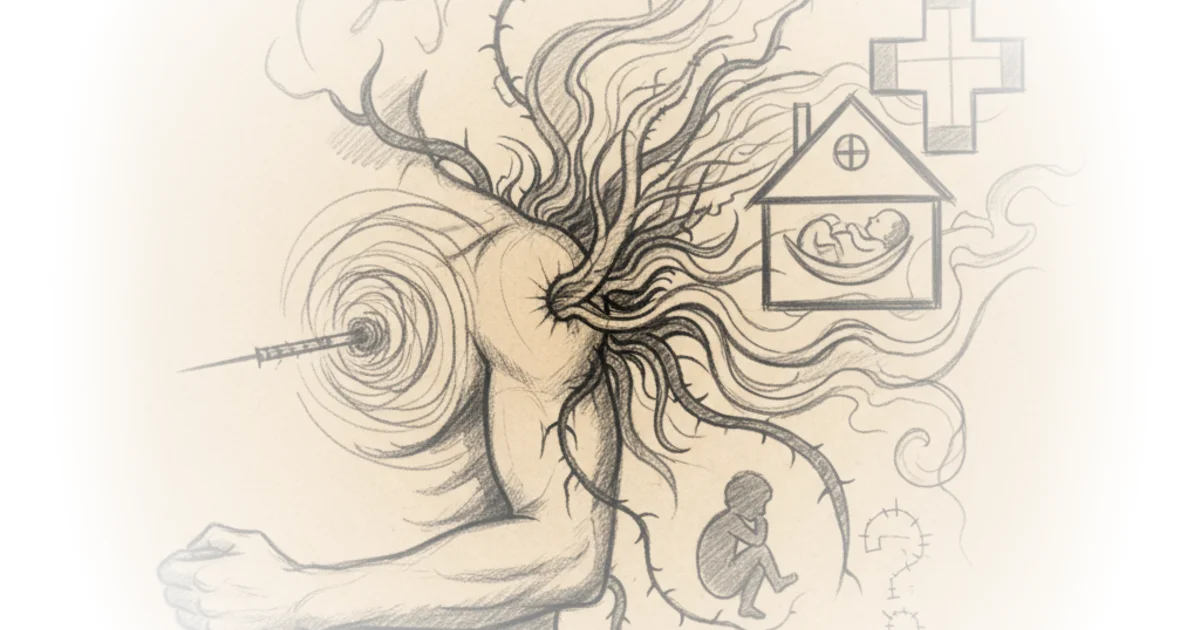
The turning point comes not from a change in medical understanding, but from a moment of domestic exhaustion. The author recounts her husband's exasperated question: "OK, so we're all going to die early and you'll be left to live on into old age, I get it... but will you really want to live on, all by yourself?" This line encapsulates the central tragedy of the piece: the decision to vaccinate was driven by a desire for connection rather than a belief in the efficacy of the mandate. The author describes the physical sensation of the injection as "feeling myself poisoned even as it was administered," a visceral metaphor for the psychological violation of acting against one's better judgment.
"It has become the voice of my conscience; it tells me I have squandered one of my nine lives and must compensate."
The aftermath reveals a complex web of regret and shifting perspectives. The author notes that her husband, who had initially pushed for compliance, has since "pivoted 180 degrees," now attributing his hay fever to the vaccine. This reversal highlights the volatility of public health narratives and the difficulty of maintaining a "shared reality" when facts seem to change with the political wind. The piece argues that while individuals may forgive each other for these shifts, the officials who "ridiculed and demonized the unvaccinated" have yet to face a reckoning.
The Monster of Unchecked Authority
In the final analysis, the author expresses a vindictive hope that the architects of the pandemic response will eventually face the consequences of their actions. The piece invokes the figure of Doctor Frankenstein, suggesting that the authorities have "created a monster that will haunt them for the rest of their lives." This metaphor serves as a powerful critique of the hubris involved in imposing sweeping social controls without a clear understanding of the long-term societal damage. The author writes, "Time is running out for them to join us in rebuilding a shared reality," warning that ignoring the emerging data on "excess mortality figures" and health complications will only deepen the divide.
The piece concludes with a call for truth to "out anyway," suggesting that the suppression of dissent has only delayed, not prevented, the inevitable confrontation with reality. While the author acknowledges that "moving on is a sound instinct when one cannot go back," she insists that the question remains: "does everyone get to move on?" This final query challenges the reader to consider the moral cost of a public health strategy that prioritized compliance over trust.
"Time is running out for them to join us in rebuilding a shared reality. If they continue to ignore the facts, well, this is where I get vindictive."
Bottom Line
The strongest element of this commentary is its refusal to simplify the vaccination debate into a binary of science versus ignorance, instead exposing the profound emotional and relational fractures caused by social enforcement. Its greatest vulnerability lies in its reliance on anecdotal evidence and the author's personal health trajectory, which may not reflect broader epidemiological realities. Readers should watch for how this narrative of "betrayed instinct" influences future public health communications, particularly as trust in institutions remains fragile.