Maria Popova does not merely recount an expedition; she excavates a buried history of how gendered assumptions about courage and competence distorted the very maps we use to understand the world. This piece is notable because it reframes the tragedy of a husband's death not as a cautionary tale of wilderness danger, but as the catalyst for a woman to dismantle the "performative masculinity" that nearly cost her everything and to redefine exploration as an act of love rather than conquest. In an era where we often accept official narratives at face value, Popova's deep dive into Mina Hubbard's journals offers a corrective lens, proving that the most accurate maps are often drawn by those who refuse to look away from the beauty of the unknown.
The Architecture of Permission
Popova opens with a sweeping thesis that sets the stakes immediately: "Nothing changes the history of the world more profoundly than changing the landscape of permission and possibility for people." She argues that true progress comes from those who possess the "self-permission to defy the prohibitive dogmas of their time." This framing is essential because it shifts the focus from individual heroism to systemic barriers. Popova illustrates this by contrasting the internal landscapes of Mina Hubbard and her rival, Dillon Wallace. While Wallace saw only a "dismal waste" and felt "menaced by the 'desolate' landscapes," Mina viewed the same terrain as an "uncommon place with an uncommon power to grasp the soul."
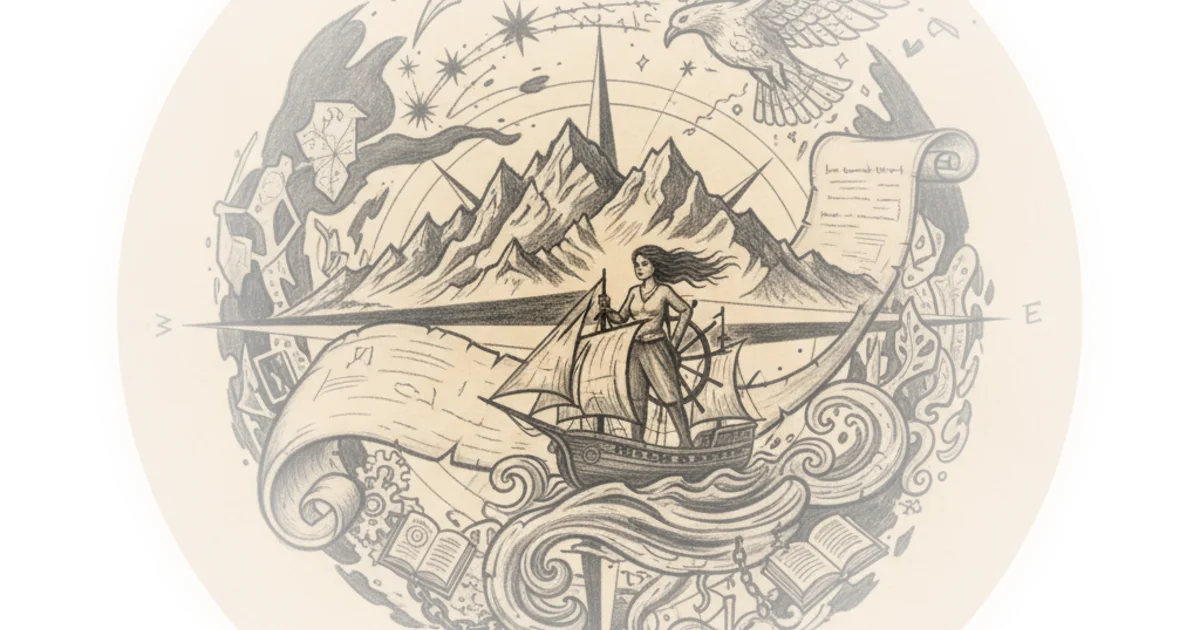
The author's choice to juxtapose these two perspectives is not just literary flair; it is a methodological critique of how history is recorded. Popova notes that Wallace, a "pale and pot-bellied" lawyer, approached the wilderness with a sense of entitlement that blinded him to the reality of the land, whereas Mina, a widow grieving her husband Leonidas, approached it with a "love letter" sensibility. This distinction is crucial. It suggests that the "heroic" narrative of exploration, often dominated by men who viewed nature as an enemy to be conquered, was fundamentally flawed. As Popova puts it, Mina's account stands against the history of male explorers "writing about nature and native cultures in the phallic language of conquering continents."
Against the history of male explorers writing about nature and native cultures in the phallic language of conquering continents and penetrating uncharted wildernesses in a perpetual hysteria about the hardships their heroism surmounted, Mina's account stands as a love letter.
This argument holds up remarkably well when examining the outcome: Wallace's expedition failed, leaving him trapped on a cliff and requiring rescue, while Mina's party, though less resourced, successfully mapped the region. The failure of the male-led expedition was not due to a lack of resources, but a lack of humility and a refusal to adapt to the environment. Critics might note that Popova risks romanticizing the hardship Mina endured, glossing over the sheer physical brutality that nearly killed her. However, the text is careful to acknowledge the "terror within" and the "mosquitos and flies in clouds" that bit like "live coal," grounding the poetic analysis in visceral reality.
The Cartography of Grief
The narrative pivot occurs when Popova details the aftermath of Leonidas Hubbard's death. The administration of the expedition's legacy was hijacked by Wallace, who published a book casting himself as the hero and Leonidas as a "homesick boy." Popova describes Mina's reaction not as a personal vendetta, but as a moral imperative: she "protested the only way a person of courage and creative vitality protests — she would do it herself."
This section of the commentary is where Popova's analysis of institutional dynamics shines. She highlights how Wallace, leveraging his social standing, was able to appropriate Leonidas's field notes and maps, effectively erasing Mina's agency. Mina's response was to enroll in high school at age thirty-four to study navigation and classics, a move Popova describes as understanding that "the fulcrum of any great feat is the total person, body and mind." This detail adds a layer of historical context that is often missed in standard biographies. While the young Albert Einstein was dreaming up relativity in a Swiss patent office, Mina was in a classroom, preparing to chart the "last unexplored frontier of her continent."
The author weaves in the historical context of the Naskapi people (now known as the Innu) to further critique the colonial mindset of the era. While other explorers were "taunted with tales of rape and violence" regarding the indigenous population, Mina met them as equals. Popova quotes her observation of a young man's flirtatious behavior, noting the "little touches that go to prove human nature the same the world over." This humanization of the indigenous people, contrasted with the dehumanizing rhetoric of other explorers, underscores Popova's point that Mina's maps were not just scientific documents but acts of ethical resistance.
She would accomplish this by making a home at that place where poetry and science meet — the blessing refusal to decouple truth and beauty.
The evidence here is compelling. Mina's maps of the Naskaupi and George Rivers became the backbone of atlases for decades, outlasting the flawed accounts of her male contemporaries. The fact that her work remained the standard until the advent of aerial mapping in the 1930s serves as a testament to the accuracy born of her respectful engagement with the land. However, a counterargument worth considering is that the "official" history still largely credits the male explorers of the era, and Mina's story only gained traction through the lens of modern feminist historiography. Popova's piece is part of that necessary correction, but the broader institutional recognition of her contribution remains incomplete.
The Legacy of the Unmapped
In the final analysis, Popova argues that Mina Hubbard's greatest contribution was not the maps themselves, but the "new terrain of permission and possibility" she charted for others. By refusing to let the "prohibitive dogmas" of her time define her potential, she expanded the horizon for women in science and exploration. The text closes on a poignant note, describing how Mina met her husband in the beauty of the landscape, instructing herself to "make memories breathe inspiration, not discouragement."
This framing transforms the story from a simple adventure narrative into a profound meditation on how we process loss and find meaning. Popova suggests that Mina's success was rooted in her ability to hold two truths simultaneously: the brutal indifference of nature and its "strange, wild beauty." This duality is what allowed her to succeed where Wallace failed. Wallace was paralyzed by his fear of the "desolate"; Mina was propelled by her awe of the "splendid."
"Try to make memories breathe inspiration, not discouragement."
The strength of Popova's argument lies in her refusal to separate the emotional from the empirical. She shows that Mina's scientific rigor was enhanced, not hindered, by her emotional connection to the land and her husband. This challenges the modern assumption that objectivity requires emotional detachment. Instead, Popova posits that true objectivity requires a deep, empathetic engagement with the subject. The piece leaves the reader with a sense of urgency: to look at the world not as a resource to be plundered, but as a mystery to be understood with an open heart.
Bottom Line
Maria Popova's piece is a masterful reconstruction of a historical injustice, using Mina Hubbard's journals to expose the flaws in the traditional "heroic explorer" narrative. Its greatest strength is the seamless integration of scientific fact and emotional truth, proving that the most accurate maps are drawn by those who respect the land they traverse. The argument's only vulnerability is the inherent difficulty of fully recovering a history that was systematically suppressed, but Popova's meticulous attention to detail ensures that Mina's voice is finally heard above the noise of her rivals.