Sam Denby dismantles the popular narrative that Hurricane Katrina was a failure of nature, arguing instead that it was a catastrophic failure of human coordination. The most striking claim in this piece is that the storm itself was merely a catalyst; the true disaster was a logistics chain that collapsed under the weight of its own rigid bureaucracy. For busy leaders facing complex crises today, this breakdown offers a stark lesson on why pre-planning without communication redundancy is a recipe for tragedy.
The Illusion of Readiness
Denby begins by challenging the assumption that the federal response was absent from the start. In fact, the machinery was turned on early. "The earliest stages went as they should have," he notes, pointing out that FEMA activated its full operational capacity 48 hours before landfall. This detail is crucial because it shifts the blame from a lack of preparation to a failure of execution. The author meticulously lists the mobilization of mobile emergency response support units, describing an "armada of 275 vehicles" carrying generators and fuel, ready to deploy.
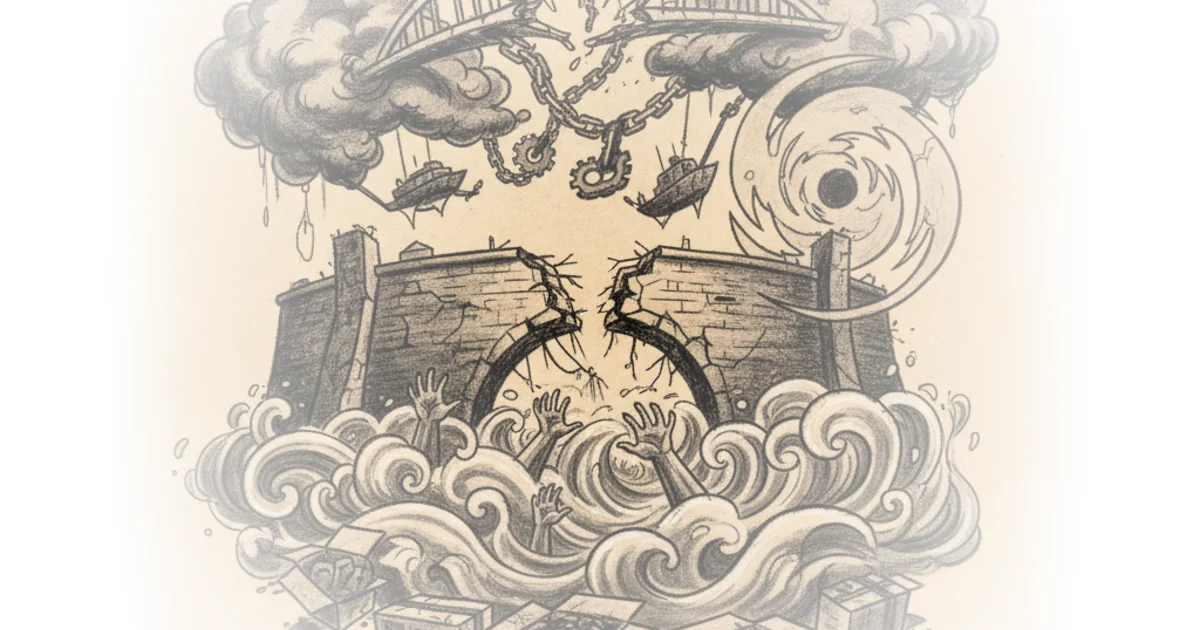
The core of the argument here is that having resources is useless if the system to direct them is broken. Denby explains that FEMA's role is not to run the show but to coordinate based on local requests. "It's the role of FEMA to listen to what local and state level emergency offices need, then coordinate with other federal offices... to procure the physical goods or expertise required." This distinction is vital for understanding the subsequent chaos. The system was designed to be reactive, waiting for a call that never came clearly.
Critics might argue that the federal government should have anticipated the communication blackout and pushed resources proactively rather than waiting for a request. However, Denby's evidence suggests the federal system was structurally incapable of acting without that specific trigger, turning a natural disaster into a bureaucratic stalemate.
The Communication Blackout
The turning point of the disaster, according to Denby, was not the flooding but the silence. When the levees broke, the city's command center was flooded, and the mayor's office lost all ability to communicate. "One phone line from the mayor's room would occasionally connect an outbound call, but could not receive them," Denby writes. This single sentence encapsulates the entire logistical nightmare. Without a way to speak, the city could not ask for help, and the help sitting nearby could not know where to go.
The author describes the resulting chaos as a "stresscharged game of telephone." Requests for supplies were made via word of mouth and radio, then haphazardly entered into databases without verification. The consequence was a mismatch of supply and demand. "Truckloads of ice when food was needed, a truckload of ice when 10 truckloads were needed," Denby observes. This highlights a critical vulnerability in modern logistics: the system is only as strong as its data integrity. When the data stream is severed, the entire machine grinds to a halt.
A logistics chain carefully designed to procure and track resources, but built around the assumed reliability of phone lines and internet access had now turned into a stresscharged game of telephone.
Denby's coverage effectively illustrates how a lack of redundant communication systems—like satellite phones—can render millions of dollars of equipment useless. The mobile command units, including the unit named "Red October," were physically close but operationally distant, unable to penetrate the flooded city core to establish a link.
The Shelter That Wasn't a Shelter
The failure of the Superdome serves as the emotional and logistical climax of the piece. Denby points out that the decision to use the stadium as a shelter of last resort was fraught with warning signs. "The latter argued that it shouldn't be a shelter of last resort since engineering reports showed the structure may not even hold in the event of a category 3 hurricane," he writes regarding the disagreement between the mayor and the FEMA head. Despite these warnings, the plan proceeded, and the roof tore open, flooding the lower levels and cutting power.
The situation deteriorated rapidly as the population swelled to 23,000 people in a facility that was no longer safe. Denby notes that the evacuation of the Superdome was delayed because the city's own buses were underwater, forcing officials to scramble for vehicles from across the state. "By that evening, nearly 2 days after landfall, bus evacuations finally began, but it was hardly a major mobilization as a meager 120 evacuees headed towards Houston." This stark statistic underscores the gap between the scale of the disaster and the speed of the response.
A counterargument worth considering is whether the evacuation could have been faster given the sheer scale of the destruction. However, Denby's narrative suggests that the delay was not just about traffic but about the lack of a coherent command structure to authorize and execute the move. The system was paralyzed by the very rumors and misinformation that flourished in the communication vacuum.
Bottom Line
Sam Denby's analysis is a masterclass in identifying the specific point of failure in a complex system: the disconnect between local needs and federal capacity caused by a broken communication link. The strongest part of the argument is the detailed reconstruction of how a perfectly stocked warehouse of resources became useless simply because no one could call the order. The biggest vulnerability in the narrative is the limited discussion on the political will required to override bureaucratic protocols during an emergency, but the logistical evidence remains undeniable. For any leader managing large-scale operations, the lesson is clear: redundancy in communication is not an option; it is the only thing standing between order and chaos.