In an industry obsessed with the next technological disruption, this profile of Ben Greenberg offers a startling counter-narrative: the most profound shift in music production isn't coming from artificial intelligence, but from the generative engines of video games that have been operating in the shadows for a decade. Gary Hustwit's piece moves beyond the standard musician biography to dissect the economic and creative friction between high-stakes film scoring and the fluid, algorithmic demands of modern gaming, revealing a world where "finality" is becoming a relic of the past.
The Generative Shift
Hustwit frames Greenberg not just as a musician, but as a translator between rigid human committees and fluid digital systems. The author highlights Greenberg's transition from mixing scores for major films like The Smashing Machine to working on generative game soundtracks, a move that exposes a massive disconnect in the industry. "The gaming industry is lightyears ahead of everyone in that respect," Greenberg tells Hustwit, noting that game music engines have been assembling audio stems dynamically for ten years, long before the current AI hype cycle began.
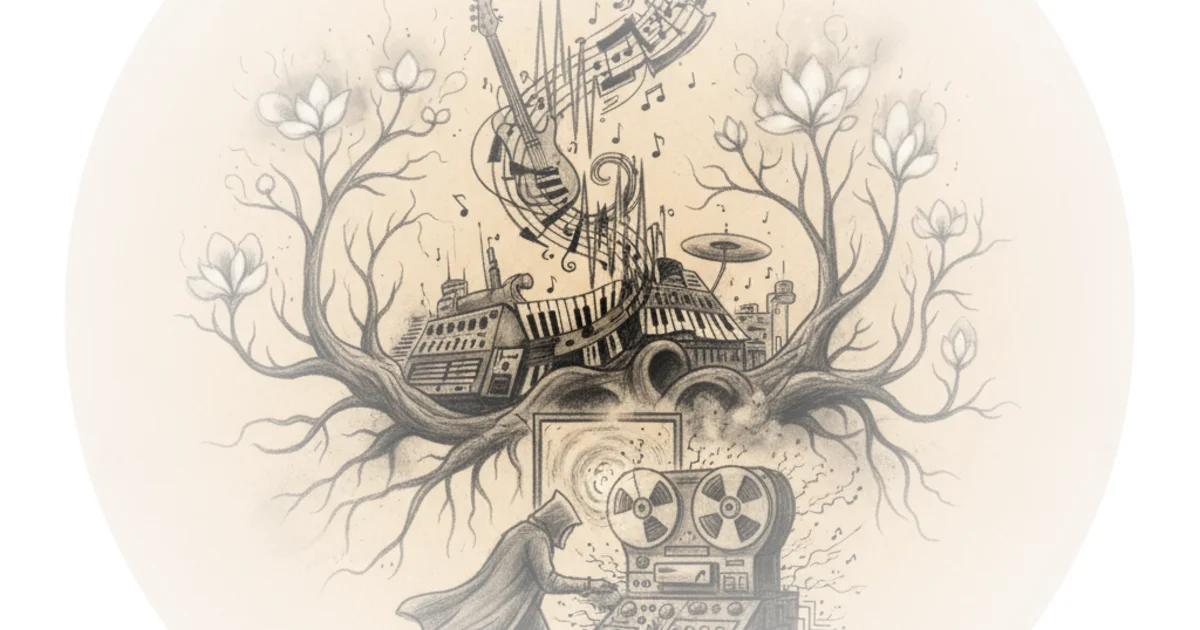
This observation reframes the conversation around automation. While the public fears AI replacing composers, Hustwit shows that the real evolution is in the delivery mechanism. The argument lands because it strips away the sci-fi panic and replaces it with a technical reality: the engine, not the artist, is the new mixer. "When you're dealing with a film or mixing a record, there's a committee that's making decisions... With a film, there can be 30 people involved in that process and it can take a really long time to get anything done," Greenberg explains. In contrast, the generative process removes the paralysis of endless meetings, though it introduces a new challenge: the lack of a definitive ending.
"There is no final say. When you're dealing with a film or mixing a record, there's a committee that's making decisions and you're the point person that actually puts your hands on the stuff to realize those decisions."
Critics might argue that removing the "final say" dilutes artistic intent, turning music into background noise rather than a curated experience. However, Hustwit's reporting suggests that for open-world games, this fluidity is a feature, not a bug, forcing composers to think in terms of layers and moods rather than linear narratives.
The Economics of Authenticity
The piece takes a sharp turn into the brutal economics of the creative class, where Hustwit documents Greenberg's pragmatic approach to survival. The author captures a rare moment of candor about the financial realities of the music industry, noting that "it's a faux pas of the engineering and production world to avoid talking about the brass tacks of how you earn a living." Greenberg admits that balancing high-profile film work with unsigned bands is a necessity, not just an artistic choice. "If I only said 'yes' to the things that were the biggest look, I would work half as much as I do," he admits.
This section is particularly effective because it dismantles the romantic myth of the starving artist. Hustwit presents a clear-eyed view where "hard work and dedication are what make great art," but also where the market has devalued music so severely that "survival aspect" dictates the schedule. The author notes that mastering, once a specialized and expensive service, has become a necessary in-house skill for studios like Greenberg's because "the mastering bills have doubled and tripled" while production fees have stagnated.
"I think the cool thing about AI is that it forces that conversation for people who'd never thought about it before, which is the most of the mass music listening audience. I think it's really cool that everyone has to think about the value system behind what they're listening to now–even if that's not specifically how they're thinking about it, they have to consider it on some level because now there's human music and there's not human music."
Hustwit uses Greenberg's perspective to argue that AI, despite its flaws, serves a vital cultural function: it forces a distinction between entertainment and art. The author notes that we are currently in the "least authentic era" of media, where content is often a "copy-of-a-copy-of-a-copy," yet audiences are desperately seeking the feeling of authenticity. Greenberg suggests that the 1990s were a similar moment where labels sold a "simulacrum of authenticity," and we are now circling back to that tension.
The Human Element
Ultimately, the piece argues that the human element in music is defined by decision-making under pressure, a skill no algorithm can replicate. Hustwit writes that Greenberg's approach to collaboration is rooted in empathy and the ability to make simple, decisive choices. "It's about having the confidence in your ideas or guidance. There is no objective right or wrong, it's about how it feels to each individual–so what feels right to me is all I've got," Greenberg states.
This framing is crucial. In a world increasingly driven by data and generative models, the value of the human creator lies in their ability to trust their intuition and cut through the noise. Hustwit effectively contrasts the "option paralysis" of inexperienced creatives with Greenberg's seasoned ability to ask simple questions like "Tube or solid state?" rather than getting lost in gear specifics. The author's choice to focus on this psychological aspect of production elevates the piece from a technical interview to a meditation on creativity itself.
"You have to be empathetic, but you also have to be committed to your own vision. It's about balancing those roles."
While the piece celebrates the resilience of human creativity, it could be argued that it underestimates the speed at which generative tools are learning to mimic human "intuition." However, Hustwit's reliance on Greenberg's experience in high-stakes environments suggests that the human capacity for nuanced, emotional decision-making remains the ultimate competitive advantage.
Bottom Line
Gary Hustwit's profile succeeds by shifting the focus from the fear of replacement to the evolution of craft, arguing that the true value of the human artist lies in their ability to make decisive, empathetic choices in an increasingly automated world. The piece's strongest asset is its unflinching look at the economic realities that force artists to adapt, while its greatest vulnerability is perhaps a slight over-reliance on the idea that "authenticity" is a solvable problem in a market that increasingly rewards the simulacrum. Readers should watch how the generative models in gaming continue to blur the line between composition and curation, as that is where the next great battle for the soul of music will be fought.