Grant Sanderson has spent years translating complex math into visually stunning explanations. His latest piece tackles something most people never think about: how polarized light behaves inside a tube of sugar water, and why it produces diagonal stripes that seem to walk up the cylinder.
The hook isn't just the visual phenomenon—it's that understanding what's happening requires "having very solid intuitions for a number of different fundamental concepts about light," as Sanderson puts it. This is his challenge: not merely showing what happens, but building the intuition so readers can feel why it happens.
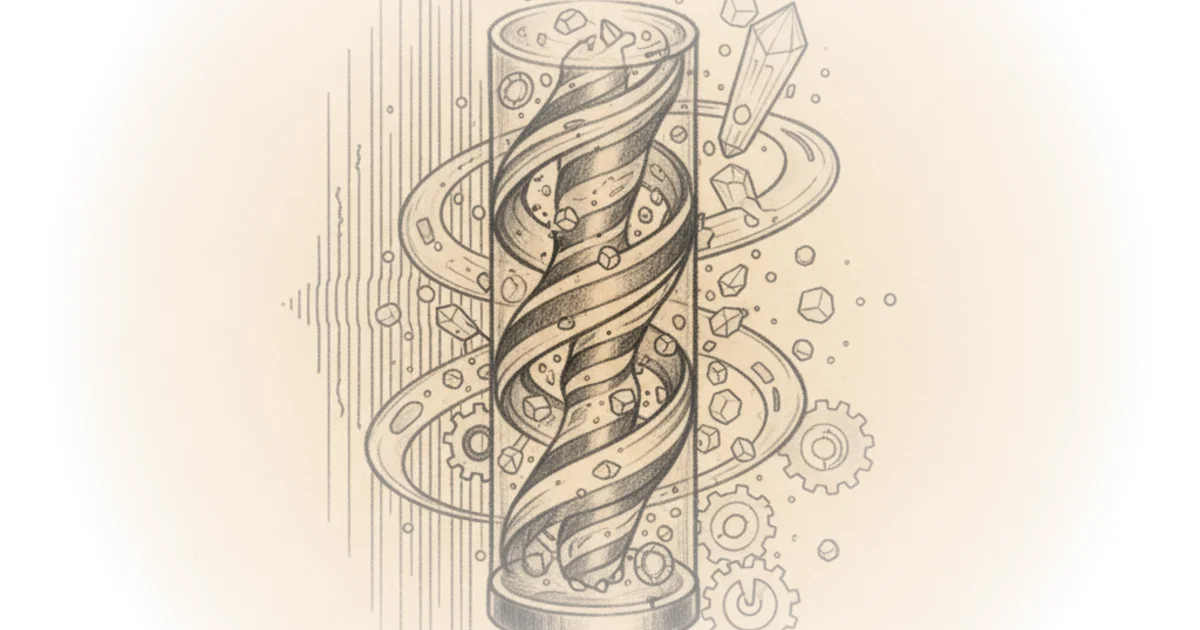
Sanderson begins with the setup: white light passes through a linear polarizing filter, emerging "wiggling in Just One Direction." He's careful to defer full explanation—question number zero, he says, is "what exactly is wiggling which is to say what is light?" This is classic Sanderson. He wants you to sit with that question before answering it.
The Twist That Separates Color
The core of the phenomenon is this: sucrose is a chiral molecule. Its handedness means it interacts differently with right-handed versus left-handed circularly polarized light. "The slightly different effects that it has on right-handed versus left-handed circularly polarized light ends up explaining the twist."
Sanderson emphasizes that as different colored waves propagate through the tube, they twist at different rates—violet fastest, red slowest. This is crucial: "the rate at which it's getting twisted depends on the frequency of the light." Higher frequencies get twisted more quickly.
But here's what's counterintuitive: even though all colors have been rotated differently, "the light at that point is still white... if you were to stick your eye inside the tube and look towards the lamp you would see white."
Sanderson writes with precision when he notes that this separation only becomes visible after passing through a second filter. The amount of light of any given frequency that passes equals "the component of its polarization direction that lines up with the filter." Colors aligning closely with vertical pass through almost completely; perpendicular colors barely get through.
This explains why rotating either filter rotates the family of distinct hues you see.
Why Diagonal Stripes Appear Sideways
The most visually arresting part is what happens when you view the cylinder from the side: those diagonal stripes. Sanderson acknowledges this seems odd. "Why would viewing it from the side change what you see?" He notes that at any point down the tube, all colors are still white—they haven't separated yet.
The explanation comes from scattering: "when light scatters off of a material it's not like some projectile bouncing in any old Direction—the direction of scattering depends on the direction of polarization." This dependency explains both why stripes appear and why they're diagonal rather than vertical or horizontal.
If you want to really understand what you're looking at with that deep-to-your-bones satisfying sense of what's going on, it requires having very solid intuitions for a number of different fundamental concepts about light.
What Readers Should Watch For
Sanderson promises this is just the beginning. Future videos will tackle the "why" questions: how circularly polarized light works, why sucrose's chiral nature causes twisting, and where the frequency dependence comes from mathematically.
The most interesting tension here is that even after understanding both the twist mechanism and its frequency dependence, there's still something seemingly asymmetric about viewing the side view—something Sanderson admits had him scratching his head. The diagonal stripes seem to violate what should be "completely symmetric from top to bottom."
Bottom Line
Sanderson's strongest move is acknowledging that this phenomenon feels intuitive only after you have deep knowledge of several foundational optics concepts. His vulnerability is leaving viewers suspended at the edge of understanding—knowing something unusual happens without fully grasping why.
The piece works because it resists the temptation to hand down easy answers. Instead, it positions the viewer to discover the explanations themselves. This approach transforms what could be a simple demonstration into genuine intellectual satisfaction—and that's precisely why people return to 3Blue1Dor.