In an era where scientific literacy often feels like a casualty of political polarization, this episode of Big Biology offers a rare blueprint for how the next generation is reclaiming the narrative. The piece doesn't just profile a student; it documents a strategic pivot from passive research to active civic engagement, suggesting that the future of science depends as much on advocacy as it does on discovery.
The Shift from Lab to Podium
Big Biology introduces JP Flores not merely as a bioinformatics PhD candidate at UNC Chapel Hill, but as a practitioner of a new kind of scientific citizenship. The editors frame his journey as a direct response to a widening gap between complex data and public understanding. "How can grad students advocate for science policy?" the piece asks, immediately setting a tone of urgent inquiry rather than academic abstraction. This is a crucial distinction; it moves the conversation from "what did we find?" to "how do we make sure it matters?"
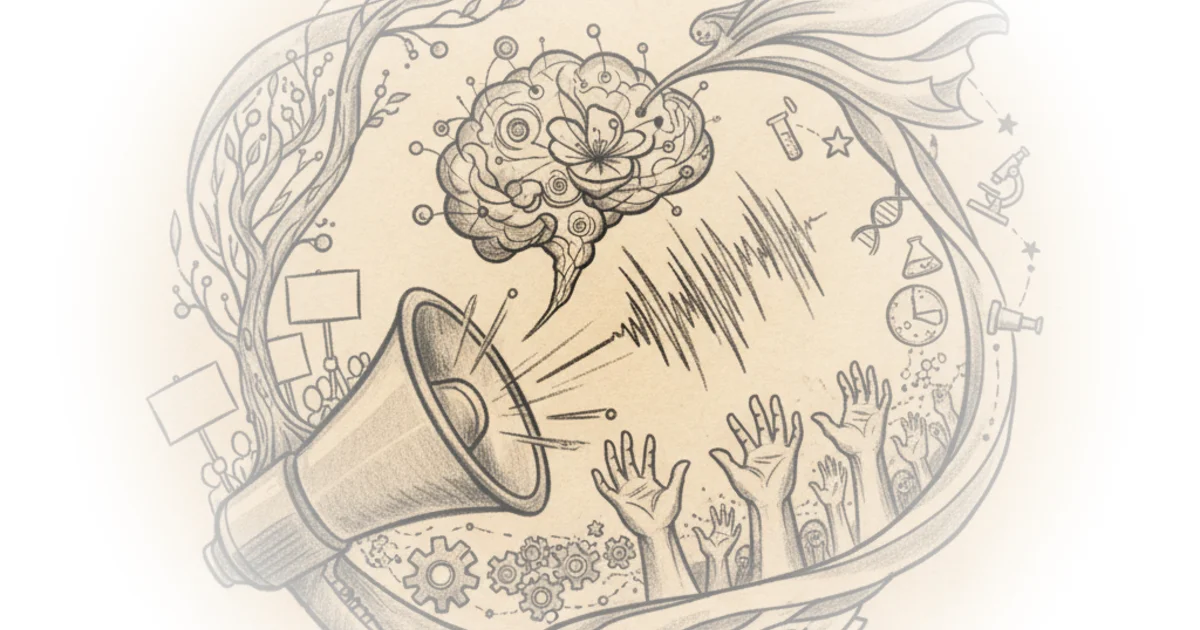
Flores's work bridges the gap between the ivory tower and the street corner. The article notes that he "hosts the award-winning podcast From where does it STEM?" and has "worked in science policy as an intern at the National Institutes of Health." By highlighting these dual roles, Big Biology argues that the siloed nature of modern academia is no longer sustainable. The piece suggests that "science communication make[s] research more accessible and inclusive," a claim that resonates deeply given the current public distrust in institutional expertise. This framing is effective because it positions communication not as a soft skill, but as a hard requirement for scientific integrity.
"Science communication makes research more accessible and inclusive."
Critics might argue that focusing on individual advocates like Flores places too much burden on students to fix systemic failures in public funding and political will. While one person's passion is inspiring, it cannot replace the need for structural reform in how science is funded and regulated. However, the editors wisely contextualize Flores's work within a broader movement rather than presenting him as a solitary hero.
From Protest to Policy
The most compelling section of the coverage details how Flores moved from theory to tangible action. The editors report that "Earlier this year, JP helped to organize the Stand Up for Science 2025 protest." This is not a minor footnote; it represents a generational shift where researchers are willing to take to the streets to defend the very institutions that employ them. The piece connects this activism directly to institutional outcomes, noting that "as a result of the movement, co-founded the non-profit Science for Good."
This trajectory—from organizing a protest to founding a non-profit—demonstrates a sophisticated understanding of leverage. Big Biology argues that "JP does more than just research," implying that the traditional definition of a scientist is incomplete without an advocacy component. The editors note his involvement with the "Science Policy and Advocacy Group at UNC," suggesting that universities are slowly beginning to recognize that their students are natural allies in the policy arena. This is a vital development for the scientific community, which has often struggled to find a seat at the policy table.
The narrative here holds up because it avoids the trap of romanticizing protest. Instead, it focuses on the result of the protest: the creation of a new organization. This grounds the emotional energy of the movement in concrete, long-term strategy. It answers the skeptical reader's question: "What happens after the signs come down?"
Bottom Line
The strongest part of this coverage is its refusal to treat science communication as a secondary activity; it presents it as a core competency for the modern researcher. The biggest vulnerability lies in the lack of detail regarding the specific policy victories achieved by "Science for Good" so far, leaving the reader to trust the potential rather than the proven track record. For busy professionals, the takeaway is clear: the future of science belongs to those who can speak its language to the public, not just to each other.