In a landscape often cluttered with partisan noise, N.S. Lyons offers a chillingly coherent diagnosis of our current political moment: the collapse of the barrier between state and society is not an accident, but the deliberate design of a global managerial elite. This piece is essential listening because it reframes the rise of "global governance" not as a noble pursuit of human rights, but as a self-perpetuating engine of technocratic control that has quietly dismantled the private sphere. Lyons argues that the fusion of public and private power has created a system where dissent is not just illegal, but financially impossible.
The Bipartisan Architecture of Control
Lyons builds his case on a startling revelation: the drive to transform national governments into instruments of global governance was a project shared by both the neoliberal and neoconservative wings of American politics. He points to the post-Cold War era as the moment this machinery was fully unleashed. "Pinkoski expertly reveals just how bipartisan the scheme to transform national 'government' into global 'governance' was," Lyons notes, highlighting how opposing political factions worked in lockstep to expand state reach. The evidence he cites is damning, including a declaration from Bill Clinton's National Security Advisor that the strategy would be to "pursue our goals through an enlarged circle not only of government officials but also of private and non-governmental groups."
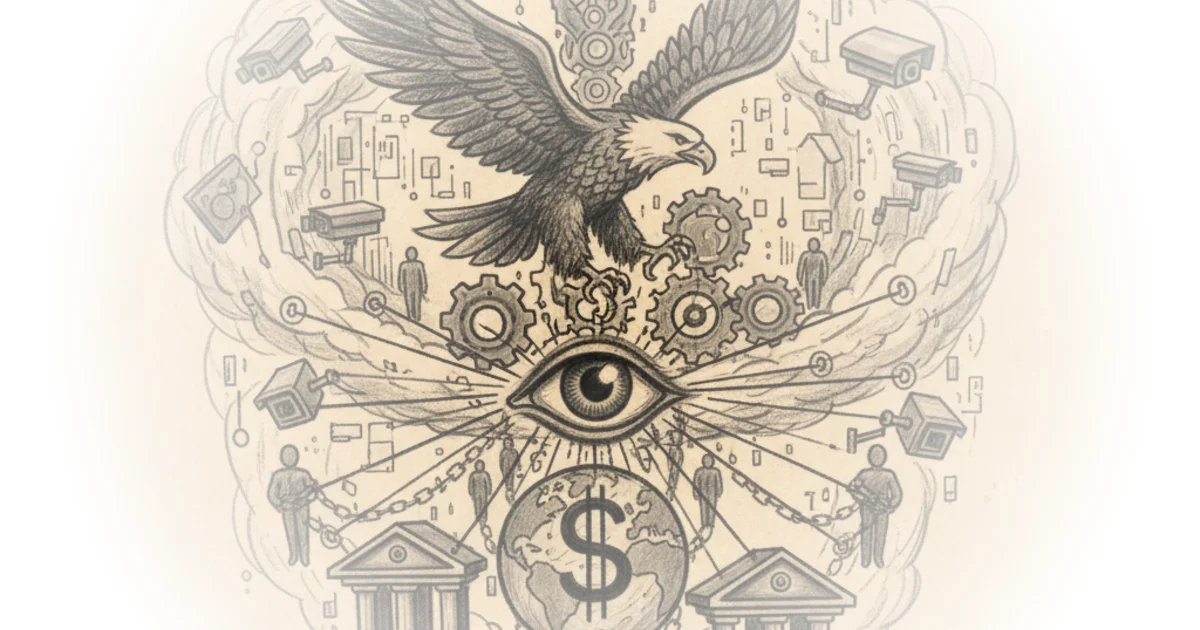
This framing is powerful because it strips away the illusion of political debate. Lyons suggests that whether the rhetoric was about fighting terrorism or promoting human rights, the mechanism remained the same: the use of private financial power to enforce public policy goals. He points out that the concept of Environmental, Social, and Governance (ESG) investing was not invented by shadowy left-wing cabals, but by the George W. Bush administration's national security staff, who realized that "private finance 'could drive the isolation of rogue entities more effectively than governments.'" The implication is clear: the tools of coercion were outsourced to the very institutions that claim to be neutral.
The fusion of state and society, politics and economics, means political dissidents and cultural thought criminals can now regularly find themselves de-banked by putatively private institutions.
Critics might argue that financial regulations are necessary for stability and that the "de-banking" of bad actors is a legitimate tool of modern statecraft. However, Lyons counters that the definition of "bad actor" has expanded so broadly to include ideological dissent that the system itself has become the threat. He notes that in 2021, the former President stood with establishment opponents to declare that the real threat to America comes from "extremists at home," effectively justifying the application of the same coercive regimes abroad against domestic populations.
The Managerial Doom Loop
Lyons goes deeper than policy analysis, proposing a sociological theory to explain why this expansion is inevitable. He introduces the concept of "managerialism," a system where a professional class of experts justifies its own perpetual growth by manufacturing complexity. "The evolutionary genius, so to speak, of managerialism is that it functions constantly to justify its own perpetual expansion," Lyons writes. He describes a "managerial doom loop" where the need for more managers creates more complexity, which in turn demands more managers, creating a self-sustaining cycle of bureaucratic bloat.
This is a crucial distinction. While many commentators blame specific politicians or parties, Lyons identifies the engine as a structural feature of modern civilization. He argues that the end of the Cold War was the catalyst that allowed "liberal managerialism" to break free from its last constraints. With the Soviet Union gone, the Western elite felt a "giddy urge to fulfill their manifest destiny by expanding the mandate of their managerial apparatus to an unprecedented, truly global scope." The nation-state, in this view, became an obstacle to the efficient management of the world.
The author's analysis of the ideological underpinnings is particularly sharp. He suggests that the managerial elite congealed around a consensus that elevates them to a position of moral superiority. This ideology includes a "devotion to the 'liberation' of individuals from all former norms and constraints" and an incentive to flatten cultural particularities to create "undifferentiated human material." Lyons writes that this is not merely about policy, but about a "spiritual principle" that became a resolve to "construct a new national, social, and cultural identity" based on Western guilt and a quasi-theological belief in open borders.
The objects of managerial ambition become 'global problems' necessitating 'global solutions' and indeed 'global governance.'
A counterargument worth considering is whether this "managerial class" is truly a monolithic entity or simply a collection of competing interests that occasionally align. Lyons treats them as a cohesive flock with a single personality, which risks oversimplifying the messy reality of bureaucratic infighting. Yet, his observation that these elites behave with "flock-like similarity" across different institutions and borders remains a compelling explanation for the uniformity of global policy responses.
The Triumph of Liberalism Unbound
Perhaps the most provocative claim in the commentary is that what some call "postliberalism" is actually the ultimate victory of liberalism itself. Lyons argues that the current system is not a betrayal of liberal democracy, but its logical conclusion: a world where the state and society are indistinguishable, and where the market is fully subordinated to the goals of the managerial elite. "What he describes as 'postliberalism' is in fact the triumph of liberalism unbound," Lyons asserts, suggesting that the separation of public and private spheres has been completely erased.
This reframing challenges the reader to reconsider the nature of the current crisis. It is not a failure of the system, but a success of its original, hidden design. The "hellscape of technocratic 'global governance'" is the result of a deliberate project to isolate "backlash states" and manage the flow of "human capital" on a planetary scale. Lyons concludes that the events we witness today, from the expansion of the European Union to the surveillance of global finance, are simply the inevitable outcomes of a system designed to grow without limit.
The end of the Cold War proved a transformative moment because, with the collapse of the Soviet Union, the Western liberal managerial regime appeared to have triumphed over its last remaining major competitor.
Bottom Line
N.S. Lyons provides a terrifyingly lucid map of how the modern world became a managed system, arguing that the erosion of privacy and national sovereignty was a deliberate, bipartisan project of the managerial elite. While his theory of a monolithic "managerial class" may overlook internal friction, his identification of the "managerial doom loop" offers a powerful explanation for why these systems resist reform. The strongest takeaway is the realization that the tools of control are not external threats, but the very institutions we rely on for stability, now operating under a logic of perpetual expansion.