Sara Ahmed delivers a searing critique of a recent UK Supreme Court ruling that redefines legal womanhood through a rigid biological lens, arguing that the decision is not a victory for women's rights but a "patriarchal hammer" striking at the heart of feminist history. While mainstream coverage often treats this as a legal technicality regarding the Equality Act, Ahmed reframes the issue as a profound erasure of decades of feminist scholarship that has long understood biology as a social construct. For busy readers navigating a shifting political landscape, this piece offers a crucial corrective: the ruling doesn't just change definitions; it actively rewrites the legislative intent of protections meant for transgender people.
The Myth of Biological Clarity
Ahmed immediately dismantles the court's premise that "biological sex" is a plain, unambiguous term. She writes, "I call the judgement a patriarchal hammer." This metaphor is potent because it suggests a tool of force rather than a tool of interpretation, implying that the court is imposing a specific worldview rather than discovering a neutral truth. The author, a cis lesbian of colour with a background in workplace equality research, argues that the court's reliance on "common use" is a fabrication. She notes that the ruling claims sex refers only to biological sex, yet the word "biological" does not even appear in the original 2010 Act. By importing this term and treating it as self-evident, the judges have created a new legal reality that contradicts the text they were supposed to interpret.
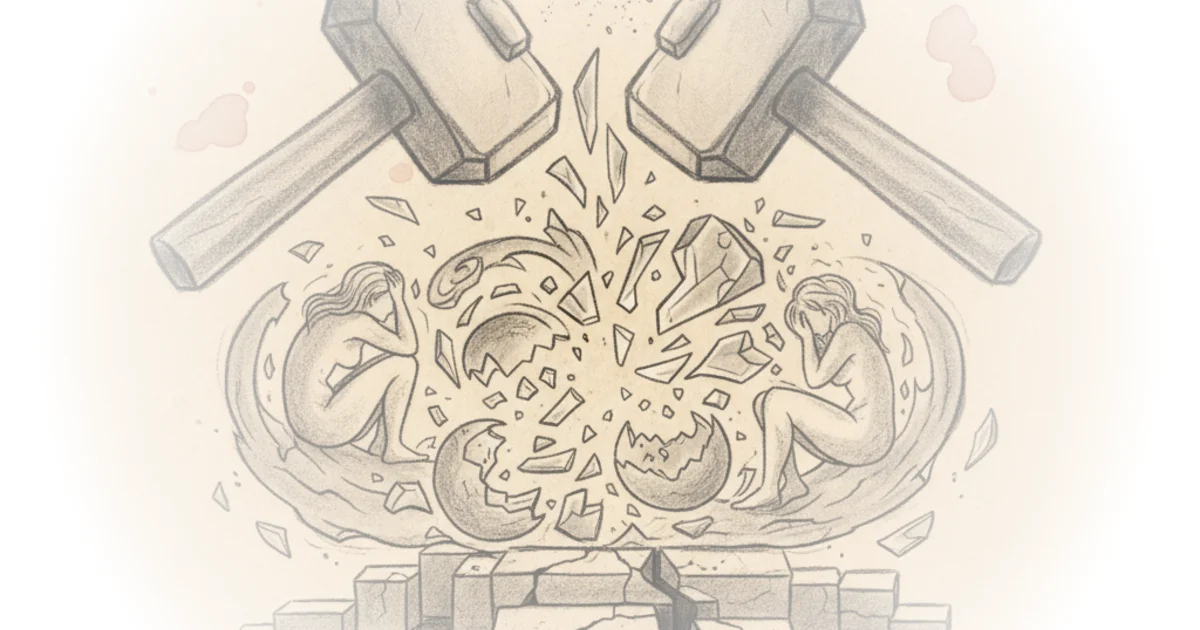
The core of Ahmed's argument rests on the historical record of feminist thought, which has consistently challenged the idea that biology is destiny. She cites biologist and feminist Ruth Hubbard, who argued that "women's biology is a 'social or political construct' and 'not a scientific one.'" This is a critical distinction. Ahmed explains that Hubbard viewed biology as constructed in three ways: through the social expectations that shape our bodies, through the male-dominated history of scientific study, and through our own internalized concepts of self. By ignoring this lineage, the court has effectively silenced generations of feminist inquiry. Critics might argue that legal clarity requires fixed definitions, but Ahmed counters that this "clarity" is achieved only by excluding the messy, complex reality of human biology, such as intersex variations and hormonal differences.
"The reasoning adopted, and the relentless desire to police 'what is a woman' can only hurt our wider communities."
The Collapse of Legislative Intent
Perhaps the most damning part of Ahmed's analysis is her examination of the gap between the court's interpretation and the actual intent of the lawmakers who drafted the legislation. The Supreme Court claimed to be deciphering the "legislative intent" of the Equality Act, but Ahmed points out that the very officials who wrote the law disagree with this reading. She quotes Melanie Field, a civil servant involved in drafting the Act, who stated, "what I'm saying is that the basis on which the act was drafted was not to give sex the meaning that they have concluded it has."
Ahmed goes further, citing Lord Filkin, who introduced the Gender Recognition Act in 2003. Filkin explicitly stated that the bill was about legal recognition, noting, "Once recognition has been granted, they will be able to claim the rights appropriate to that gender." This direct evidence suggests that the court has not merely interpreted the law but has actively overturned the original purpose of the statute. Ahmed argues that the court's distinction between "statutory interpretation" and "public adjudication" is a "self-serving" maneuver to avoid acknowledging the political nature of their decision. By claiming they are only looking at the "plain meaning" of words, they ignore the fact that language is fluid and that the direction of traffic for terms like "sex" and "gender" had already shifted toward inclusivity before this ruling.
The Immediate Human Cost
The commentary does not linger in abstract legal theory; it moves swiftly to the tangible consequences of the ruling. Ahmed highlights how quickly the political establishment has moved to adopt the court's logic, noting that within days, the Prime Minister declared that trans women are not women and that women are simply "adult females." She writes, "We are witnessing a fundamental attack on the rights of trans women to live safely, with dignity, and to participate in public life." This is not just a semantic dispute; it is a policy shift that threatens to strip trans women of their protected status under the Equality Act.
Ahmed warns that the ruling will have an immediate impact on the workplace, where institutions may rush to change policies not because they agree with the logic, but because the judgment has given hostile groups "more tools to bring grievances." She describes this as "increasing the costs of non-compliance," a powerful tool for "adjudicating meaning" that forces organizations to conform to a narrow definition of sex to avoid legal trouble. The author emphasizes that this outcome was predictable, driven by a small group of "gender critical" feminists who have dominated the media narrative to the exclusion of other feminist voices. As she puts it, "The many feminists who have argued against the biologisation of sex have been so routinely ignored that if you picked up a mainstream paper in the UK, you would not even know they existed."
Bottom Line
Sara Ahmed's piece is a vital intervention that exposes the Supreme Court's ruling as a political act disguised as legal neutrality, effectively dismantling decades of feminist scholarship on the social construction of biology. While the argument relies heavily on historical and theoretical precedents that may feel abstract to some, its power lies in connecting these intellectual traditions to the immediate, dangerous reality of policy changes in the UK. The piece's greatest strength is its unflinching exposure of the gap between legislative intent and judicial interpretation, a gap that now threatens the safety and dignity of trans women across the country.