Matt O'Dowd tackles one of modern physics' most polarizing concepts not by dismissing it as science fiction, but by rigorously interrogating whether the multiverse violates the very rules of scientific inquiry it claims to uphold. While critics often dismiss the idea as "bad science," O'Dowd argues that the multiverse may actually be the most parsimonious explanation for a universe that seems improbably fine-tuned for life. This is not a speculative fantasy; it is a logical consequence of our best theories on quantum mechanics and cosmic inflation, and O'Dowd's defense forces us to reconsider what we mean by "evidence" in an era where the observable universe might just be the tip of a colossal iceberg.
Redefining the Cosmic Container
O'Dowd begins by dismantling the semantic confusion that often derails the conversation. He notes that the original definition of "universe" as the totality of all existence makes the word "multiverse" nonsensical. However, he pivots to the modern usage, where "universe" refers to a specific continuous spacetime tracing back to a particular Big Bang. "If the laws of physics change over extremely long distances, there could be regions of a vast connected spacetime that operate very differently to here," O'Dowd writes. This distinction is crucial; it transforms the multiverse from a philosophical abstraction into a potential physical reality where different regions obey different rules.
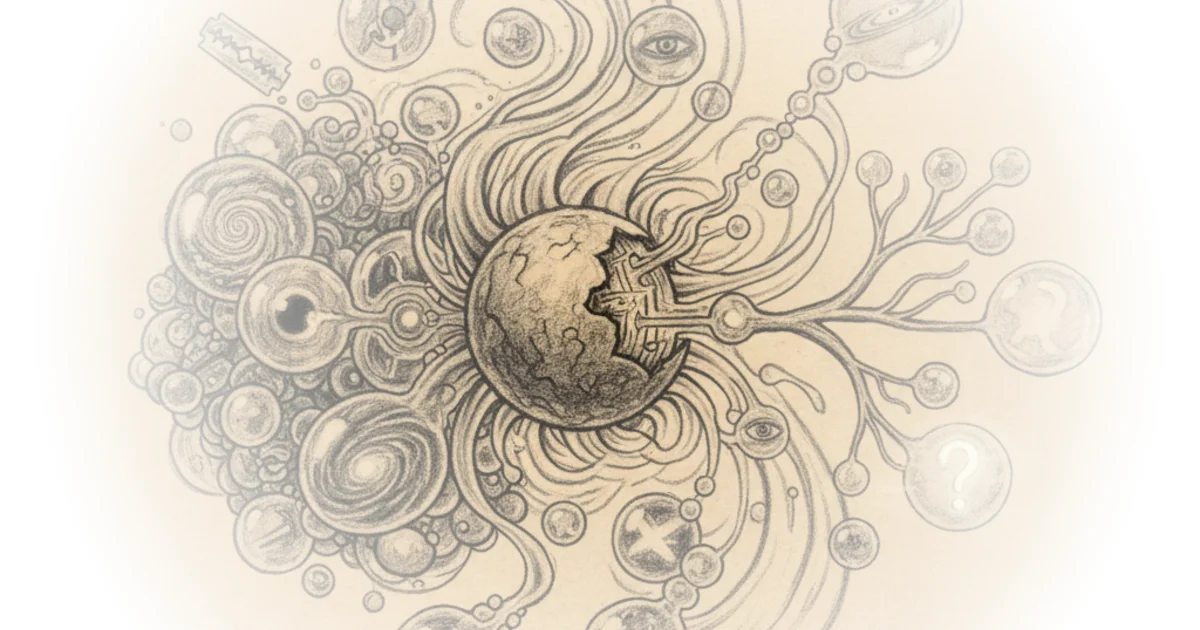
He outlines several mechanisms that could generate these divergent realities, from the "quilt multiverse" to the "eternal inflation hypothesis" where bubbles of spacetime form with varying physical laws. The author suggests that the most compelling version involves the "string landscape," a concept derived from string theory where the geometry of extra dimensions determines particle physics. "This leads to an enormous number of possible configurations for the ground or vacuum state, at least 10 to the power of 500 of them," O'Dowd explains. The sheer scale of this landscape implies that almost every possible combination of physical laws exists somewhere. This framing is effective because it grounds the multiverse in mathematical necessity rather than whimsy, suggesting that our universe's specific laws are just one random draw from a massive lottery.
Critics might argue that positing 10^500 universes is the ultimate violation of scientific rigor, turning physics into a game of "anything goes." However, O'Dowd counters that this is a misunderstanding of how the theory works; the multiverse isn't an assumption added to save the theory, but a prediction that emerges from it.
The Fine-Tuning Dilemma
The core of O'Dowd's argument rests on the anthropic principle, a concept often used to explain why our universe seems so perfectly calibrated for life. He argues that we should not be surprised to find ourselves in a universe capable of supporting observers, simply because we couldn't exist in one that wasn't. "At some levels, it's not in the least controversial," O'Dowd writes, comparing it to finding ourselves in a rare, habitable biosphere within a vast, mostly empty cosmos. The logic extends seamlessly: if a multiverse exists, it is statistically inevitable that at least one universe would have the right conditions for life.
He emphasizes that the parameters of our universe, such as the mass of the Higgs boson or the strength of dark energy, appear "finely tuned." Change them slightly, and life becomes impossible. "Coupled with the anthropic principle, the multiverse gets us out of having to explain why these specific laws and in a way also gives an explanation for why the physics of our universe seems finally tuned to allow life," he states. This is a powerful rhetorical move. It shifts the burden of proof from explaining why the universe is perfect for us to explaining why we are here to observe it. The multiverse becomes a selection bias rather than a design.
"It's a selection bias just like the bias that leads us to observing the universe from an unusually warm wet biosphere."
The Razor's Edge: Parsimony and Size
Perhaps the most sophisticated part of O'Dowd's commentary is his defense of the multiverse against Occam's razor—the principle that one should not multiply entities beyond necessity. Skeptics argue that postulating infinite universes is the ultimate act of multiplying entities. O'Dowd refutes this by clarifying that Occam's razor applies to the number of assumptions or causes in an explanation, not the number of outcomes or the sheer size of the result.
He draws a parallel to historical scientific shifts where humanity had to accept increasingly "preposterous" sizes to explain reality. "The ancients rejected the idea that the earth is moving around the sun because if that were so, then the distant stars should appear to change position relative to each other due to parallax," O'Dowd notes. They assumed the universe must be small enough for parallax to be obvious. We now know the universe is vast, and that assumption was the real error. Similarly, he argues, "the size or number of universes doesn't necessarily map to the number of new prior assumptions that we would use to weigh our hypothesis against Occam's razor."
This distinction is vital. If a theory like string theory or eternal inflation is simple and elegant in its fundamental rules, the fact that it predicts a vast multiverse does not make the theory complex. "The parsimony of a given multiverse theory is really equivalent to the parsimony of the theory that predicts the multiverse," O'Dowd concludes. This reframing forces critics to attack the underlying theories (like string theory) rather than the multiverse itself, which is a much harder target to hit.
The Falsifiability Trap
Finally, O'Dowd addresses the accusation that the multiverse is "unfalsifiable" and therefore bad science. He acknowledges that under a strict Popperian definition of science—where a theory must be disprovable by experiment—the multiverse might fail. However, he argues for a more relaxed, pragmatic view of scientific inquiry. "If something is potentially part of reality, then it's in principle approachable by scientific methods," he writes. He points out that we already accept the existence of regions beyond our particle horizon that we cannot see or touch, yet we do not dismiss them as unscientific.
A counterargument worth considering is that without a way to test the multiverse directly, the theory risks becoming unfalsifiable in practice, not just in principle. If every observation can be explained by "we just happen to be in this universe," the theory loses its predictive power. O'Dowd hints at this tension but maintains that logical consistency and the ability to explain fine-tuning are valid scientific tools in their own right.
Bottom Line
Matt O'Dowd's strongest argument is his redefinition of parsimony, successfully decoupling the complexity of a theory's predictions from the complexity of its foundational assumptions. His biggest vulnerability lies in the practical limits of falsifiability; while logically sound, the multiverse remains difficult to test empirically, leaving it perpetually on the fringe of the scientific method. Readers should watch for future developments in cosmological signatures that might provide indirect evidence for these other universes, as that is the only way to move the debate from philosophy to hard physics.