In a landscape often dominated by conspiracy theories and political posturing, Economics Explined cuts through the noise to ask a terrifyingly simple question: What if the United States actually tried to dismantle its central bank? The piece is notable not for predicting an imminent collapse, but for revealing how deeply the Federal Reserve is woven into the fabric of the global economy, arguing that while scrapping the Fed is "borderline impossible," the political will to do so is growing more dangerous by the day.
The Historical Pendulum
Economics Explained anchors the current debate in a forgotten reality: the Federal Reserve is not a permanent fixture, but a recurring experiment. The author writes, "Central banks have been abolished before, including in the USA," a fact that often surprises modern readers who view the institution as an immutable law of nature. The piece traces a chaotic history where Alexander Hamilton's original vision for a national bank was repeatedly dismantled, most notably by President Andrew Jackson, who "did not like how much power the institution had."
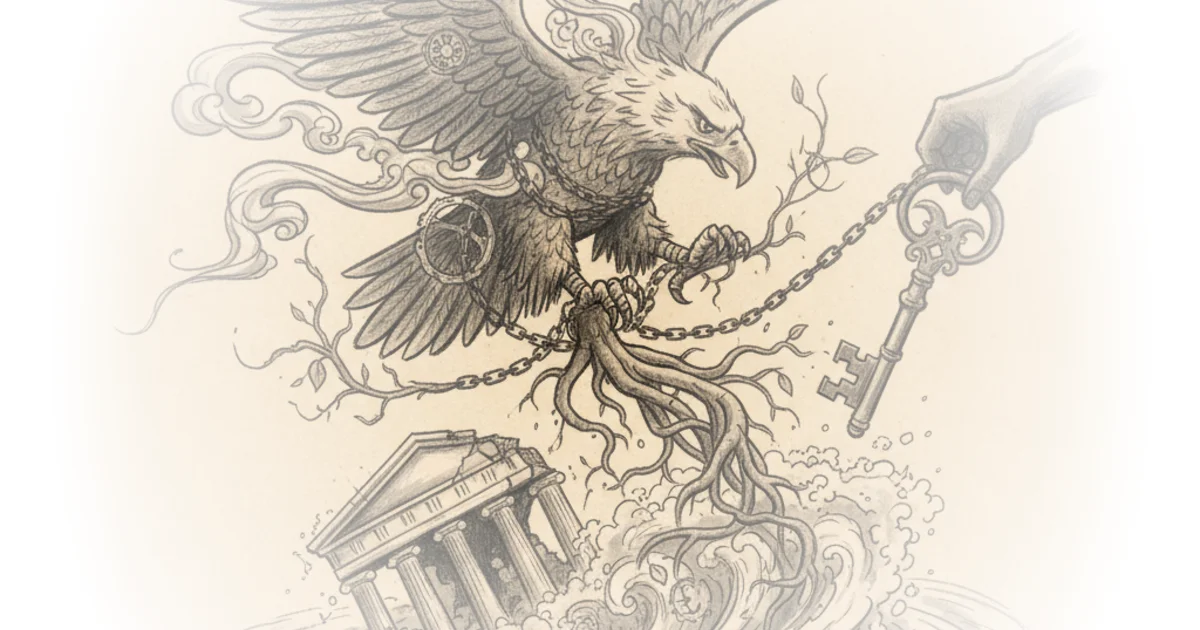
This historical context is crucial because it reframes the current political rhetoric not as a new anomaly, but as a return to a recurring American tradition of distrusting centralized financial power. The author notes that early iterations were "compromised at best" because they were private entities with profit motives trying to serve public goals. This tension between private profit and public stability remains the core vulnerability of the system today.
"With such powerful institutions acting in such unintuitive ways with so much of a consequence on our everyday lives, it's almost understandable that people just assume that something sinister is going on in these places."
Critics might argue that the comparison between the 19th-century banking system and the modern Federal Reserve is flawed; the stakes of a 1907 bank run were local, whereas a modern collapse would be global. However, the author effectively uses this history to show that the political friction between elected officials and technocratic bankers is a feature, not a bug, of American financial history.
The Mechanics of Control
Moving from history to mechanics, Economics Explained demystifies the Federal Reserve's toolkit, stripping away the jargon to reveal a surprisingly simple, albeit powerful, mechanism. The author explains that unlike the government, the Fed cannot simply hire people to solve unemployment. Instead, they rely on two levers: interest rates and open market operations. The piece describes interest rates as a "Rube Goldberg machine," where the Fed adjusts the overnight rate to influence banks, which then influences borrowing, which finally influences prices.
This analogy is effective because it highlights the indirect, lagging nature of monetary policy. The author writes, "Interest rates are kind of like the brake pedal on the economy. If things are getting out of hand, they can be used to slow down inflation. However, in doing so, they will also slow down economic growth." This trade-off is the central dilemma facing policymakers today. The commentary correctly identifies that the Fed's power is not absolute; it is a blunt instrument that affects the entire economy, often with unintended consequences for specific sectors.
The discussion on open market operations further clarifies how the Fed injects liquidity. The author notes that in times of crisis, the Fed engages in "quantitative easing, where the Fed will create money and use it to pump liquidity into the market." This is a critical distinction: the Fed does not just move existing money; it creates new money to purchase assets like government bonds and mortgage-backed securities. This ability to "bippity boop their own cash into existence" is what makes the institution so powerful, yet also so politically vulnerable.
"The Fed is the most powerful financial institution on the planet, and unwinding its place in the global economy, would be borderline impossible."
A counterargument worth considering is that while the Fed is powerful, its recent inability to perfectly predict inflation or manage the balance sheet suggests its tools are becoming less effective in a highly integrated, digital global economy. The author acknowledges this by noting that the Fed is currently running a "large loss" because the interest it pays on bank deposits exceeds the interest it earns on its long-term bond holdings.
The Modern Dilemma
The piece concludes by addressing the immediate financial reality facing the Federal Reserve: a paradoxical situation where the institution is losing money. Economics Explined writes, "Unfortunately for the Fed right now, it's actually running at a large loss." This occurs because the Fed bought bonds at low interest rates during the pandemic and now must pay higher rates to banks to keep deposits from fleeing. While the author correctly points out that this doesn't technically matter since the Fed can create money to cover losses, it provides a potent political weapon for those wishing to attack the bank's independence.
The author suggests that political opponents could use these losses to "shake up management at the Federal Reserve," turning a technical accounting issue into a crisis of legitimacy. This is the most urgent part of the argument. The Fed's independence relies on public trust, and a narrative of financial incompetence, even if technically irrelevant to its solvency, could erode that trust. The piece implies that the greatest threat to the Fed is not a lack of tools, but a loss of political cover.
"If one was hypothetically politically motivated to shake up management at the Federal Reserve, they could point out these massive financial losses, and to the vast majority of people, that would look like incompetence."
Bottom Line
Economics Explained delivers a sobering verdict: the Federal Reserve is too big to fail, but its political shield is cracking under the weight of its own financial losses and historical distrust. The strongest part of the argument is the historical framing that reminds us the Fed has been abolished before, making the current political threats less abstract and more plausible. Its biggest vulnerability, however, is the assumption that the global economy can absorb the shock of a Fed without a central bank, a scenario the author admits is "borderline impossible" to unwind but politically tempting to attempt. Readers should watch for how the Fed's current losses are weaponized in upcoming election cycles, as this could be the catalyst for the very institutional crisis the author describes.