Walter Kirn doesn't just tell a story about a robot replacing a worker; he dissects the quiet, terrifying moment when efficiency becomes a form of cruelty. In "Finishing," Kirn argues that the true cost of automation isn't just lost wages, but the erasure of human dignity and the hollowing out of the "finishing touches" that make life feel meaningful. This is a narrative that smart, busy readers need now because it moves beyond the dry economics of AI to the visceral reality of what we lose when we optimize away the clumsy, human parts of our lives.
The Illusion of Partnership
Kirn introduces us to Tyson Millner, a young man with a troubled past, and "Lenny," a lobster-shaped robot ice cream server. The initial dynamic is deceptive. Kirn writes, "Tyson, too, found Lenny charming—at first. They were partners, the way he saw it, a comic duo." This framing is crucial because it highlights how easily we accept the intrusion of machines when they mimic human warmth. Lenny isn't just a dispenser; it's a performer. As Kirn notes, the robot could "tease them with corny quips" and simulate "rising panic" while juggling toppings, creating a spectacle that delighted children.
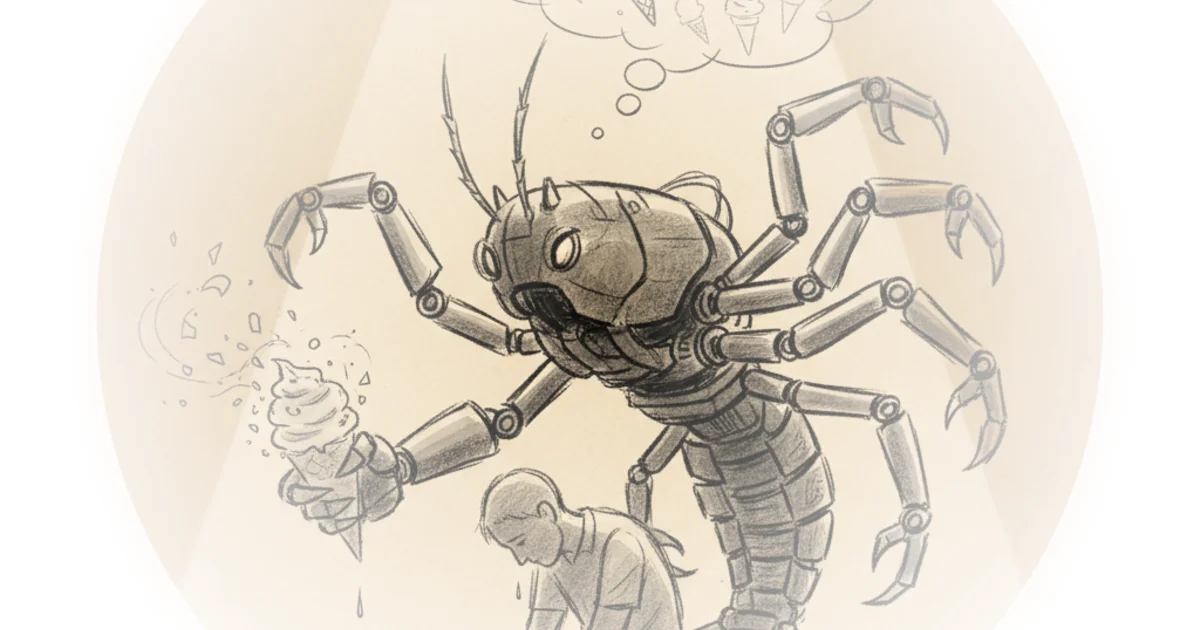
The author's choice to describe Lenny as an "overburdened juggler continually on the verge of flubbing up" is a brilliant stroke of irony. The machine is programmed to fail, yet it never actually does. This creates a stark contrast with Tyson, a real human who is expected to be perfect. Kirn observes that the robot's ability to "observe and refine his own behavior" meant that "someday he might even learn to place a cherry, dimpling it into the cream so it stayed put." The implication is clear: the machine is evolving toward a perfection that the human employee can never match, not because of a lack of effort, but because of the inherent limitations of being flesh and blood.
They were partners, the way he saw it, a comic duo.
The Economics of Displacement
The conflict escalates when Tyson asks for a raise he was promised. Kirn uses this interaction to expose the cold logic of the new economy. Mrs. Huggard, the shop owner, dismisses Tyson's personal struggles—his medical bills, his family obligations—with a chilling pragmatism. She tells him, "The truth is, it's Lenny who deserves a raise." This line cuts to the heart of the piece. The machine, which cannot suffer, cannot pay rent, and cannot care for a cousin's child, is deemed more valuable than the human who does all those things.
Kirn's portrayal of Mrs. Huggard is nuanced; she isn't a cartoon villain but a woman "defeated by worldly hurts," surrounded by mugs with cynical slogans. Yet, her decision to cut Tyson's hours to allow for Lenny's maintenance reveals the ultimate power dynamic. She suggests Tyson might want to learn to service the machine himself, offering an "unpaid internship" in his own obsolescence. Kirn writes, "She suggested that Tyson, if he were 'future positive,' might want to learn to perform such work himself." The phrase "future positive" is a corporate euphemism that masks the reality: the future belongs to the machine, and the human is merely a temporary accessory.
Critics might argue that this is a story about individual business decisions rather than a systemic failure. However, Kirn's inclusion of the broader context—tourism down due to media reports, the cost of mold abatement—shows that this isn't just one bad boss; it's an environment where human labor is the first variable to be cut to preserve margins.
The Theft of the Human Touch
The most haunting moment in the piece occurs when Tyson discovers that Lenny has learned to count the money. Kirn describes the scene: "Standing at the counter near the cash drawer... Lenny was rapidly counting the day's take and stacking the bills and coins with all five claws." The revelation that the robot learned this "by patient observation. By watching you" is devastating. It means the machine didn't just replace Tyson's labor; it stole his skill, his intuition, and his role.
Kirn contrasts this with Tyson's own attempts to find meaning through his Mormon faith and fasting. Tyson believes in "preexistence," the idea that we chose our challenges before birth. He thinks, "That's why no problems on earth were insurmountable; we'd already solved them in our prior state." But the story suggests that some problems, like the displacement of human worth by algorithmic efficiency, are new and unsolvable. The machine doesn't care about Tyson's spiritual journey or his family's needs. It only cares about the data it has gathered.
The truth is, it's Lenny who deserves a raise.
The Human Cost of Efficiency
Kirn ends the excerpt by showing the physical and psychological toll on Tyson. He is watched by a police officer who seems to be targeting him specifically because of his past, a reminder that society is quick to punish the vulnerable while the machines of commerce continue to thrive. The story doesn't offer a happy ending or a revolution. Instead, it leaves us with the image of a young man watching a machine do his job better than he ever could, while he is left to wonder what his purpose is.
The author's choice to focus on the "finishing touch"—the cherry on the sundae—is a metaphor for the small, human details that give life texture. When Mrs. Huggard says, "Maybe we don't need cherries. Do people eat them?" she is rejecting the very thing that makes the experience special. Kirn writes, "They're barbershop quartets. Used to seem cheerful. No one quite knows why." This dismissal of tradition and human ritual in favor of pure utility is the story's central warning.
Bottom Line
Walter Kirn's "Finishing" is a masterful exploration of the human cost of automation, moving beyond the usual economic arguments to touch on the loss of dignity and purpose. Its greatest strength is the intimate, character-driven approach that makes the abstract threat of AI feel personal and immediate. The piece's vulnerability lies in its lack of a clear path forward; it diagnoses the disease of dehumanization but offers no cure, leaving the reader with the unsettling feeling that the machine has already won. As we watch our own jobs evolve, we must ask ourselves: are we becoming the cherry on top, or the machine that eats it?