Zichen Wang leverages a state-produced television drama to expose a fundamental tension in China's legal evolution: the clash between the efficiency of punishing the "guilty" and the necessity of protecting the rights of the accused. While the series The Pillar is ostensibly a celebration of the rule of law, Wang argues that its most powerful moments reveal how deeply the system still struggles to separate moral outrage from judicial procedure. This is not merely a review of a show; it is a forensic examination of why defending the unpopular remains the ultimate test of a legal system's integrity.
The Paradox of Order
Wang begins by dismantling the notion that the rule of law is simply a tool for crime control. He writes, "Modern rule of law is more than a static body of statutes and institutions, or the dynamic practice of administration according to law. It is a more comprehensive order in which law is supreme." This distinction is critical because it reframes the legal system not as a weapon for the state, but as a cage for state power itself. The author points to the historical crime of "hooliganism," a catch-all offense used to criminalize vague social deviance, to illustrate the danger of unchecked authority. As Wang notes, "If the sole objective is to crack down on crime, such a vaguely defined offence is undeniably effective: it allows the authorities to treat almost any socially disapproved conduct as an 'other hooligan act.'"
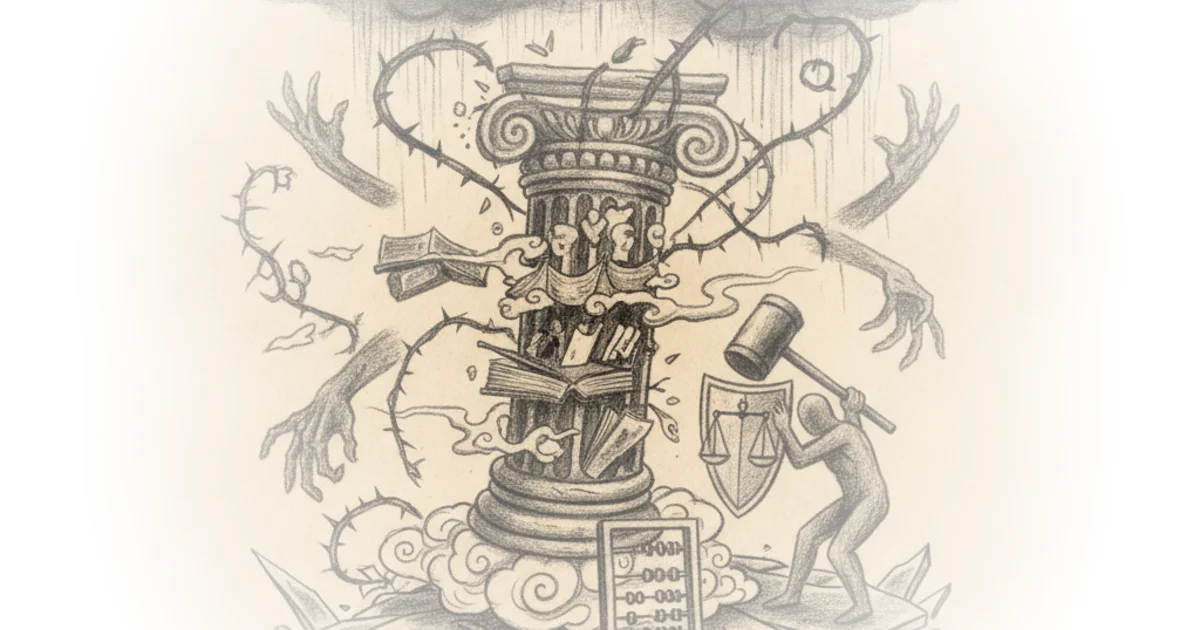
The commentary here is sharp: Wang suggests that the abolition of hooliganism was a necessary step, yet the mindset that created it persists. He recounts a telling anecdote about a retired court president who lamented the loss of the hooliganism charge, admitting, "Without it the judicial authorities now had their hands tied." Wang's retort to this official—that the same standards could easily condemn the official's own family—highlights the fragility of legal protections when they are viewed as obstacles rather than safeguards. This framing effectively strips away the moral high ground of "public safety" to reveal the arbitrary nature of power when law is subservient to political will.
When punishments are unknown, the reach of power is impossible to gauge.
The Cost of Defense
The core of Wang's argument centers on the 1984 "Three Lawyers Shielding a Criminal Case," dramatized in the series as the story of lawyer Li Xiang. Wang describes a scenario where a lawyer is arrested for arguing that evidence was insufficient to support a rape and murder charge, even when the defendant had confessed. "Li Xiang became a defendant because he defended someone else," Wang writes, quoting the fictional lawyer Yuan Yifang. "By the prosecutor's logic, I too should be made a defendant."
This section is the emotional and intellectual anchor of the piece. Wang uses the historical context of the 1983 "Strike Hard Against Crime Campaign" (often referred to as the "Stern Blows" campaign in the text) to show how the demand for swift, severe justice creates an environment where defense lawyers are viewed as enemies of the people. The author notes that in the series, Li is charged with "shielding a criminal, resisting official authority, and leaking state secrets" simply for doing his job. Wang argues that this dynamic creates a terrifying precedent: "If the second [course of action, arguing for acquittal] amounts to shielding a criminal, then every defendant has only one fate: to confess and submit to punishment, even when falsely accused."
The historical reality behind the drama is even more stark. Wang reveals that the real-life lawyers in the 1984 case were not immediately exonerated; they remained "wrongfully implicated for four years" and were only freed after intervention by the National People's Congress Standing Committee. This detail underscores that the struggle for the rule of law is not linear. Critics might argue that in times of social upheaval, the state prioritizes stability over procedural niceties, but Wang counters that sacrificing defense rights ultimately undermines the very stability the state seeks to protect.
The Moral Trap
Wang extends his critique to the cultural mindset that fuels judicial overreach. He invokes the Qing-dynasty philosopher Dai Zhen to warn against the fusion of law and morality: "Cruel officials kill people through the law; later Confucians kill people in the name of principle." The author argues that the legal profession must guard against the "harshness of the ancient Legalists" as well as the "Confucians' use of 'principle' as a weapon."
This distinction is vital for understanding why the public often turns against defense lawyers. Wang observes, "Many remain deeply shaped by a moralistic mindset, believing that anyone who is morally corrupt should be severely punished by the criminal law." He illustrates this with a personal case from twenty years ago where a couple accused of murder was saved from immediate execution only because of a technicality in phone records. Wang admits, "I often wonder whether we won that case or lost it," suggesting that while the defendants' lives were spared, the system's failure to fully embrace the principle of "in dubio pro reo" (when in doubt, acquit) remains a lingering defeat.
The legal profession exists to prevent wrongful convictions to the greatest extent possible.
Bottom Line
Wang's most compelling contribution is his assertion that the legal profession is not an adversary to the state but a necessary component of its legitimacy. He concludes with a quote from the late legal scholar Jiang Ping: "When lawyers flourish, the rule of law flourishes; when the rule of law flourishes, the nation flourishes." The strongest part of this argument is its refusal to accept "order" as a sufficient goal for a legal system; instead, it demands that order be built on the dignity of the individual, even the most despised one. The argument's vulnerability lies in its reliance on the state's willingness to self-correct, as seen in the eventual, albeit delayed, exoneration of the 1984 lawyers. However, by anchoring the discussion in a state-sanctioned drama, Wang forces a public conversation about the limits of power that might otherwise remain silenced.