In a week where digital noise often drowns out legal reality, a quiet administrative denial from the Vatican's Promoter of Justice office has ignited a fresh storm of conspiracy theories regarding the 2013 resignation of Pope Benedict XVI. The Pillar cuts through the speculation to reveal that this sudden attention is not a breakthrough in canonical law, but rather a procedural footnote misinterpreted by those hoping to invalidate the current papacy. For busy readers tracking the stability of global religious institutions, the distinction between a bureaucratic delay and a theological crisis is not just academic—it is the difference between a healthy church and a fractured one.
The Spark of Confusion
The controversy centers on Alessandro Diddi, the Vatican's chief prosecutor, who recently denied a lawyer's request to access files related to a petition claiming Benedict's resignation was invalid. The Pillar reports that Diddi's office stated access could not be granted during an "investigative phase" and that his office "is carrying out investigations and it is not, at present, possible to predict when they will conclude." While this standard legal phrasing was intended to protect an ongoing inquiry into financial matters, it has been seized upon by online theorists as proof that the resignation itself is under review.
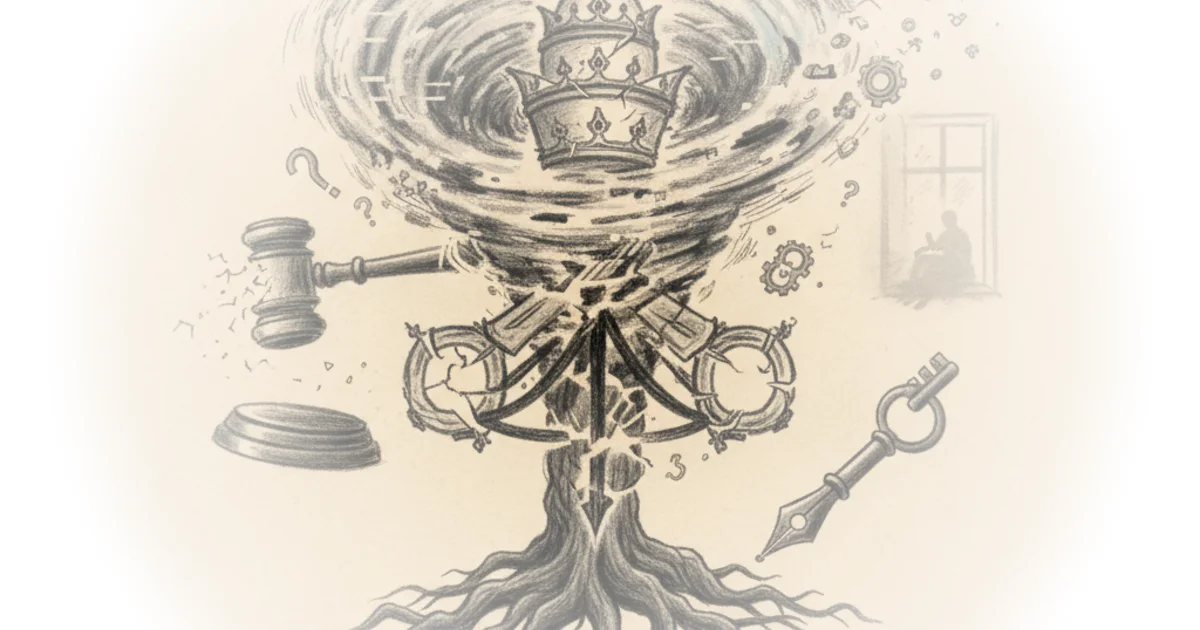
The piece argues that this interpretation is fundamentally flawed, noting that the request was tied to a 2022 book by Andrea Cionci, "The Ratzinger Code," which posits that Benedict placed a deliberately coded invalid resignation in 2013. The editors note that claims like this have spread "across social media like wildfire," yet they lack any grounding in the actual legal process. This is a classic case of a procedural silence being filled with the loudest possible noise. The underlying reality is that Diddi's office is focused on financial scandals, not the metaphysical status of a retired pontiff.
"But is it significant at all, actually? The Pillar explains."
The Theology of Departure
To understand why the conspiracy theories fail, one must grasp the specific legal and theological mechanics of papal resignation, a topic the article handles with refreshing clarity. The Pillar reminds readers that on February 11, 2013, Benedict addressed the College of Cardinals in Latin, stating he wished "to communicate to you a decision of great importance for the life of the Church." He explicitly declared that he renounces the ministry "with full freedom," a phrase that is the bedrock of the resignation's validity.
The coverage highlights a crucial distinction in Catholic law: the difference between the sacrament of Holy Orders and an ecclesiastical office. The piece explains that while ordination as a bishop is an ontological change that cannot be lost, the papacy is an "ecclesiastical office"—a function that can be resigned. The article cites the Code of Canon Law, which requires only that the resignation be "made freely and properly manifested but not that it be accepted by anyone." This is a vital point often missed by critics who assume a higher authority must approve the Pope's departure. Since there is no higher authority on earth than the Roman Pontiff, no one can accept or reject his resignation; he simply ceases to hold the office.
Critics might argue that the ambiguity of Latin terms like munus (duty/office) versus ministerium (ministry) leaves room for doubt. However, the article dismantles this by pointing out that Benedict himself, in his final years, repeatedly affirmed the resignation was "a conscious choice" and that there was only one pope, Francis. The piece notes that even prominent voices who flirted with "Benevacantism"—the theory that the papal see has been vacant since 2013—have failed to produce a single canonical authority to support their claims.
The Weight of History
The article contextualizes this event by weaving in the history of papal renunciations, noting that while rare, they are not unprecedented. The editors point out that "Benedict was not first, even if the last papal resignation was in 1415." This historical anchor serves to normalize the event, stripping it of the mystique that conspiracy theorists rely on. The piece also touches on the unique status of the retired Pope, who lives in the Mater Ecclesia Monastery, a setup that has occasionally caused confusion but remains fully consistent with canon law.
The coverage suggests that the future of papal retirement may need refinement, noting that "some observers have suggested that in the future, it might be more straightforward if a retired pope used a different title, dressed like a cardinal, and lived outside the Vatican." Yet, the current situation is legally sound. The Pillar emphasizes that "no canonical authority anywhere, of any prominence or rank or academic standing, has supported any of the supposed arguments against Benedict's resignation being anything other than what he said it was: free, correctly placed, and valid."
"The papacy is an ecclesiastical office... it is a function, which can be taken up by a person who has been sacramentally ordained as a bishop, but it isn't a new sacramental identity that changes a person's essential nature."
Bottom Line
The strongest part of this analysis is its rigorous separation of bureaucratic procedure from theological validity, effectively neutralizing a narrative that thrives on ambiguity. Its biggest vulnerability is that it relies on the assumption that the public will accept legal technicalities over the allure of a grand conspiracy, a gamble that has often failed in the modern information age. Readers should watch for whether the Vatican's legal office will issue a more explicit clarification to stem the tide of misinformation, or if the silence will continue to be misinterpreted as a secret investigation. The truth is far less dramatic than the rumors: the resignation stands, and the office remains full.