The City on the Screen vs. the City on the Street
A man running a jungle lodge in the Amazon rainforest, barely connected to the outside world, warns a departing British tourist that London will have Sharia law by next year. A taxi driver in Dubai, who has never visited the United Kingdom, describes a city so consumed by knife crime that residents need identification to purchase cutlery. A tour guide in rural Australia asks whether Britain is on the verge of civil war. None of these people have been to London. All of them are convinced they know exactly what is happening there.
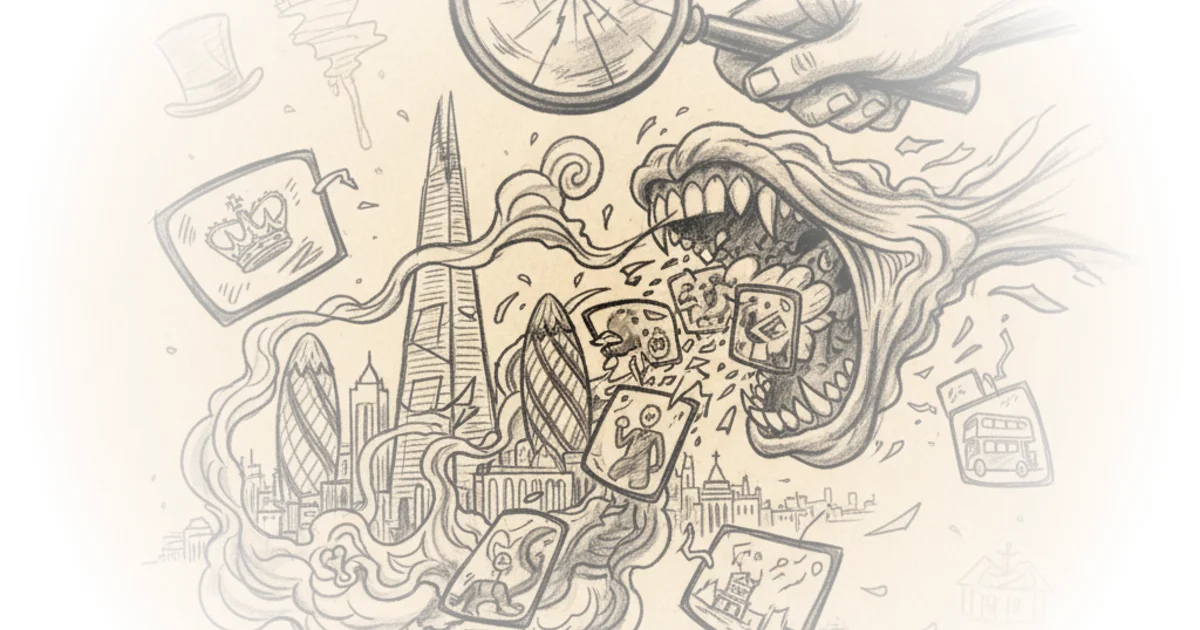
Michael Macleod's investigation captures something genuinely unsettling: London is experiencing a global reputational collapse that has very little to do with the actual city and everything to do with the economics of viral video platforms. The piece traces how the city's image has been hollowed out and rebuilt as a dystopian backdrop by content creators who profit from rage, and how the consequences ripple outward to tourism, investment, and the everyday confidence of Londoners themselves.
The Pipeline from Rage to Revenue
The central mechanism is straightforward and profit-driven. As Macleod writes, "For some YouTubers, X posters, or TikTokers who just need cheap clicks, London is nothing more than a filming location that provides them with the background footage for whatever viral ragebait will earn a few dollars in advertising revenue." Legitimate videos of street thefts and robberies — real problems the city does face — are stripped of context, amplified, and repackaged as evidence of total societal failure.
One TikTok creator reportedly admitted to specializing in fabricated stories about London homes being allocated to undocumented immigrants. The motive was candid: "hate brings views." The Metropolitan Police are now investigating whether criminal offences were committed by the individual behind that account — a case that could test how existing law applies to deliberately manufactured misinformation designed to inflame ethnic tensions.
Macleod frames this precisely: "It's increasingly clear that London is suffering a global reputational crisis exacerbated by the incentives of viral video sites. It's impacting tourism, investment in the capital, and the general sense of wellbeing in the city."
The problem, as the piece documents, is that these fabricated narratives travel further and faster than any correction ever could. They reach people in places that have no independent means of verification and no reason to doubt what their screens are telling them.
The line between a real threat and teenagers messing about on the internet is increasingly blurry and difficult to deal with.
When Rumour Becomes Self-Fulfilling
The London-focused portion of Macleod's investigation is equally instructive. A TikTok account called Hackney706 — allegedly operated by a single school student — attempted to manufacture what it called a "Hackney War," dividing eight secondary schools into rival camps and urging Year 9 pupils to attack students from opposing schools. The post listed improvised weapons: compasses, metal combs, rulers.
Whether the threat was genuine or juvenile posturing, the response was not. Macleod reports that police issued a dispersal order for Mare Street, McDonald's barred unaccompanied under-16s from entering, and central Hackney filled with disappointed teenagers who mainly seemed frustrated they couldn't get a Big Mac. One bystander asked whether there had been "a heist at M&S."
The deeper concern, which Macleod identifies, is that the virality of such posts could become a self-fulfilling prophecy. A fabricated threat, amplified by algorithms optimized for engagement rather than accuracy, can produce real-world police deployments, school lockdowns, and neighborhood anxiety regardless of whether the original post was sincere.
The Distance Between Reporting and Reality
Macleod is careful not to suggest London is flawless. "Whether you're an illegal ice cream van, a dodgy charity fundraiser, or a triad gang daubing houses in red paint … we're still coming after you," he writes, positioning London Centric as a publication that holds the city accountable precisely because its writers care about it.
Critics might note that the piece relies heavily on reader anecdotes — compelling but not statistically rigorous evidence of a reputational crisis. One could also argue that the distorted views of London described here are not new: every major city has always been a screen onto which distant people project their anxieties. What has changed is the scale and speed of projection, not its existence. The article would benefit from concrete data on tourism bookings, foreign direct investment, or corporate relocation decisions — the actual economic metrics that would confirm whether the reputational damage is measurable or merely atmospheric.
What is undeniably true, though, is that the Metropolitan Police are now fielding real-world consequences of digital fabrication — the same force dealing with actual crime while also investigating a TikTok account that manufactured fake crime stories for profit. The two phenomena are beginning to collide.
Bottom Line
London is not collapsing. But a city's reputation is its own form of infrastructure, and the platforms that profit from rage are systematically mining that infrastructure for content. Macleod's piece is a reminder that misinformation is not an abstract democratic concern — it is actively reshaping how the world sees one of its great cities, and how the people who live there see themselves.