In a geopolitical landscape often clouded by nationalist triumphalism, a rare voice of sober legal realism emerges from China's own policy sphere. While much of the domestic commentary celebrates the use of the Renminbi to pay transit fees as a victory against dollar hegemony, this piece from Sinification argues that such a view is a dangerous illusion. The article posits that accepting these fees is not a strategic win, but a catastrophic precedent that could unravel the very maritime norms China relies upon for its survival.
The Trap of Tactical Convenience
The piece opens by dismantling the prevailing narrative in Beijing. It notes that while the Strait of Hormuz has seen a "limited resumption of transit," the situation is far from a return to normalcy. Instead, the editors report that the waterway has shifted into a state of "controlled passage," characterized by "extreme uncertainty, tight regulation and low traffic volumes." In this new reality, Iran is attempting to levy fees of roughly $2 million per vessel, a move designed to generate billions in revenue for reconstruction.
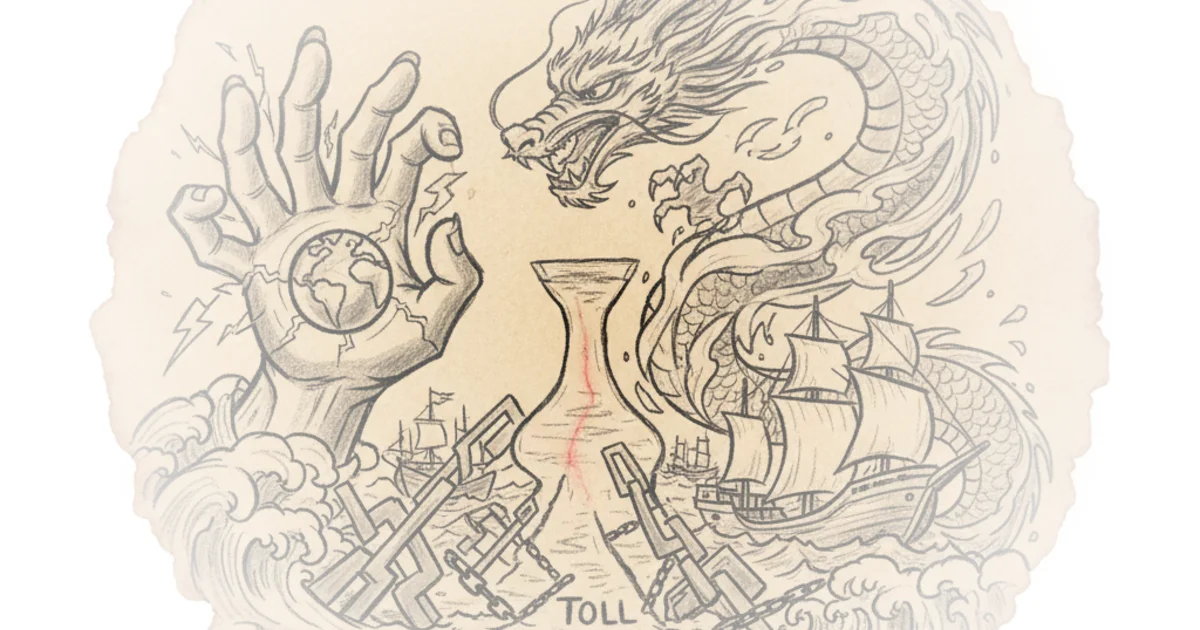
The article's most striking claim is that celebrating the settlement of these fees in Chinese currency is a "fatal strategic misreading." Sinification argues that this perspective "confuses tactical convenience with strategic gain and overlooks the broader erosion of China's legal and geopolitical position." The author, Ye Yan, a legal academic with deep experience in the state energy sector, warns that the real victory lies not in paying "protection money" with a different currency, but in holding the line on the principle of free passage.
This analysis cuts through the noise of financial nationalism. By framing the payment as "protection money" rather than a diplomatic breakthrough, the piece forces a re-evaluation of what constitutes a win for Beijing. It suggests that the short-term ease of using the Cross-Border Interbank Payment System (CIPS) masks a long-term vulnerability: the legitimization of maritime extortion.
The real victory does not lie in using China's own currency to pay 'protection money' on a shipping lane that has been illegally turned into a checkpoint and subjected to political screening. It lies in holding the line on 'free passage' through the world's sea lanes.
The Mathematics of a Strategic Trap
To explain why the current "ceasefire" is actually a trap, the article employs a game theory framework. It constructs a "composite utility model" where China's national interests are weighed against five variables: energy security, rule integrity, buffer capacity, sanctions risk, and precedent transmission. The argument is that while energy security is vital, the risks of secondary sanctions and the precedent of tolling are "destructive costs" that could cause a "cliff-like collapse" in China's overall strategic utility.
The piece suggests that the United States is not merely reacting to Iran but is engaging in a strategy of "acquiescent attrition." By allowing Iran to maintain a "controlled passage" regime, Washington can wear down East Asian manufacturing powers at a low cost to itself. The editors note that this "controlled-passage equilibrium" suits Washington because it "keeps pressure on China, Japan and other energy-dependent Asian economies at a low cost to the United States."
This reframing is crucial. It moves the discussion from a bilateral US-Iran conflict to a broader strategic contest where the rules of the sea are the primary battleground. The article warns that accepting the Iranian toll in Hormuz creates a "dual chokepoint dilemma," where similar coercion could be applied to the Strait of Malacca. This echoes historical lessons from the concept of "Transit passage" under the UN Convention on the Law of the Sea, where the right of innocent passage is designed specifically to prevent such chokepoints from becoming leverage points for regional powers.
Critics might argue that this legalistic approach ignores the immediate reality of energy needs. If the Strait is blocked, China needs oil now, regardless of the legal precedent. However, the piece counters that relying on short-term access without securing long-term norms is a losing strategy. It argues that "plugging China's Cross-Border Interbank Payment System into an unlawful tolling regime would not create institutional rights for Chinese shipping. It would merely turn payment convenience into sanctions exposure and diplomatic extortion."
A Path Forward: The Asian Consumer Order
So, what should China do? The article rejects the path of accommodation and instead proposes a strategy of "legal resistance backed by strategic reserves." The author urges Beijing to draw on its strategic petroleum reserves and utilize overland pipelines to bypass the Strait, rather than paying the tolls. This aligns with the broader geopolitical concept of "Global strategic petroleum reserves," which are designed precisely for such moments of supply disruption.
The most distinctive proposal is the formation of an "Asian Consumer Order Alliance." The piece suggests that Beijing should try to assemble a "buyers' club of major Asian importers" to collectively reject unlawful tolls. This move fits China's self-image as a responsible, multilateral actor, though the editors acknowledge it "may demand more Sino-Japanese co-ordination than the relationship can realistically bear."
The argument here is that the crisis is not a local aberration but part of a wider US strategy to recast the Middle East as a "West Asian corridor" within an Indo-Pacific frame. By forming a coalition, China could shift the burden of maintaining maritime order from a unilateral US enforcement to a collective regional defense of the rules.
Accepting tolls and political screening in Hormuz could legitimise similar coercion in Malacca or Sunda, creating a future 'dual chokepoint dilemma' across the sea lanes on which China depends.
Bottom Line
The strongest part of this argument is its ruthless clarity: paying the toll, even in RMB, is a surrender of principle that invites future exploitation. Its biggest vulnerability lies in the political feasibility of the proposed solution; convincing regional rivals like Japan to join a Sino-led alliance to defy a US-backed status quo is a monumental diplomatic challenge. The reader should watch for whether Beijing prioritizes the immediate flow of oil or the long-term integrity of the maritime order, as this decision will define the region's security architecture for decades.