Cory Doctorow cuts through the hype of artificial intelligence to expose a terrifying reality: the technology itself is mundane, but the financial bubble surrounding it is a destructive force reshaping society. He argues that the trillion-dollar rush isn't about genuine innovation, but about a specific economic pathology where executives and investors bet on the displacement of human workers regardless of the technology's actual utility. This is not a story about the future of machines, but about the present-day vulnerability of labor and the environment to the whims of speculative finance.
The Bubble as the Feature, Not the Bug
Doctorow reframes the entire AI narrative by stripping away the technical mystique. He writes, "As a technology, AI isn't exceptional. It's not exceptionally wicked. It's not exceptionally good." This is a crucial distinction that many industry observers miss; the technology is merely a "plug-in" that would be used and abused like any other tool if not for the "galactic-scale stock-swindle" driving its adoption. The core of the argument is that the massive capital injection—over $1.4 trillion in the past year alone—is not funding a revolution in capability, but funding a strategy to maximize unemployment and suppress wages.
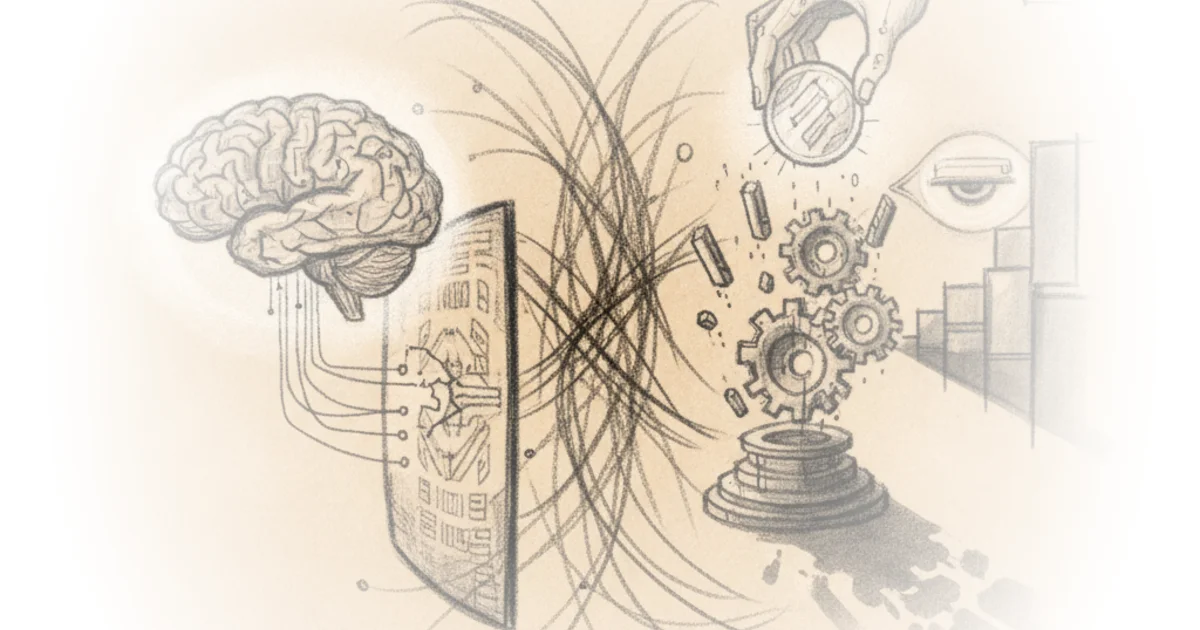
The author suggests that the current economic model relies on monopolies that can deliberately degrade their products without consequence because they face no competition. He notes that "AI is predicated on the premise that the monopolies, duopolies and cartels that control the global economy can deliberately worsen their products without suffering economic or regulatory consequences." This perspective shifts the blame from the software to the market structure, suggesting that the failure of these systems is a feature of the business model, not a bug in the code.
The single most salient fact about AI is the investment bubble, not the technical characteristics of chatbots or recent advances in statistical inference.
This framing holds up when looking at the physical footprint of the industry. Doctorow points out that in the rush to turn losses into profit, companies have suborned regional governments to bypass environmental reviews, leading to the seizure of land through eminent domain. He describes the indignity of having a farm or house seized only to be replaced by "a weed-choked empty field, a lonely foundation slab, or an abandoned empty building." Critics might argue that infrastructure development always involves friction with local planning, but Doctorow's specific focus on assets that may never be switched on due to an imminent bubble pop adds a layer of urgency that standard infrastructure debates lack.
Solipsism and the Cynical Investor
To explain why billionaires continue to pour money into a system that clearly harms the broader economy, Doctorow introduces a psychological dimension. He argues that achieving such extreme wealth often requires a form of "billionaire solipsism," where the wealthy stop believing that other people are fully real. He writes, "If you truly believed that those people were as real as you are, you'd never be able to look yourself in the mirror." This solipsism allows executives to view workers not as human beings with families and skills, but as statistical artifacts or obstacles to be removed.
However, Doctorow posits that solipsism alone doesn't explain the entire market. There is a second group of investors who don't believe in AI at all but are betting on the fact that others will. He invokes the concept of the "Keynesian beauty contest," a historical economic theory where investors don't pick the most beautiful contestant, but the one they think the judges will pick. "As Keynes wrote, the point of investing isn't necessarily to pick the most beautiful contestant to win the beauty contest – it's to pick the contestant that the other judges will hand the crown to," he notes.
This creates a dangerous dynamic where the goal is simply to identify which businesses other investors will pile into, allowing the cynic to sell their shares before the crash. The author suggests that the question for these investors isn't "Can AI do your job?" but rather "Can an AI salesman convince your boss that an AI can do your job?" This cynical wager relies on the assumption that corporate bosses are desperate to bypass the friction of human labor. Doctorow writes, "Bosses are absolute suckers for this scam," noting that many executives hate having to confront workers who point out that their plans are illegal, stupid, or impossible.
You don't need to be a solipsist to bet on AI. It is sufficient to believe that bosses are solipsists, who can be relied upon to empty the corporate coffers in exchange for worker-replacing magic beans.
The Long-Tail Catastrophe
The piece concludes with a grim forecast of what happens when the bubble inevitably bursts. Doctorow warns that the aftermath will not be a return to the status quo, but a permanent degradation of societal capacity. He compares the current situation to asbestos being shoveled into the walls of civilization, a toxic legacy that future generations will have to dig out. "When the AI bubble bursts, the defective chatbots that replaced skilled workers will disappear with it, leaving us scrambling to get that work done after the workers who understood it have retrained, retired, or exited the workforce," he argues.
Furthermore, the environmental cost is already locked in. The massive energy consumption required for these data centers contributes to climate change regardless of whether the technology ever becomes profitable. Doctorow reminds readers that "The Second Law of Thermodynamics isn't up for debate. Once we sink enough therms into the sea, we are losing the ice-caps." The argument is that the financiers are motivated by a mix of solipsism and a belief in the solipsism of others, creating a scenario where "hell is other people" becomes the primary investment hypothesis.
Critics might suggest that this view is overly deterministic, ignoring the potential for regulation to curb the worst excesses or for the technology to find genuine, non-destructive applications. However, Doctorow's focus on the sheer scale of the malinvestment and the structural incentives of the market suggests that without a fundamental shift in how capital is allocated, the damage is already in motion.
Bottom Line
Doctorow's most compelling contribution is his refusal to treat AI as a technological inevitability, instead exposing it as a financial vehicle for wealth extraction and labor suppression. The argument's greatest strength is its synthesis of economic theory, psychological insight, and physical reality, but it leaves the reader with a sobering question: if the system is designed to fail the many to enrich the few, what mechanisms exist to stop the crash from destroying the foundation of society? The most urgent takeaway is that the bubble itself, not the technology, is the primary threat to our economic and environmental stability.