Dave Amos delivers a counterintuitive truth that cuts through the usual noise about American transit: the United States isn't lacking in rail, it is lacking in the specific density required to justify the most expensive kind. While most observers fixate on the absence of subways in cities like Houston or Phoenix, Amos reframes the entire debate by arguing that the American preference for light rail and streetcars is not a failure of ambition, but a rational economic response to a sprawling landscape.
The Hierarchy of Rail
Amos begins by dismantling the assumption that the U.S. is uniquely transit-starved, noting that thirteen metro systems do exist, yet they leave a glaring gap in the top twenty most populous urban areas. He contrasts this with Europe, where a city the size of Leeds would be expected to have a subway, whereas American cities of similar or greater magnitude often rely on bus networks or light rail. The distinction, he argues, comes down to the mechanics of the vehicles themselves. "A heavy rail metro system can carry about 810 passengers on a typical six-car train," Amos writes, highlighting the sheer scale of capacity that defines a true metro. This capacity is matched by a price tag that makes it a difficult sell in the American political climate.
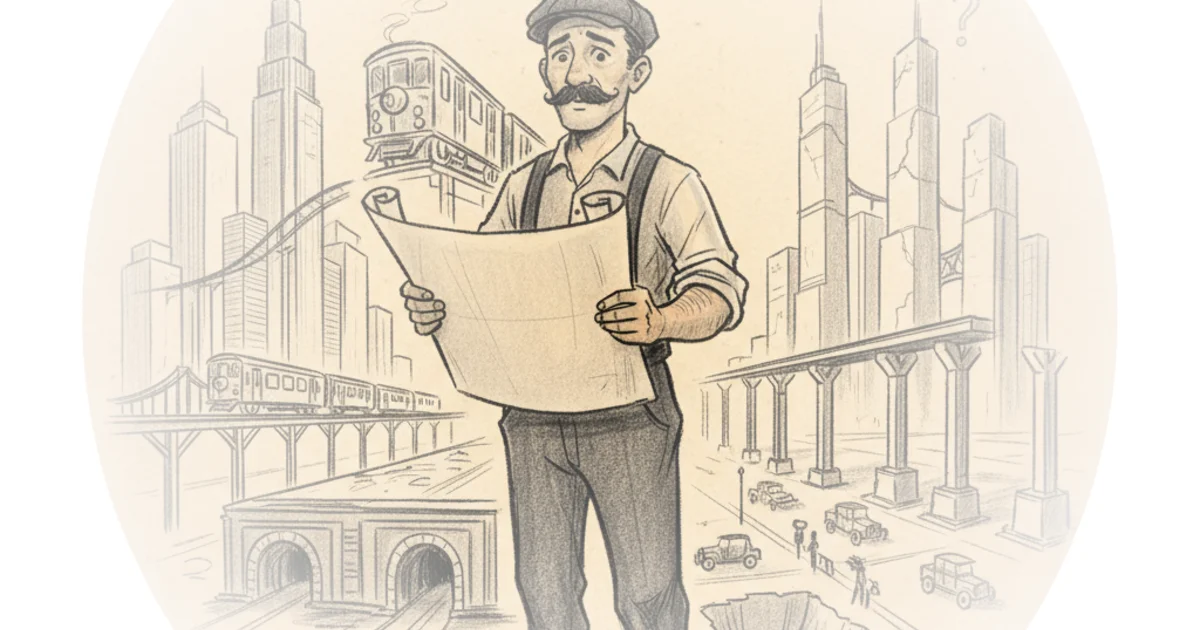
The author effectively breaks down the spectrum of rail options, positioning light rail as the "sweet spot" for American cities. He explains that light rail is often two to four times cheaper than heavy rail because it runs at grade, avoiding the astronomical costs of tunneling or building elevated viaducts. "Cost matters in American cities where transit isn't really a high priority," he observes, a blunt assessment that grounds the technical comparison in political reality. Critics might note that this framing underestimates the long-term economic benefits of high-capacity transit, but Amos's point remains: without the immediate pressure of extreme congestion, cities naturally gravitate toward the cheaper, lower-capacity option.
"You're never going to generate enough ridership for a train in a rural area. There are certain density thresholds you need to meet to make transit service make sense."
The Density Threshold
The core of Amos's argument rests on the inextricable link between land use and transportation. He posits that the failure to build more metros is not a planning oversight but a direct consequence of the post-1910 suburban explosion. To make this abstract concept concrete, he uses a football pitch as a visual aid, calculating that a successful heavy rail system requires roughly 84 homes per pitch, while the average American suburb offers only 6 to 10. "The first wave of suburbanization was indeed street car induced, but soon after people were buying cars and moving to areas around cities," he notes, tracing the historical pivot that made the heavy rail model obsolete for most of the country.
This historical context is crucial. Amos suggests that the "sprawl" of the United States wasn't an accident but a structural shift that rendered the 1905 vision of a metro for every major city impossible. He points out that even when federal funding arrived in the 1960s via the Urban Mass Transportation Act, the political will often failed to materialize. He cites the 1968 Seattle vote, where a massive metro proposal failed despite an 80% federal subsidy, proving that money alone cannot force a system into existence if the underlying density isn't there. "You need political will, people to want transit," Amos writes, a reminder that infrastructure is ultimately a reflection of voter priorities.
The Modern Compromise
In the final analysis, Amos suggests that the debate is shifting from "metro vs. no metro" to a more nuanced reality where light rail systems are being upgraded to function more like metros. He points to Seattle and Portland, where new tunnel projects are being added to existing light rail lines to achieve the speed and grade separation of a heavy rail system. "Cities with light rail systems are using them more like metros or are considering it," he explains, signaling a hybrid future. This evolution acknowledges the reality that while the classic heavy rail model may be too expensive for many American cities, the demand for high-quality, rapid transit is still growing.
A counterargument worth considering is whether this "good enough" approach of upgrading light rail is sufficient to solve the deep-seated congestion issues in cities like Los Angeles or Dallas. Amos acknowledges the limitations but maintains that the cost-benefit analysis of digging new tunnels in low-density sprawl remains the primary barrier. The piece concludes by emphasizing that the solution isn't simply building more subways, but understanding that the American city is fundamentally different from its European counterparts.
Bottom Line
Amos's strongest contribution is his refusal to treat the lack of American metros as a moral failing, instead presenting it as a logical outcome of specific density thresholds and historical land-use choices. The argument's vulnerability lies in its somewhat static view of density, potentially underestimating how aggressive zoning reform could alter the calculus for future heavy rail projects. Readers should watch for how cities attempt to bridge the gap between their current sprawl and the high-density requirements of true rapid transit.