History often remembers the Cold War as a grim standoff of sober deterrence, but Kings and Generals reveals a darker, more absurd undercurrent: the era was defined by a reckless imagination that nearly turned the moon into a bomb test site. This piece is notable not for new classified documents, but for its unflinching look at how seriously the superpowers treated the idea of using atomic weapons as a "technological Swiss Army knife" for everything from digging harbors to propelling spacecraft. In an age where policy is often paralyzed by risk aversion, understanding how close the world came to detonating a nuclear device on the lunar surface offers a startling perspective on the volatility of that era.
The Moon as a PR Stage
Kings and Generals opens by dismantling the myth that nuclear strategy was always purely about mutual destruction. They write, "The period between 1945 and late 1980s was a time when the nuclear bomb wasn't just a weapon. It was seen by some as that technological Swiss Army knife." This framing is crucial because it shifts the narrative from fear to hubris. The authors argue that the driving force behind Project A119—the US plan to nuke the moon in 1958—was not scientific curiosity but a desperate need for a psychological victory following the Soviet launch of Sputnik.
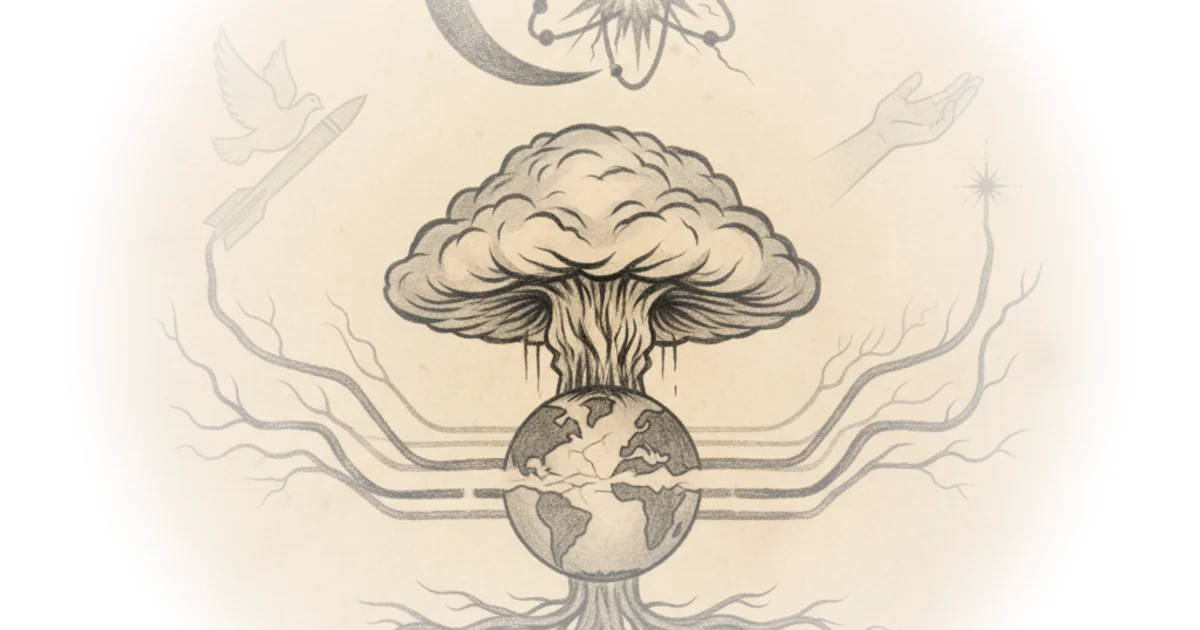
The coverage details how the US Air Force tasked a team at the Illinois Institute of Technology with modeling a detonation that would be visible from Earth. As Kings and Generals puts it, "The entire purpose was a public relations coup, a way to show the world that America was not behind in the space race." This admission highlights a dangerous disconnect: the military was willing to risk radioactive fallout on American soil just to win a propaganda battle. The authors note that even the young doctoral student on the team, Carl Sagan, was modeling the explosion, a fact that underscores how normalized these extreme ideas were within the scientific community at the time.
"The idea wasn't scientific. It was psychological."
Critics might argue that the authors downplay the genuine strategic anxiety of the late 1950s, where the US felt existentially threatened by Soviet capabilities. However, the piece effectively counters this by showing that the plan was shelved not because of moral awakening, but because the risk of a launch failure scattering fallout over the US was simply too high. The parallel Soviet plan, Project E4, met the same fate, reinforcing the authors' point that both sides eventually realized the gamble was too great.
Space as a Testing Ground
Moving beyond the moon, the commentary shifts to the reality of high-altitude testing, where the theoretical became terrifyingly real. Kings and Generals describes the 1962 Starfish Prime test, where a hydrogen bomb detonated 400 kilometers above the Pacific Ocean. "The detonation also generated a powerful electromagnetic pulse, EMP, that knocked out street lights and microwave telephone communications in Hawaii over 300 km away and even damaged satellites in orbit." This evidence serves as a stark warning about the unintended consequences of nuclear technology, a theme the authors weave through the entire piece.
The authors are particularly effective when contrasting the US tests with the Soviet Project K. They note that a Soviet detonation during the height of the Cuban Missile Crisis "fused a 570 km stretch of overhead power lines, caused fires and power plants, and knocked out communication systems across the region." This detail is vital; it shows that the danger wasn't just theoretical but immediate and destructive to civilian infrastructure. The narrative suggests that the 1963 Partial Test Ban Treaty was less a triumph of diplomacy and more a necessary retreat from chaos.
The Illusion of Peaceful Uses
Perhaps the most disturbing section of the coverage is the examination of "peaceful" nuclear explosions. Kings and Generals writes, "Proponents argued that atomic blasts could move Earth, create harbors, stimulate natural gas mining, and even build canals faster and cheaper than conventional methods." This argument, known as Project Plowshare in the US and the Soviet "Nuclear Explosions for the National Economy," reveals a profound misunderstanding of the technology's side effects.
The authors detail the failure of Project Chariot in Alaska, where a plan to carve a harbor with hydrogen bombs was canceled only after local communities and scientists raised alarms about fallout. They also highlight the Soviet "Atomic Lake" created by the Chagan test, noting that "the water was highly radioactive and fallout from the blast was detected as far away as Japan." This section effectively debunks the idea that nuclear energy could be safely repurposed for civil engineering. As Kings and Generals concludes, "By the 1970s, it was clear that nuclear earth moving wasn't practical. Public opposition grew, costs spiraled, and the fall-out problems were impossible to solve."
"Just because you can use a nuclear bomb for something doesn't mean you actually should."
A counterargument worth considering is that the Soviet program did achieve a unique success: extinguishing runaway gas fires. The authors acknowledge this, noting that a 30-kiloton bomb successfully collapsed a burning well in Uzbekistan. Yet, they rightly frame this as an anomaly in a landscape of environmental disasters, emphasizing that the long-term contamination outweighed the short-term utility.
Bottom Line
Kings and Generals delivers a compelling, if chilling, reminder that the Cold War was driven as much by wild, untested imagination as by strategic caution. The piece's greatest strength is its ability to humanize the absurdity of the era, showing how serious planners considered nuking the moon or riding atomic bombs to Mars. Its vulnerability lies in occasionally glossing over the specific geopolitical pressures that made these ideas seem rational at the time, but the ultimate verdict remains clear: the restraint shown by the superpowers was born of fear of their own creations, not moral clarity. Readers should watch for how modern space powers are approaching similar dual-use technologies, ensuring history does not repeat its most reckless chapters.