Richard Hanania delivers a jarring diagnosis of modern American conservatism, arguing that the movement's most prominent new figure has adopted the very tactics of victimhood he once criticized. The piece's most startling claim is not that JD Vance is a populist, but that he is effectively transplanting the framework of black identity politics—specifically the style pioneered by figures like Al Sharpton and Jesse Jackson—onto the white working class. For a reader trying to understand the seismic shift in the Republican Party's rhetoric, Hanania offers a provocative lens: the rise of a politics defined not by individual agency, but by a conspiratorial, zero-sum worldview that blames outsiders for every societal ill.
The Inversion of Conservative Philosophy
Hanania begins by establishing the traditional conservative stance he once held: a rejection of self-pity and an emphasis on personal responsibility in an era of unprecedented human prosperity. He writes, "The world is full of enough cruelty, sadism, and injustice. The least we can do is not add to the suffering by imagining new forms of oppression that don't exist." This framing sets a high bar for the argument that follows, suggesting that the current political moment represents a fundamental betrayal of Stoic principles. He invokes the ancient philosopher Marcus Aurelius to underscore the absurdity of modern grievance, noting that "to live any other way is grotesque" when life has become so materially secure.
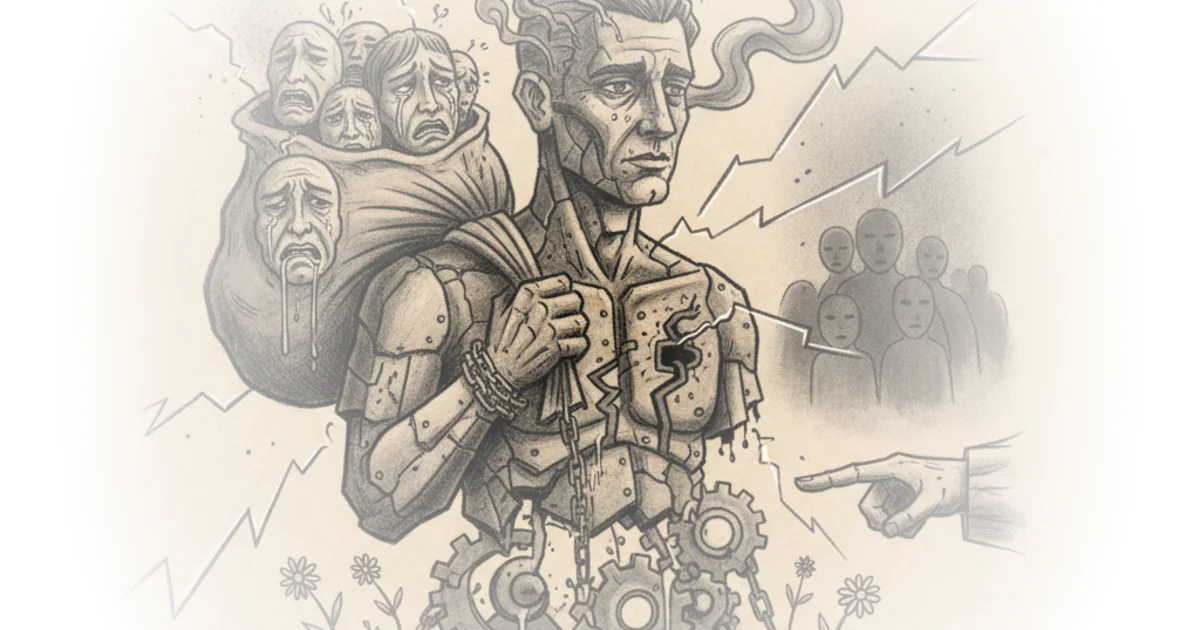
The author's central thesis is that JD Vance has shattered this tradition. Hanania observes, "While supposedly a figure of the right, his embrace of the politics of victimhood is so over the top and deeply embedded in his worldview that he makes Al Sharpton look like a hero from an Ayn Rand novel." This comparison is the piece's most aggressive rhetorical move. It forces the reader to confront the idea that the language of oppression is no longer the exclusive domain of the left. Hanania argues that Vance has become a "political entrepreneur," taking the playbook of inner-city identity politics and applying it to rural and working-class white Americans. The danger, as Hanania sees it, is that this shift encourages a culture of weakness rather than resilience.
"Vance has been able to ride the train of lower-class white grievance all the way to the vice presidency, and perhaps it will get him to the top job itself."
Critics might argue that Hanania underestimates the genuine economic despair in regions like Appalachia, suggesting that dismissing these feelings as mere "self-pity" ignores structural realities. However, Hanania's point is not that the pain isn't real, but that the explanation for that pain has shifted from internal cultural factors to external scapegoating.
The Zero-Sum Economic Trap
The commentary then dissects Vance's economic philosophy, which Hanania characterizes as a "zero-sum mentality" where every gain for an outsider is a loss for the native-born. He draws a sharp parallel to the tensions of the 1992 Los Angeles riots, where economic competition between Korean store owners and Black residents fueled violence. Hanania notes that during that era, conservatives asked why locals couldn't simply compete, but today, Vance offers no such agency. Instead, Vance treats immigration as a universal explanation for every policy failure.
Hanania writes, "Why is housing expensive? Immigrants buy houses. What has gone wrong for the American worker? Foreigners came into the country and competed for jobs..." He points out that this is not just standard restrictionism but a totalizing worldview where "if you cut out hostility to foreigners, it is difficult to see what Vance substantively stands for." The author suggests that this approach is intellectually dishonest, relying on the "oldest and most blatant economic fallacies" to simplify complex global dynamics into a narrative of theft.
This framing is effective because it highlights the inconsistency in Vance's position. He claims to champion the working class, yet his policy prescriptions often ignore the consensus of economists who argue that immigration boosts overall economic growth. Hanania notes, "The vast majority of economists agree that immigration is good for the economy. To Vance, then, the entire field of economics is simply a conspiracy paid for by people who get rich off migrant labor." By reducing expert consensus to a conspiracy of privilege, Vance abandons the conservative commitment to objective analysis in favor of identity-based resentment.
Disparate Impact and the Death of Objectivity
Perhaps the most damning section of Hanania's argument concerns Vance's adoption of "disparate impact" logic. Hanania contrasts Vance's current rhetoric with his earlier memoir, Hillbilly Elegy, where he blamed cultural choices for the decline of his community. Now, however, Vance blames external forces for statistical disparities. Hanania writes, "Conservatives spent decades rolling their eyes at leftists who assumed disparities can only be caused by discrimination. And someone who once understood this better than just about anyone else is JD Vance himself."
The author highlights how Vance now treats any statistical gap as evidence of systemic victimization. "You know what really pisses people off? When they realize that their loved ones are dying much sooner than everyone else," Hanania quotes Vance, using this to illustrate the shift toward a worldview where the community is a victim of forces beyond its control. This mirrors the logic of Ibram X. Kendi, who argued that any policy yielding inequality is inherently racist. Hanania argues that Vance has applied this same logic to class and nationality, creating a new orthodoxy where objectivity is dismissed as a mask for privilege.
"Mass migration is theft of the American Dream. It has always been this way, and every position paper, think tank piece, and econometric study suggesting otherwise is paid for by the people getting rich off the old system."
Hanania points out the irony that Vance, a wealthy man who benefited from the very system he now condemns, uses class resentment to dismiss the expertise of those with less power. He notes, "I doubt there is any scholar who writes in favor of immigration who is anywhere near as wealthy as JD Vance." This suggests that the politics of victimhood can be a tool for the powerful to consolidate support, rather than a genuine cry from the marginalized.
Conspiracy and the Crack Epidemic Parallel
Finally, Hanania draws a chilling parallel between Vance's rhetoric and the conspiracy theories surrounding the crack epidemic of the 1980s and 1990s. He recalls how figures like Maxine Waters and Louis Farrakhan promoted the idea that the CIA deliberately spread drugs in Black communities. Hanania writes, "In pop culture, this idea shows up in 2Pac's 'Changes,' released posthumously in 1998, with the following lyrics: 'Give the crack to the kids, who the hell...'" He argues that Vance has imported this same conspiratorial mindset, suggesting that the federal government and elites are actively working to destroy the white working class.
This comparison is potent because it links modern political rhetoric to a history of deep-seated mistrust that has historically been damaging to the communities it claims to protect. Hanania suggests that by adopting these narratives, Vance is not empowering his base but trapping them in a cycle of paranoia and helplessness. The author concludes that this style of politics is "conspiratorial, tribal, and zero sum," and that it represents a dangerous departure from the principles of individual agency and rational discourse.
Bottom Line
Richard Hanania's piece is a powerful, if uncomfortable, critique of the direction of modern conservatism, successfully arguing that JD Vance has weaponized the language of victimhood to build a political coalition. The strongest part of the argument is the historical parallel drawn between Vance's tactics and the identity politics of the past, revealing a disturbing continuity in how grievance is manufactured. However, the piece's biggest vulnerability is its potential dismissal of the very real economic anxieties that fuel this movement, risking a tone that sounds detached from the lived reality of the voters Vance represents. Readers should watch for whether this "politics of victimhood" can sustain a governing majority or if it will ultimately fracture the coalition it seeks to build.