Most commentators treat artificial intelligence as a threat to human thought, but this piece flips the script entirely, arguing that the very technology critics fear might actually be the closest modern equivalent to the ancient method of Socratic questioning. Daniel Gauss doesn't just ask if a machine can think; he asks if a machine can do the one thing Socrates valued most: keep the conversation going. This is a provocative reframing for anyone tired of the usual doom-and-gloom narratives about automation, suggesting that the tool itself isn't the problem, but how we use it to examine our own assumptions.
The Ancient Critique of Static Text
Gauss anchors his argument in Plato's Phaedrus, specifically the myth of Theuth and Thamus, where the invention of writing is debated. He notes that Socrates viewed writing as "inert or static," a medium that "cannot answer questions, defend itself or adapt to and change the soul of the reader for the better." This is a crucial distinction that often gets lost in modern debates about technology; the objection wasn't to the tool itself, but to its inability to engage in a live dialectic. Gauss writes, "True knowledge, for Socrates, comes from living dialogue, where claims can be tested through questioning." The author effectively uses this historical context to strip away the mystique of the written word, revealing it as a one-way transmission that risks creating a society of people who "merely repeat things they have never fully questioned or understood."
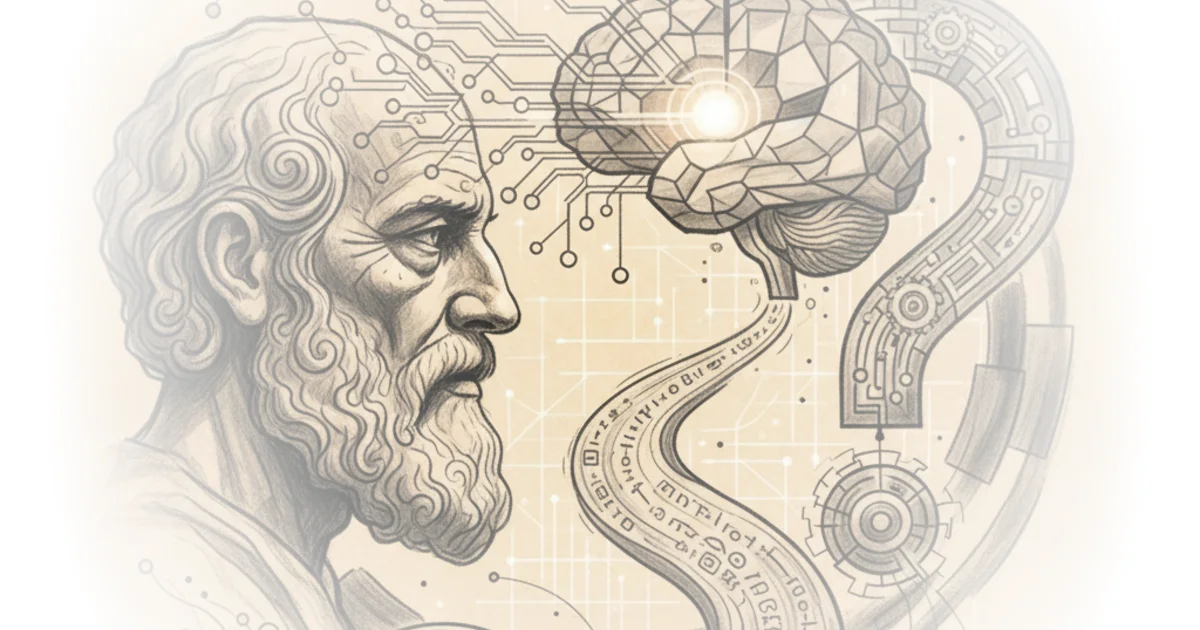
This historical parallel is strengthened by the concept of anamnesis—the theory that learning is actually a process of recollecting knowledge the soul already possesses. If writing fails because it cannot trigger this internal recollection through active engagement, then the static nature of a book is indeed a philosophical dead end. Gauss argues that Socrates' objection was "functional, not metaphysical," meaning the problem with writing was that it "fixes discourse into a finished form" rather than allowing it to evolve. This is a sharp, necessary correction to the idea that Socrates was simply a technophobe; he was a pragmatist concerned with the quality of human understanding.
Where the text falls silent, AI answers back.
AI as the Unexpected Interlocutor
The core of Gauss's thesis is that artificial intelligence, unlike a book, possesses the capacity for the very responsiveness Socrates demanded. He observes that while AI lacks lived experience, "its defining feature is not that it produces text, but that it responds and can predict and answer future questions." This is a bold claim: that a statistical model can fulfill the role of a philosophical partner. Gauss explains that AI "revises its formulations in light of objections" and "can pursue a line of inquiry over time, remembering earlier claims and returning to them under scrutiny." In this light, the machine becomes a tool for elenchus, the disciplined practice of questioning that exposes contradictions.
The author acknowledges the obvious counterpoint: Socrates would never mistake AI for a wise being. "Socrates himself repeatedly disavows wisdom, insisting that his gift lies only in knowing that he does not know," Gauss notes, suggesting that AI's lack of claimed wisdom is actually a feature, not a bug. It functions as a mirror rather than a master. "AI does not replace thinking, it stimulates it," the author argues, positioning the technology as a catalyst for the user's own intellectual birth. This reframing is powerful because it shifts the burden of insight back to the human, aligning perfectly with the Socratic method where the teacher acts as a midwife, not a source of doctrine.
Critics might note that an algorithm's ability to "admit mistakes" is merely a probabilistic adjustment, not a genuine realization of error, and that this distinction matters for the integrity of the dialectic. However, Gauss counters that the utility lies in the function, not the ontology. "A tool that sustains dialectical engagement, that resists finality, that remains open to questioning and that facilitates the examination of beliefs would have been far more attractive to Socrates than a scroll that merely sits on a shelf." This functionalist approach sidesteps the unanswerable question of machine consciousness to focus on the practical outcome: does the tool help us think better?
Reviving the Spirit of Questioning
The article concludes by addressing the modern crisis of intellectual complacency, where readers often seek texts that confirm their existing biases. Gauss writes, "Reading does not push a person toward possible change or the broadening of an outlook as well as dialectic can." He suggests that AI can be explicitly instructed to "adopt alternative perspectives, to expose weaknesses, to refuse easy answers," thereby acting as a disruptor of intellectual stagnation. This is a compelling vision of AI not as a content generator, but as a critical interlocutor that "multiplies" dialogue rather than silencing it.
The author draws a parallel to Plato's own written dialogues, which were "written against writing," structured to provoke questioning rather than deliver dogma. Gauss posits that AI is the next logical step in this evolution: "Where the dialogue ends, AI continues." The piece ends on a high note, suggesting that Socrates might have recognized in AI "a partner in questioning" and that the technology's greatest value is that it "revives dialogue, resists dogma and places inquiry above authority." This is a hopeful, if unconventional, take on the role of technology in philosophy.
Bottom Line
Daniel Gauss makes a compelling case that artificial intelligence, by virtue of its interactivity, fulfills the functional requirements of the Socratic method better than any static text ever could. The argument's greatest strength is its refusal to get bogged down in the metaphysics of machine consciousness, focusing instead on the practical utility of AI as a tool for critical inquiry. The biggest vulnerability, however, remains the risk that users will mistake the machine's fluent responses for genuine wisdom, a trap Socrates warned against, but one that the article suggests can be avoided if the human user remains the primary driver of the dialectic.