Wesley Yang frames the current debate over pediatric gender care not as a civil rights victory, but as a civilizational stress test that the mainstream media has largely refused to report on with rigor. He argues that a "sane posterity" will look back on this era and ask how institutions allowed what he terms a "social contagion" to consume the lives of confused teenagers while the medical and educational establishments provided eager collusion.
The Media Silence and the Information Void
Yang begins by challenging the standard flow of journalism, noting that the usual progression from local anecdote to national analysis has been "forcibly interrupted" regarding transgender issues. He suggests that major outlets have taken a "vow of silence" on the complexities of pediatric gender medicine, preferring instead to focus on legal battles framed as anti-LGBTQ+ discrimination. "The evidence of this is the article you haven't seen in The New Yorker chronicling the transition and later detransition of three teenagers," Yang writes, pointing to a conspicuous absence of investigative depth in top-tier publications.
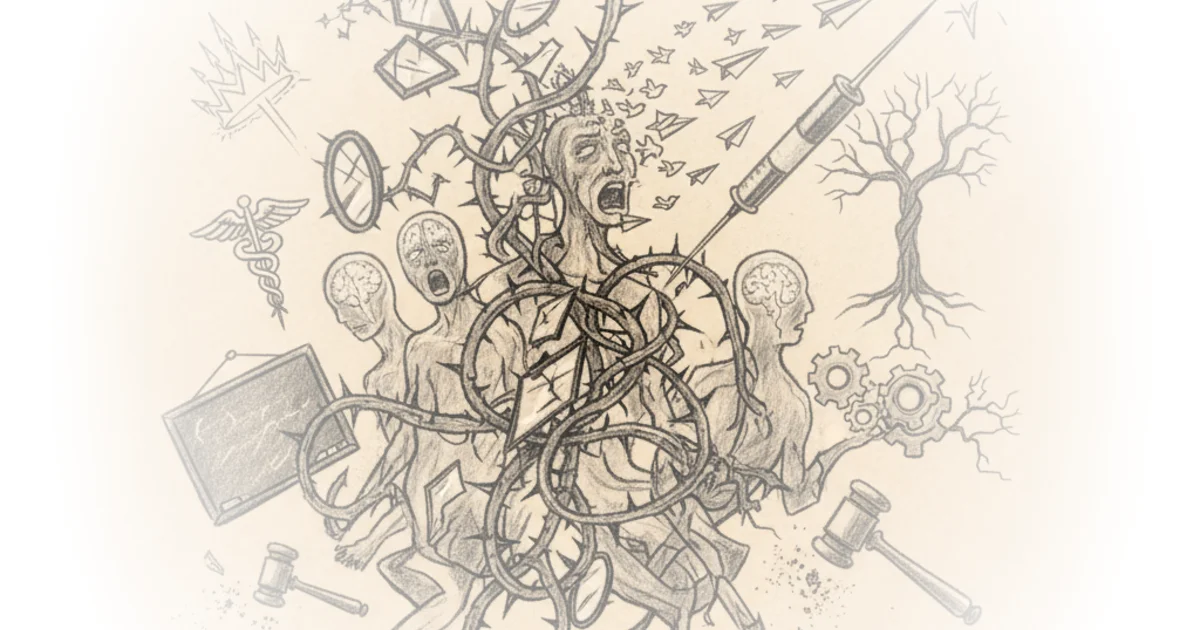
This framing is provocative, suggesting that the information ecosystem is actively hiding data rather than just lacking it. Critics might argue that the media's caution stems from a fear of harassment and a desire to avoid amplifying misinformation, rather than a coordinated cover-up. However, Yang's point resonates with parents who feel they are navigating a minefield without a map. He posits that the current obsession with these issues is actually an "unintended consequence of a media strategy that is backfiring spectacularly in real time," creating a vacuum where curiosity turns into suspicion.
Logical flow is for logical stories: this one's special.
The Clash of Clinical Philosophies
The core of Yang's commentary focuses on a new book, When Kids Say They're Trans, by Stella O'Malley, Sasha Ayad, and Lisa Marchiano. He presents these authors as intrepid figures standing against a "bizarre catechism" that has taken hold in therapy. Yang contrasts the standard "affirmative approach" with traditional mental health practices, noting that therapists usually do not simply agree with a patient's self-diagnosis. "The affirmative approach doesn't accord well with treatments for any other mental health issue — therapists don't usually simply agree with a patient's self-diagnosis and green-light whatever treatments the patient wishes," he quotes from the book.
Yang argues that the current medical consensus, driven by the World Professional Association for Transgender Health (WPATH), has created a "juggernaut with no pre-existing institutional opponent." He compares the situation to "Big Oil with no Sierra Club," suggesting that the rapid expansion of gender clinics and the lowering of age restrictions for interventions lack the necessary checks and balances found in other medical fields. He highlights the existence of procedures like "genital nullification" for non-binary individuals as evidence of how far the field has drifted from conventional medical prudence.
This argument relies heavily on the premise that the current surge in youth gender dysphoria is a "contagion" driven by social media and identity politics rather than an increase in genuine, underlying distress. While the authors of the book provide a compelling narrative for parents who feel unheard, the medical community largely rejects the "Rapid Onset Gender Dysphoria" (ROGD) hypothesis as a valid diagnosis, viewing it instead as a stigmatizing label that ignores the complexity of gender identity development.
A perfect storm of social phenomena has occurred, a confluence of apparently random events: the arrival of social media... a rise in the popularity of identity politics... and the tendency to self-diagnose via the internet.
Historical Parallels and the Call for Restraint
Yang draws a striking historical parallel between the current gender debate and the "Satanic Panic" of the 1980s and 1990s, where therapists were accused of coining false memories of abuse. He writes that the authors of the book remind us that "a look back through the strange history of our field indicates that this parallel contagion has happened before." The comparison serves to validate the fears of parents who worry that their children are being swept up in a cultural wave rather than receiving objective care.
He praises the authors for building Genspect, a nonprofit that challenges WPATH's guidelines by hosting counter-conferences. Yang describes this as a "bold to the point of brashness" move, noting that it successfully drew attendees from the mainstream medical community to hear arguments against sterilizing children. "This document effectively signs all the relevant permission slips... to the 'Nullo' surgeon... to the therapists in your hometown," Yang writes regarding WPATH's guidelines, implying a dangerous lack of oversight.
The historical analogy is powerful but potentially reductive. Critics might note that equating the gender identity movement with the Satanic Panic overlooks the lived experiences of transgender individuals who have long faced medical gatekeeping, not just overzealous therapists. However, Yang's focus remains on the process of medicalization and the speed at which experimental treatments are being adopted without long-term data.
The therapists, in short, were as caught up in the cultural currents as their patients.
Bottom Line
Wesley Yang's commentary is a forceful indictment of the medical and media establishments for what he perceives as a failure of due diligence in pediatric care. His strongest argument lies in highlighting the lack of long-term data and the speed of institutional adoption for experimental interventions. However, his reliance on the "social contagion" framework risks dismissing the genuine distress of transgender youth as merely a symptom of peer pressure, a vulnerability that may limit the piece's persuasiveness among those who view gender identity as an intrinsic human reality rather than a cultural trend.