Dylan Patel delivers a stark warning that the US electrical grid is not merely struggling to keep pace with artificial intelligence; it has already hit a structural wall. While headlines obsess over chip shortages, Patel's modeling reveals a more immediate bottleneck: the physical inability of the public grid to deliver firm power when hyperscalers need it most. This analysis forces a reckoning with the reality that the era of plugging massive data centers into the utility is effectively ending for new builds.",
The Grid Ceiling
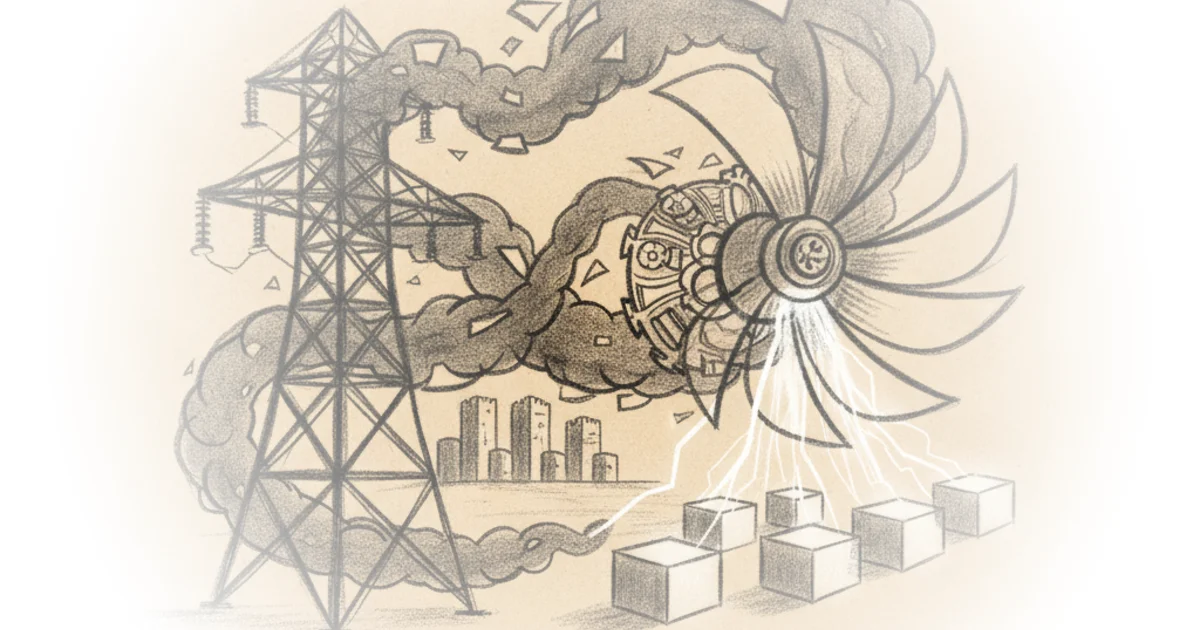
Patel's central thesis rests on a brutal arithmetic: demand is accelerating while supply is stuck in slow motion. He writes, "As the insatiable demand for power of AI Labs and hyperscalers keeps accelerating, the grid simply can't add capacity fast enough." This isn't a prediction of future scarcity; it is an observation of current constraints turning into hard limits. The author's data suggests that by 2028, behind-the-meter generation—power plants built directly on or next to the data center site—will power well over half of new US facilities.
The argument gains weight from its granular approach. Patel doesn't just look at megawatts; he dissects the timeline of construction. He notes that while solar and battery storage are being added in massive quantities, their value to grid reliability is diminishing due to correlation issues. "Solar's famous Duck Curve is the best example," he explains, noting that as more solar is added, "the marginal value of adding new solar declines very sharply because all plants generate electricity at roughly the same hours." This insight reframes the renewable boom not as a solution to the data center crisis, but as a variable that requires even more firm capacity to stabilize.
Critics might argue that grid interconnection queues are merely temporary friction points that will resolve with regulatory reform. However, Patel's evidence on lead times suggests a deeper structural issue. He points out that gas turbine and generator step-up transformer lead times have stretched to three or four years, pushing total development timelines from two years to at least four. This isn't just bureaucracy; it is a supply chain reality that the administration cannot wish away with policy tweaks alone.
"Nearly a year ago, our Onsite Gas deep dive was the first to predict the fast rise of new entrants in the BTM gas equipment market... Overcoming GEV and Siemens turbine capacity constraints proved far easier than many had feared."
The Shift to Self-Generation
The most consequential part of Patel's coverage is how he describes the changing power dynamic between utilities and data center operators. Historically, utilities held the leverage; now, the burden of securing power is shifting entirely to the buyer. "Switch Datacenter, for instance, closed a multi-billion-dollar performance letter-of-credit facility in 2026 to back exactly these obligations," Patel notes. This detail highlights a fundamental market shift: companies are no longer waiting for the grid; they are financing their own generation because the public system cannot deliver.
Patel explains that this isn't just about building backup generators. It is about creating fully islanded or hybrid campuses that operate independently of the main grid's constraints. He writes, "Generation and transmission constraints, combined with inadequate market incentives, makes Behind-The-Meter often the most attractive solution for GW-scale newbuilds." This framing moves the conversation from "can we build more power plants?" to "who is building them and where?"
The author's modeling of Effective Load Carrying Capability (ELCC) is particularly sharp in exposing why renewables alone won't solve the problem. He describes a scenario in ERCOT where planners now leave solar's capacity contribution out of local reliability modeling altogether, creating a "de facto 'no-solar scenario'" for sizing firm needs. This technical nuance is vital; it shows that even with massive renewable buildouts, the grid still lacks the firm capacity needed to run AI 24/7 without interruption.
Winners and Losers in the New Era
Patel's analysis also reshuffles the deck of who benefits from this crisis. It isn't the traditional utility giants or the usual turbine manufacturers that are winning, but rather a new wave of onsite gas equipment providers. He observes that companies like Bloom Energy and W\u00e4rtsil\u00e4 have been "remarkably successful" in filling the gap left by slower-moving grid projects.
However, this shift comes with significant risks. The move toward behind-the-meter generation means data centers are becoming their own power utilities, a massive operational complexity for companies whose core competency is computing, not energy management. As Patel puts it, "Our argument runs in three steps... and that shift reshuffles the winners and losers across equipment OEMs and IPPs as the market grows." This reconfiguration of the energy landscape could lead to a fragmented grid where only the wealthiest tech giants have reliable power, potentially leaving other industrial users behind.
A counterargument worth considering is whether this trend toward private generation undermines the long-term goal of decarbonization. While Patel acknowledges that gas is currently the only viable firm option for rapid deployment, the reliance on fossil fuels for data center growth could clash with corporate net-zero commitments and future regulatory environments.
"The 2026–27 shortfall isn't the product of one bottleneck but a stack of them... Permitting alone accounted for 29% of project milestone changes between January 2023 and January 2026."
Bottom Line
Patel's most compelling contribution is his data-driven dismantling of the assumption that the grid will simply expand to meet AI demand; he proves that the timeline mismatch makes behind-the-meter generation not just an option, but a necessity for survival. The argument's greatest vulnerability lies in its reliance on natural gas as the primary bridge solution, which may face increasing political and regulatory headwinds before 2030. Readers should watch closely how the executive branch responds to these grid constraints, as the current trajectory suggests a future where energy security is determined by private capital rather than public infrastructure.