In an era where information arrives in fragmented, contradictory bursts, Hank Green and the Crash Course team offer a vital corrective: scientific consensus is not a static decree, but a dynamic, hard-won convergence of evidence. This piece stands out because it refuses to apologize for the messiness of discovery, instead framing uncertainty not as a failure of science, but as the very engine that drives it forward. For the busy professional navigating a sea of health headlines and climate data, the argument that we can be certain about the big picture while remaining unsure about the tiny details is both liberating and essential.
The Puzzle Without a Box
The core of the argument rests on a powerful analogy that reframes how we view expert agreement. Green writes, "The scientific process for building consensus is kind of like putting together a jigsaw puzzle but without seeing the picture on the box." This metaphor immediately disarms the reader's expectation that science should offer immediate, perfect clarity. Instead, it suggests a laborious process of fitting pieces together based on how they interact, not on a pre-determined image.
The commentary effectively uses the history of atomic theory to ground this abstract concept in concrete reality. The piece notes that while we have never seen an atom clearly, "scientists agree that atoms exist and make up everything because they've worked for centuries collecting evidence and performing experiments." This historical depth is crucial; it reminds us that consensus is a cumulative achievement, not a sudden revelation. The reference to John Dalton in the early 1800s adds necessary weight, showing how a philosophical idea transformed into a scientific pillar only after it gained "explanatory power, the ability to explain a phenomenon through evidence."
This framing is particularly effective because it distinguishes between the existence of a consensus and the perfection of a theory. As the text explains, "Being more precise about what we don't know actually makes the picture clearer." This is a sophisticated point often lost in public discourse. By admitting that we cannot pinpoint an electron's exact location, but can instead map its probability cloud, scientists actually strengthened the consensus around quantum mechanics. It is a reminder that precision in uncertainty is a form of knowledge.
Consensus happens only after an idea has been poked and prodded and tested from many angles.
Critics might argue that this level of nuance is too complex for general audiences who simply want a "yes" or "no" on whether chocolate prevents cancer. However, the piece wisely acknowledges that the public's frustration stems from this very gap between the desire for certainty and the reality of complex systems. The argument holds up because it validates the reader's confusion while providing the tools to understand why that confusion exists.
The Noise of Nutrition and the Signal of Climate
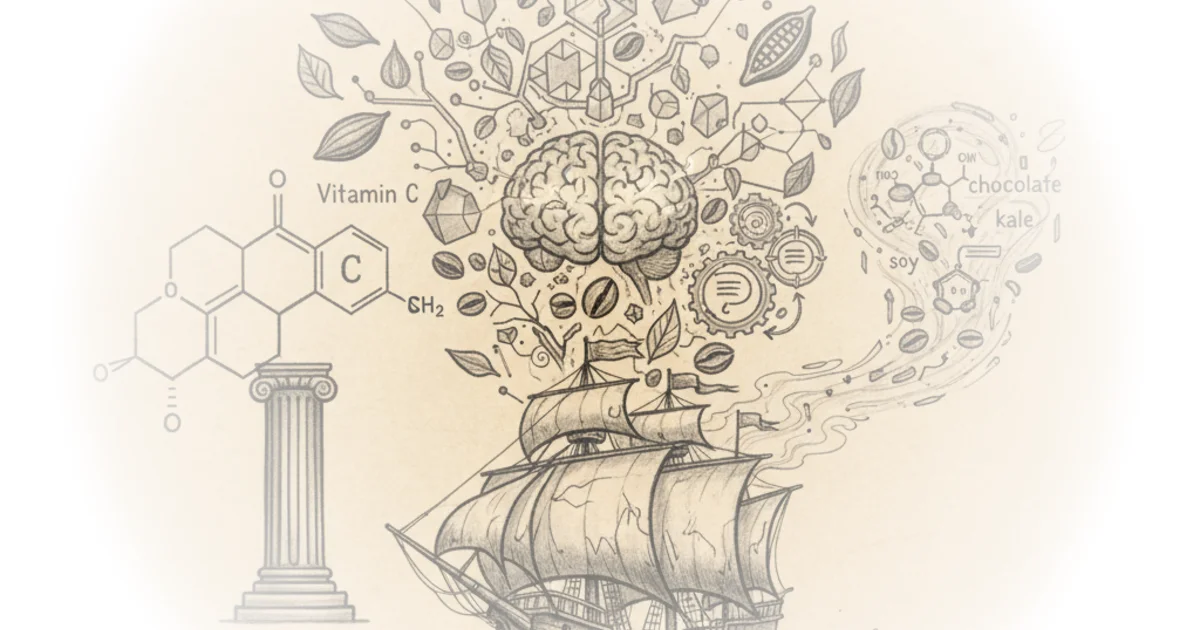
The commentary then pivots to the practical application of this framework: why do we have rock-solid consensus on some topics, like climate change, but seemingly endless debate on others, like nutrition? Green points out that while basic nutrition has clear consensus—"vitamin C prevents scurvy... fiber is good for us"—specific interactions remain murky. The text explains that studying food is uniquely difficult because "you can't really ethically design an experiment where a group of people are on a very specific diet for a very long time."
This distinction is the piece's most valuable contribution to the reader's mental toolkit. It explains that the lack of a definitive answer on chocolate and cancer is not a sign of scientific failure, but a reflection of the immense difficulty in controlling for variables like genetics, environment, and lifestyle. The author writes, "Forget comparing apples to oranges. Even comparing apples to apples isn't easy." This blunt assessment cuts through the noise of sensationalist headlines that often present preliminary studies as final verdicts.
The discussion then scales up to climate change, using the "99% of scientists" statistic to illustrate the strength of a consensus. Green clarifies that this number is not a rigid threshold but a signal that a claim has "cleared a very, very high bar." The analogy returns: "It would not just be weird, but wildly unlikely to uncover evidence that overturns this fact. It would be as strange as learning that atoms aren't real." This comparison effectively bridges the gap between the abstract concept of climate modeling and the tangible reality of atomic physics.
However, the piece also wisely notes that consensus does not mean the end of inquiry. "Scientists aren't debating if climate change will bring serious warming to the planet. They're debating things like the importance of peat bogs for carbon storage." This nuance is critical. It prevents the reader from interpreting ongoing debate as a sign that the science is unsettled. The debate is happening within the consensus, refining the details rather than challenging the foundation.
The Verdict on Being Less Wrong
Ultimately, the piece defines science not as a collection of absolute truths, but as a methodology for error reduction. Green writes, "Science is the process of becoming less wrong over time, of always being open to new evidence, but also recognizing when an idea is very good at explaining all of the weird phenomena of our world." This definition is a powerful antidote to the cynicism that often plagues public engagement with science.
The argument concludes by reinforcing that consensus is about the "big stuff"—the things that have consistently explained evidence and predicted outcomes. It is a call to trust the process, even when the specific answers to daily questions remain elusive. The text reminds us that "our knowledge continues to build and grow," and that the puzzles are "getting more complete and more detailed all the time."
Consensus is all the big stuff that scientists agree on. They understand atoms enough to know what their properties are. They understand nutrition enough to offer overarching health guidelines. and they understand climate change enough to know that we are causing it.
A counterargument worth considering is whether this level of trust in the scientific process is sufficient in a political landscape where consensus is often weaponized or ignored. The piece focuses on the epistemological strength of science but touches less on the sociological challenges of communicating that strength to a polarized public. Nevertheless, by grounding the argument in the rigorous, self-correcting nature of the scientific method, it provides a sturdy foundation for understanding how we know what we know.
Bottom Line
The strongest part of this argument is its ability to reframe uncertainty not as a weakness, but as a hallmark of rigorous science. By weaving together the history of atomic theory with modern debates on nutrition and climate, the piece demonstrates that consensus is a robust, evolving structure rather than a fragile opinion. The biggest vulnerability is the assumption that understanding the process of consensus will automatically resolve public skepticism, but the framework provided is the best tool we have for navigating an increasingly complex information landscape.