Most financial analysis treats the US dollar as a monolith—a single, unchanging pillar of global stability that will eventually be toppled by a successor. Adam Tooze dismantles this comforting myth, arguing instead that the "dollar system" is not a static object but a series of five distinct, volatile metamorphoses, each driven by different political economies and crises.
The Trap of Linear History
Tooze begins by challenging the very way we frame economic history. He writes, "The framing of the question obscures its own particular historical conditions. It reifies the idea of a reserve currency and obscures how dynamic the currency and financial system is." This is a crucial intervention for busy readers who rely on simplified narratives about "what comes next." Tooze argues that asking what will replace the dollar assumes the current system is a coherent, singular entity, when in reality, it has been reinvented repeatedly. He compares this to viewing transportation history: "A horse-drawn coach, a steam train, a petrol-powered motor vehicle... are all modes of ground transport. But each innovation does not smoothly replace its predecessors. There are qualitative breaks."
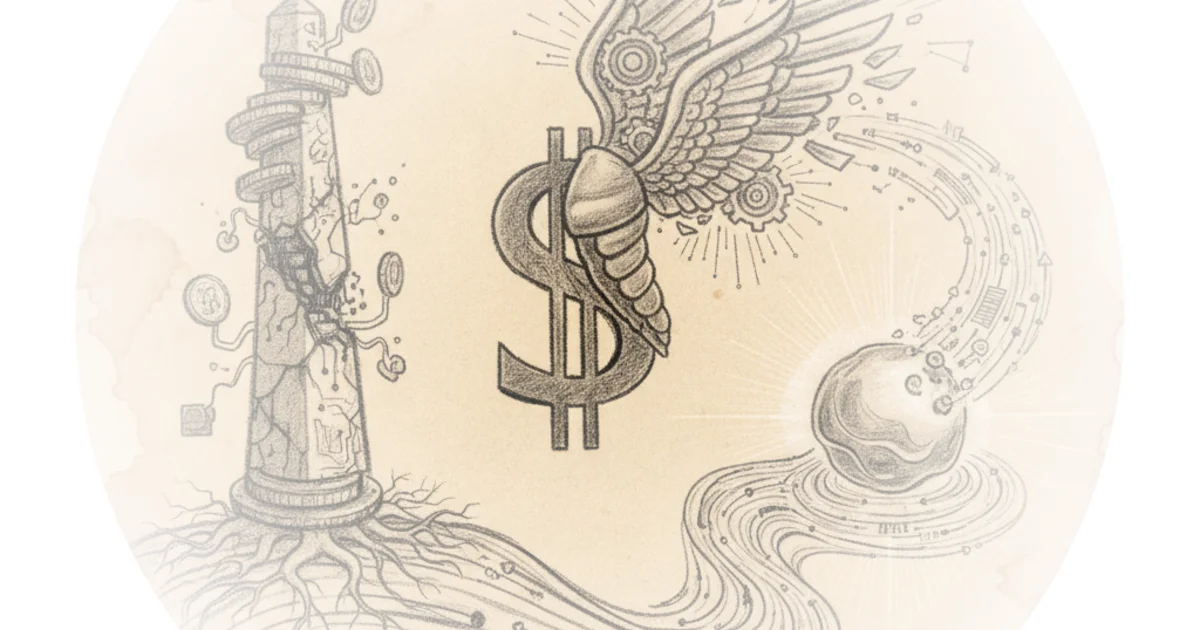
This analogy lands because it exposes the flaw in comparing the British Empire's financial dominance to modern American hegemony. The systems were fundamentally different technologies of power. Tooze notes that while we often speak of a linear succession from Genoa to the Netherlands to Britain to the US, "such analogies surely obscure as much as they reveal." Critics might argue that despite these differences, the function of a reserve currency remains constant enough for comparison. However, Tooze's insistence on the "restless dynamic of uneven and combined development" suggests that ignoring these breaks leads to dangerous policy blind spots.
The dollar before and after 1971 was quite different. The global dollar is not one thing, but something constantly shifting.
From Gold to Wall Street
The article meticulously dissects the first three regimes to show how little they resemble our current reality. Tooze points out that the era of sterling was not about fiat money but "the attachment of the British currency... to gold." When the Great Depression decoupled currencies from gold, the system didn't just evolve; it nearly collapsed until World War II created a new foundation. He describes the post-1945 order as "dollar system #1," a complex alliance where Europe and Britain maintained their own zones before the Bretton Woods model fully took hold in 1958.
The transition to "dollar #3" in the 1970s is perhaps the most significant shift. When Nixon ended the gold peg, it wasn't merely a technical adjustment; it was a political triumph for unfettered finance. Tooze writes, "In the financial sphere, the 1970s and the period that follow... are far better understood as a triumphant period of upsurge by an unfettered Wall Street." This era introduced floating exchange rates and capital mobility, creating a world where crises became endemic. He references Reinhart and Rogoff to illustrate how "actually existing neoliberalism devolved into a regime of recurring crisis," characterized by ad hoc bailouts rather than stable rules.
A counterargument worth considering is that this period of volatility was necessary to unleash the efficiency of global capital markets, even if it came with crises. Tooze acknowledges the instability but emphasizes that for American elites, "the decades of the third dollar regime... were an era of ad hoc crisis-fighting," suggesting a system built on reaction rather than design.
The Self-Insurance Era and Its End
The fourth regime, which Tooze terms "Bretton Woods 2.0," emerged from the ashes of the Asian financial crisis. Emerging markets, led by China, decided they would not rely on American benevolence again. Instead, they accumulated massive dollar reserves as a form of self-insurance. This was not a system designed in Washington; it was "defined by a government-directed accumulation of reserves... above all as a form of self-insurance against financial crisis."
This dynamic created a unique privilege for the US: the ability to borrow cheaply because foreign governments were desperate to buy its debt. However, Tooze warns that this specific configuration was fleeting, running roughly from 2000 to 2015. The critical turning point arrived when these reserve managers stopped accumulating new reserves. "Without fanfare, the dollar system was again shifting gear," he writes, marking the transition to a fifth regime.
Bottom Line
The strongest part of Tooze's argument is his refusal to treat the current financial order as inevitable or permanent; by identifying five distinct regimes, he forces us to recognize that we are currently living through another unstable transformation. His biggest vulnerability lies in predicting the trajectory of this new "dollar #5," which relies heavily on private capital flows rather than state reserves—a shift that may prove less resilient during a severe global shock. Readers should watch closely for how the US manages its unprecedented fiscal deficits without the traditional buffer of foreign official reserve accumulation.
The era in which the pound sterling and the City of London... were the dominant players... was not an era of fiat currency. It was first and foremost the era of the gold standard.