N.S. Lyons argues that the modern obsession with individual rights has paradoxically created a society of dependent automatons, vulnerable to a new, faceless form of totalitarianism. This is not a standard political critique; it is a philosophical warning that our very definition of freedom has been corrupted by the desire for safety, leaving us defenseless against a managerial state that operates like a machine. In an era where people feel increasingly trapped by bureaucratic norms, Lyons offers a startling diagnosis: the more we demand protection from the state, the less human we become.
The Paradox of Safety
Lyons begins by dismantling the contemporary understanding of liberty, suggesting it has been reduced to a "washed-out" concept that prioritizes self-preservation over genuine autonomy. He draws heavily on the 1951 work of German philosopher Ernst Jünger, The Forest Passage, to illustrate that true freedom requires the willingness to risk one's safety, not just preserve it. "The paradox is that the more individuals are liberated from the restraints imposed on them by others... the more directionless and atomized they become," Lyons writes. This observation cuts to the heart of modern anxiety: we have traded communal bonds and moral duties for a hollow independence that leaves us isolated.
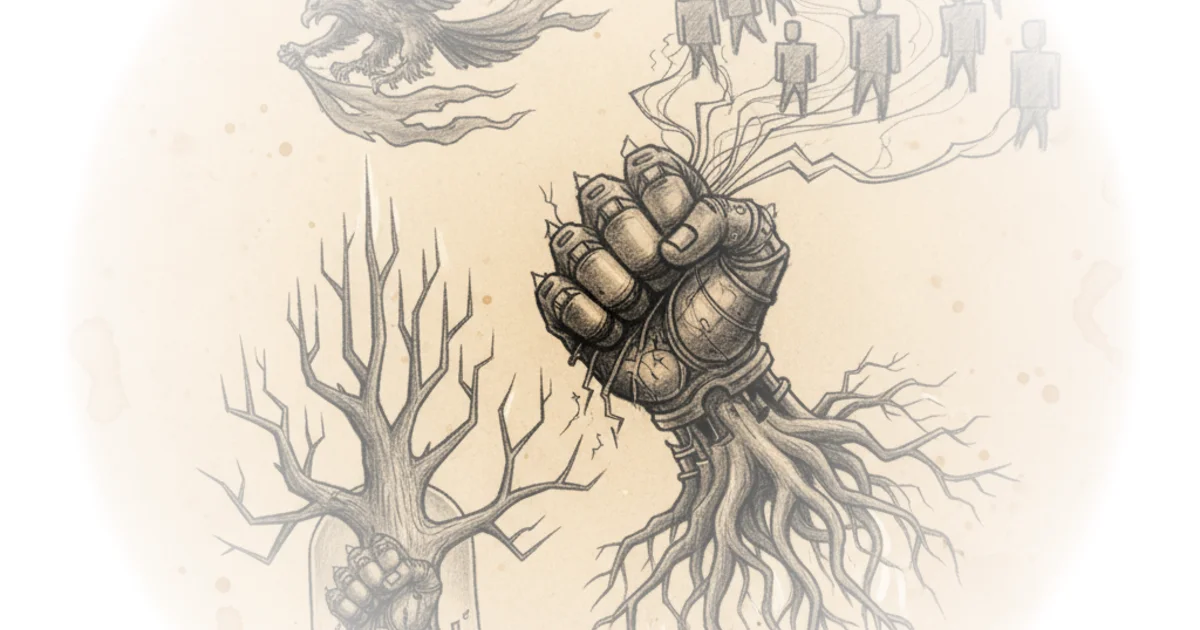
The author contends that this isolation makes us desperate for the state to step in and provide the structure we lack. "Alone in his 'independence,' the individual finds himself dependent on a larger power to protect his safety and the equality of his proliferating 'rights' (desires) from the impositions of others," Lyons explains. This dynamic creates a feedback loop where the state expands its reach to manage our lives, and in doing so, molds us into uniform cogs. The result is not a society of free actors, but one of "passive 'consumer' and easily manipulated and programmed puppet – an automaton." This framing is powerful because it shifts the blame from a specific political leader to a structural cultural shift, suggesting that the machinery of control is self-sustaining regardless of who sits in the executive office.
Critics might argue that Lyons romanticizes the "restraints" of the past, ignoring the very real oppression that communal norms and traditional duties have historically enforced on marginalized groups. However, the author's focus is not on restoring old hierarchies, but on recovering a sense of agency that the modern safety net has eroded.
In the effort to maximize his autonomy, his real autonomy has been lost.
The Machine and the Abyss
Lyons deepens the analysis by exploring how technology and bureaucracy have merged to create a system where cruelty is not the result of evil intent, but of "rational thought." He notes that Jünger saw the two World Wars as a turning point where "escalated mechanical development" conquered society, turning human beings into mere functions. "Every comfort must be paid for. The condition of the domesticated animal drags behind it that of the slaughterhouse animal," Lyons quotes, highlighting the hidden cost of our technological ease.
The piece argues that we are living on a vessel speeding toward an abyss, unaware of the danger until it is too late. "While the weather holds and the outlook remains pleasant, he will hardly perceive the state of reduced freedom that he has fallen into," Lyons writes. This metaphor of the Titanic or Leviathan effectively captures the collective denial of modern society. We feel the wind of progress but ignore the icebergs of totalitarianism looming on the horizon. The author suggests that this "automatism" strips away our humanity, reducing life to "mere functionality" and subjecting our minds to "ideological machine code."
A particularly chilling section of the commentary focuses on the medical and bureaucratic sectors. Lyons notes Jünger's prescient warning that "the constantly increasing influence that the state is beginning to have on health services, usually under philanthropic pretexts" could lead to a situation where medical files are used to "intern, castrate, or liquidate." This is not a call for conspiracy theories, but a warning about how systems designed for care can be repurposed for control when separated from individual dignity. "Even human care can, if subject to automatization and separation from the dignity of individual relationship, become a mechanism for inhumanity," Lyons asserts. This is the piece's most urgent point: the machinery of the state does not need a tyrant to be cruel; it only needs to function efficiently.
Resistance and the Human Spirit
The final section of the commentary turns to the question of how one resists such a system. Lyons recounts Jünger's own life, noting that he "helped back the plot to assassinate Hitler" while maintaining a critical distance from the regime. The author emphasizes that Jünger's resistance was not about grand, public revolutions, but about maintaining an inner fortress of individuality. "The individual was, Jünger felt, necessarily the locus of resistance against totalitarian control," Lyons writes. When institutions fail, the only hope lies in the individual's refusal to be fully absorbed by the machine.
Lyons suggests that the path forward requires a "new freedom" that reconciles liberty with duty and independence with love. It is a call to reject the "safety-obsessed nannies" of the modern world and embrace the risk of true individuality. "To escape this automatism, achieve real individuality, and recover our humanity will require us to find a 'new freedom' – or rather, an older and nobler freedom," the author concludes. This is a demanding proposition for a society accustomed to convenience, but it offers a way out of the paralysis of fear.
Critics might find the reliance on a 1951 German philosopher's worldview to be too abstract for solving contemporary policy issues, or too dismissive of the genuine protections that modern institutions provide. Yet, the argument's strength lies in its ability to articulate the vague sense of unease many feel today—a feeling that something is fundamentally wrong with the way we live, even if we cannot name it.
Bottom Line
N.S. Lyons delivers a profound and unsettling meditation on the cost of modern safety, successfully arguing that our pursuit of comfort has inadvertently built the very cage we now fear. The piece's greatest strength is its refusal to scapegoat a single politician, instead identifying a systemic cultural failure where the desire for security has eroded the capacity for genuine freedom. The biggest vulnerability is its reliance on a philosophical framework that may feel inaccessible to those seeking immediate, practical policy solutions, but the warning remains essential: without a renewed sense of individual responsibility and risk, we risk becoming mere cogs in a machine that no one controls and everyone fears.