Matt O'Dowd of PBS Space Time presents a geological detective story that upends our view of Earth's deep past, suggesting our planet once wore a crown of rock and ice that rivalled Saturn's. The piece is notable not just for its spectacular visual premise, but for the specific statistical anomaly it leverages to turn a wild hypothesis into a testable scientific theory. This is a rare instance where the history of our own planet feels as alien as the outer solar system.
The Mechanics of a Lost Ring
O'Dowd begins by dismantling the assumption that planetary rings are permanent fixtures. He notes that while Saturn's rings seem "Timeless and eternal," they are actually transient, destined to vanish in a few hundred million years. The core of his argument rests on the physics of the Roche limit, the critical distance where a planet's tidal forces prevent debris from coalescing into a moon. O'Dowd explains that "within a certain range the difference in the force of gravity across the body's width is stronger than the force of gravity holding the body together." This tidal force acts as a cosmic shredder, ensuring that any large object venturing too close is broken into a flat, stable ring.
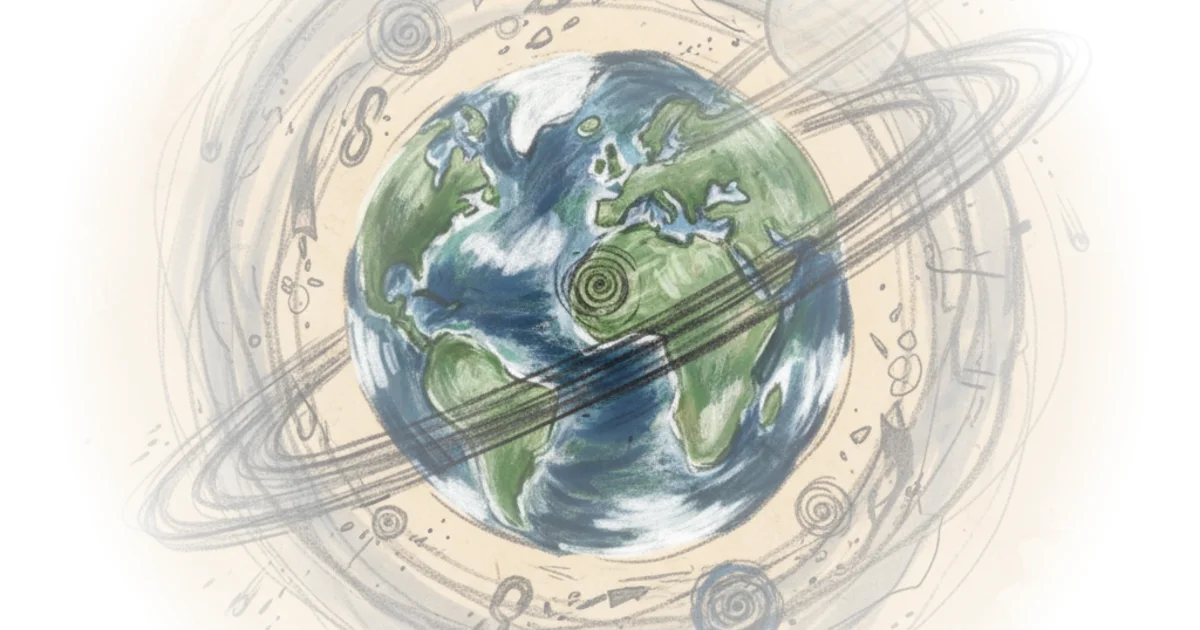
The commentary here is effective because it grounds the fantastical in rigorous orbital mechanics. O'Dowd clarifies that rings form either when material is "dynamically hot"—moving too fast to clump—or when it is trapped inside this tidal disruption zone. By establishing that Earth's Roche limit for solid rock is merely a few thousand kilometers, he sets the stage for a scenario where a massive asteroid could be torn apart without ever becoming a moon.
"If planetary rings come and go it stands to reason that Earth May once have had one and now we have evidence that it really did."
Critics might note that the window for such a ring to exist is narrow; atmospheric drag from the exosphere would cause the ring particles to spiral inward and burn up relatively quickly. O'Dowd acknowledges this, framing the ring not as a permanent feature, but as a temporary, albeit spectacular, phase in Earth's history.
The Ordovician Impact Spike
The narrative pivots from theory to evidence by examining a specific geological anomaly: the Ordovician impact spike. Roughly 466 million years ago, Earth was pummeled by a massive influx of meteorites, specifically L-chondrites. The standard explanation posits a collision in the asteroid belt, but O'Dowd points out a glaring inconsistency in that theory. "If this event really did occur in the asteroid belt we'd expect all inner solar system bodies to be affected but it seems there's no evidence for an increase impact rate on mars or the Moon from this period."
This discrepancy is the piece's strongest analytical hook. If the source were a distant asteroid belt collision, the debris field should have rained down on Mars and the Moon with similar intensity. The fact that the bombardment was uniquely concentrated on Earth suggests a local source. O'Dowd proposes that a 10-kilometer-wide asteroid made a near-miss with Earth, passing "just thousands of kilometers above the planet's surface below the RO limit where extreme tidal forces disrupted the body." The resulting debris formed a ring that slowly rained down over 40 million years.
The Equatorial Fingerprint
To validate this ring hypothesis, O'Dowd and the Monash University researchers turned to the geography of ancient impact craters. The logic is elegant: debris falling from a ring would be funneled toward the equator, whereas asteroid belt debris would strike randomly. The challenge, O'Dowd admits, is that the continents have shifted dramatically since the Ordovician. "It is crazy that we can even do that back then most of Earth's solid surface was clustered in the southern hemisphere supercontinent gondwana and the impact locations all of them within roughly 30° latitude of the Equator."
By reconstructing the positions of 21 known craters from that era, the team found a striking pattern. The impacts were not scattered; they were clustered tightly around the ancient equator. O'Dowd highlights the statistical weight of this finding: "the likelihood of getting all of these impacts within this band around the equator is reported to be one in 25 million if they really were from a global random distribution." This statistical improbability is the smoking gun that shifts the theory from speculation to a leading hypothesis.
"The likelihood of getting all of these impacts within this band around the equator is reported to be one in 25 million if they really were from a global random distribution."
A counterargument worth considering is the sample size. With only 21 craters identified, there is room for statistical noise or preservation bias, as some craters may have been erased by erosion or tectonic activity. However, O'Dowd frames this as a call for more data rather than a fatal flaw, suggesting that finding more craters from this era would either solidify the pattern or reveal a different story.
Climate Consequences and the Ice Age
The piece concludes by connecting the ring to a major climatic event: the Hirnantian glaciation, which triggered the second-largest mass extinction in Earth's history. O'Dowd suggests the ring may have been the catalyst. An equatorial ring would act as a sunshade, particularly for the hemisphere experiencing winter. "That would result in harsher winters and potentially initiate the runaway growth of Ganda glaciers that precipitated the Ice Age."
This reframing is compelling because it links a celestial event to a biological crisis in a way that previous asteroid-belt theories could not. The ring provides a mechanism for sustained cooling rather than a single, transient dust cloud. It transforms the narrative from a simple bombardment to a complex, multi-decade climatic shift driven by orbital mechanics.
Bottom Line
O'Dowd's coverage succeeds by weaving together orbital physics, geological statistics, and climate science to construct a coherent picture of a ringed Earth. The strongest element is the use of crater distribution to rule out the asteroid belt hypothesis, a move that turns a statistical anomaly into a powerful argument for a local debris source. The biggest vulnerability remains the limited number of identified craters; until more data is gathered, the theory remains a highly probable, yet unproven, chapter in Earth's history. Readers should watch for new paleontological surveys that could either confirm the equatorial clustering or force a return to the asteroid belt explanation.